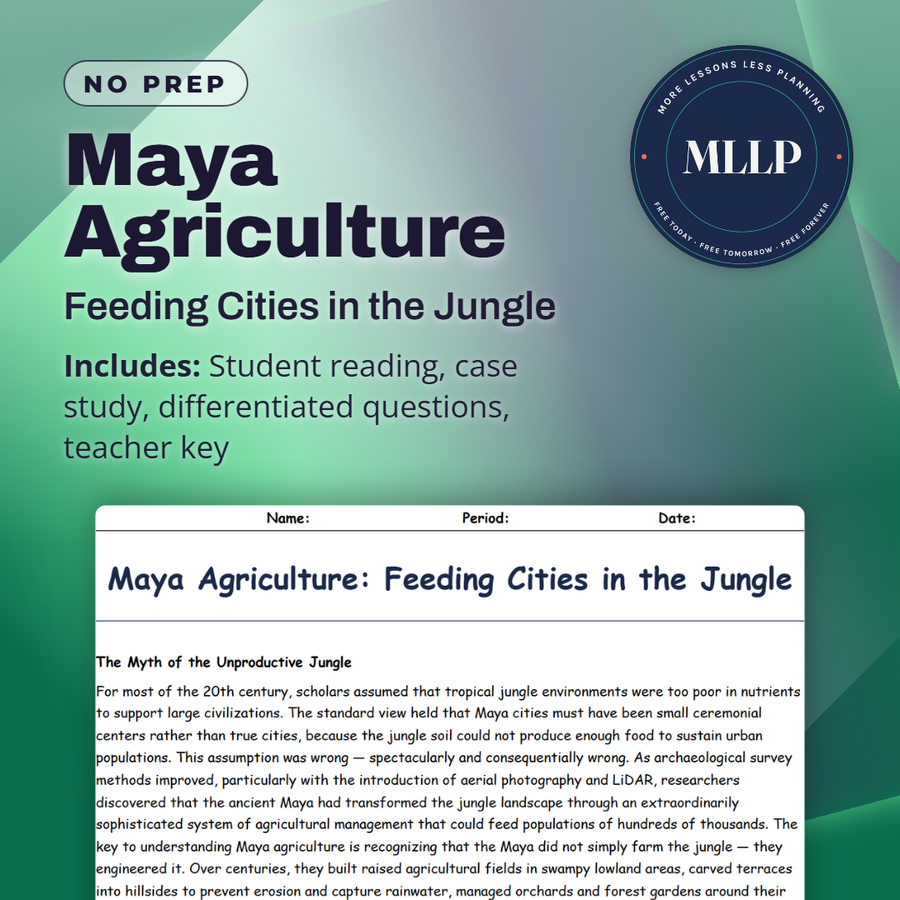
Maya Agriculture: Feeding Cities in the Jungle
Quality reviewed September 2026
Facts verified September 21, 2026
- Subject
- Social Studies
- Grades
- Grades 9-12
- Length
- 8-page student worksheet
- Time
- About one 50-minute class period
- Great for
- Sub plans and independent work
- Includes
- Reading passage, comprehension questions + full answer key
- Format
- Print-and-go PDF
What students do
- The Three Sisters planting system of corn, beans, and squash gets explained in terms of what each crop contributes
- The milpa's slash-and-burn cycle gets sorted against the raised field and terrace systems that supplemented it
- Trace how deforestation from farming success fed back into the droughts of the 9th century
- Fill in details from Chan Bahlum's case study to connect drought, tribute, and the decision to migrate
What it covers
- The milpa system of corn, beans, and squash and how each crop supported the others' growth
- Raised field and terrace engineering that let Maya farmers feed populations far larger than once assumed
- A case study connecting a lowland farmer's drought-shrunk harvest to fixed tribute demands and the decision to migrate north
Start reading this worksheet
The Myth of the Unproductive Jungle
For most of the 20th century, scholars assumed that tropical jungle environments were too poor in nutrients to support large civilizations. The standard view held that Maya cities must have been small ceremonial centers rather than true cities, because the jungle soil could not produce enough food to sustain urban populations. This assumption was wrong, spectacularly and consequentially wrong. As archaeological survey methods improved, particularly with the introduction of aerial photography and LiDAR, researchers discovered that the ancient Maya had transformed the jungle landscape through an extraordinarily sophisticated system of agricultural management that could feed populations of hundreds of thousands. The key to understanding Maya agriculture is recognizing that the Maya did not simply farm the jungle. They engineered it. Over centuries, they built raised agricultural fields in swampy lowland areas, carved terraces into hillsides to prevent erosion and capture rainwater, managed orchards and forest gardens around their cities, and maintained the milpa, the traditional corn, bean, and squash polyculture that remains in use by Maya farmers today. This was not primitive subsistence farming. It was intensive, sophisticated, and productive enough to feed cities.
The Three Sisters and the Milpa
The foundation of Maya diet was maize (corn), which held a place in Maya culture far beyond its nutritional role. In Maya creation mythology, humans were literally made from corn dough. The maize god was one of the most important deities in the Maya pantheon. Agricultural cycles were synchronized with the religious calendar. Corn was not just food; it was the substance of human identity. The milpa system that sustained Maya populations combined maize with two other crops: beans (which fix nitrogen in the soil, replenishing what corn depletes) and squash (whose large leaves shade the ground, retaining moisture and preventing weed growth). This combination, sometimes called the Three Sisters across Mesoamerica, was nutritionally complementary: corn provides calories and carbohydrates, beans provide protein, and squash provides vitamins and minerals. The three crops grown together produced a more complete diet than any one alone, and their agricultural interaction sustained soil fertility far longer than monoculture crops. The milpa system used slash-and-burn rotation: a plot of jungle would be cleared by cutting and burning, farmed intensively for two or three years, then left fallow for ten or more years while the forest regenerated. Critics argued this system could not possibly support large populations: you need too much land left fallow at any given time. But evidence from LiDAR surveys shows that the Maya supplemented milpa farming with intensive permanent cultivation in raised fields, orchards, and managed gardens, creating a mixed agricultural system far more productive than slash-and-burn alone.
Raised Field Systems: Engineering the Wetlands
One of the most dramatic discoveries in Maya agricultural archaeology was the widespread existence of raised field systems in the lowland swamps of the Peten and Belize. Aerial photography in the 1970s revealed vast networks of rectangular platforms separated by drainage canals in areas that are now seasonally flooded wetlands. These raised fields, built up from dredged muck and organic material, created elevated growing surfaces above the water table while the canals provided irrigation, transportation, and aquaculture: fish and turtles living in the canals supplemented the Maya diet with protein. The raised field systems are ancient and labor-intensive. Building and maintaining them required organized community effort coordinated across generations. Their scale in some areas is enormous: thousands of fields covering hundreds of square kilometers in the river lowlands. This kind of agricultural infrastructure is the equivalent of building a canal irrigation system, and it fundamentally changes estimates of Maya population density and political organization. Cities that could organize this level of agricultural engineering had substantial administrative capacity.
Like what you read? The full reading, the case study, and every question set are in the free download below, along with the answer key.
Why this matters
Students tend to assume that a thriving city needs open fields and modern equipment, and the Maya case flips that assumption by showing how much engineering, not luck, went into feeding a population that once reached into the millions inside a rainforest. Chan Bahlum's situation, where drought shrinks the harvest but the tribute demand stays the same, also gives students a concrete way to understand how environmental stress and political obligation can compound each other, which is a pattern that shows up again in more recent famines and rural economic crises.
From one teacher to another
Twentieth century archaeologists assumed jungle soil was too poor to feed real cities, so Maya sites got written off as ceremonial centers with a small scattered population. That assumption fell apart once aerial photography and LiDAR revealed what was actually built into the landscape: raised fields dredged up out of lowland swamps, stone terraces cut into hillsides, and the milpa system of corn, beans, and squash grown together so the crops fed the soil as much as the people. The reading covers why each of the three crops mattered, then gets into the scale of the raised field networks, which stretch across hundreds of square kilometers of wetland. The case study follows a farmer named Chan Bahlum through a third bad drought year, watching his tribute stay fixed while his corn shrinks, which sets up the reading's point that Maya farming's own success helped create the deforestation and drought that emptied southern cities.
What you get
Download
Where should I send the next one?
Everything here is free and it stays that way. Leave your email and I'll send you the new lessons as they go up. You can unsubscribe from any one of them.
Related resources

Chichen Itza: Where Tourists Meet the Ancient World

LiDAR and the Maya: Finding Hidden Cities from the Sky

Maya Mathematics and the Calendar: Zero and the End of the World

Maya Writing: Cracking the Hieroglyphic Code

Palenque and King Pakal: A Royal Tomb Inside a Pyramid

The Maya Collapse: What Really Happened in the 9th Century?
Every lesson on this site is free to download and use. If one of them saved you a prep period, you can chip in a few bucks toward my three kids' daycare fund. That's genuinely where tips go.