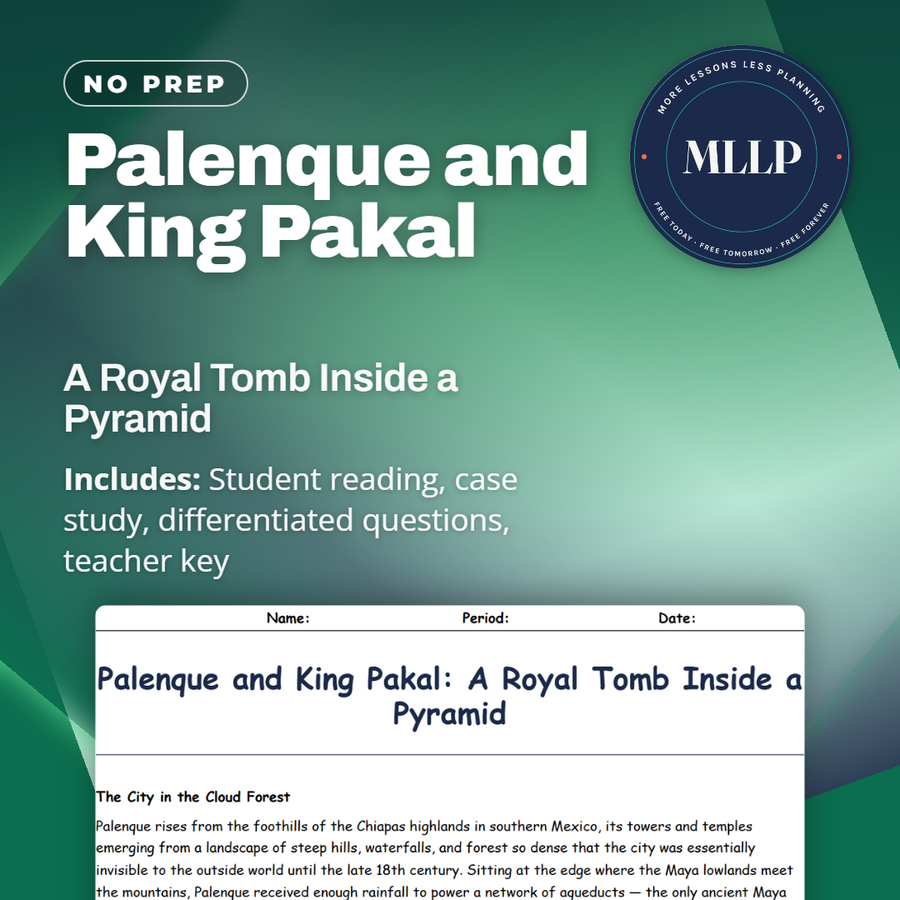
Palenque and King Pakal: A Royal Tomb Inside a Pyramid
Quality reviewed September 2026
Facts verified September 21, 2026
- Subject
- Social Studies
- Grades
- Grades 9-12
- Length
- 8-page student worksheet
- Time
- About one 50-minute class period
- Great for
- Sub plans and independent work
- Includes
- Reading passage, comprehension questions + full answer key
- Format
- Print-and-go PDF
What students do
- Sort the actual, translated meaning of Pakal's sarcophagus lid against the 1968 "ancient astronaut" claim
- The four-year process of clearing rubble from the Temple of Inscriptions gets connected to how real fieldwork actually proceeds
- Explain why Pakal used a 620-glyph inscription to defend his dynasty's unusual line of succession
- The jade death mask and psychoduct get worked into short answers about Maya burial belief and royal power
What it covers
- Alberto Ruz's 1952 discovery of King Pakal's tomb hidden beneath the Temple of Inscriptions
- Why Maya epigraphers reject the "ancient astronaut" reading of Pakal's carved sarcophagus lid
- The jade death mask, psychoduct, and dynastic inscriptions found inside Pakal's burial chamber
Start reading this worksheet
The City in the Cloud Forest
Palenque rises from the foothills of the Chiapas highlands in southern Mexico, its towers and temples emerging from a landscape of steep hills, waterfalls, and forest so dense that the city was essentially invisible to the outside world until the late 18th century. Sitting at the edge where the Maya lowlands meet the mountains, Palenque received enough rainfall to power a network of aqueducts, the only ancient Maya city known to have built a pressurized water supply system. Streams were channeled underground through stone conduits, and at one point the city's main stream ran beneath the Palace complex, creating a kind of early plumbing. The city flourished primarily during the Classic period, reaching its height under a dynasty that produced some of the most brilliant rulers in Maya history. At its peak in the 7th century CE, Palenque controlled a significant territory in the western Maya region and was an intellectual and artistic center whose sculptors and scribes produced work of extraordinary refinement. The stucco relief carvings at Palenque are considered the finest in the ancient Americas: fluid, naturalistic, and full of subtle emotional expression that feels remarkably modern.
King Pakal: The Man in the Tomb
Pakal the Great ruled Palenque from 615 CE to 683 CE, an astonishing 68 years on the throne. He came to power at age 12 and died at 80, leaving behind a transformed city. Under his reign, the Palace complex was substantially expanded, a royal residential tower was built, and the city's distinctive architectural style was developed. But Pakal's most enduring legacy is the Temple of Inscriptions (the stepped pyramid that served as his mortuary monument and, it would turn out, as his tomb). Pakal's inscriptions are among the most extensive in the Maya world. The Temple of Inscriptions itself contains three panels of hieroglyphic text with approximately 620 glyphs that record the history of the Palenque dynasty stretching back centuries. Pakal used these texts to legitimize his dynasty (which had come to power through an unusual line of succession that included his mother, Lady Zak-Kuk, as regent) by connecting his lineage to mythological ancestors and cosmic forces.
Alberto Ruz's Discovery
In 1949, Mexican archaeologist Alberto Ruz Lhuillier was working inside the Temple of Inscriptions when he noticed something unusual about the floor of the top chamber: one of the stone slabs had a double row of finger holes along its edge, as if designed to be lifted. Ruz had the slab raised and found a rubble-filled staircase descending into the pyramid's core. It would take four field seasons to clear the rubble by hand, working down and then back up in a U-shaped tunnel that descended to the pyramid's base. In June 1952, Ruz entered the burial chamber. He later described it as a space 'out of a fairy tale,' filled with stalactites and stalagmites that had grown over the centuries on the stone surfaces, with painted reliefs of figures emerging from the walls and a massive carved sarcophagus filling most of the room. The sarcophagus lid, a limestone slab nearly four meters long and weighing some five tons, bore one of the most elaborate carvings in Maya art.
Like what you read? The full reading, the case study, and every question set are in the free download below, along with the answer key.
Why this matters
The 'ancient astronaut' theory built off Pakal's sarcophagus lid is a useful case for students in how pseudoscience actually spreads: it takes a real, well-documented piece of Maya religious symbolism and reframes it as proof that ancient people needed alien help to create something sophisticated, which quietly assumes those people weren't capable on their own. Comparing that theory against what Maya epigraphers have actually translated on the lid gives students practice telling a sourced, evidence-based reading apart from a claim that just sounds exciting.
From one teacher to another
Alberto Ruz spent four field seasons hand-clearing rubble from a staircase hidden under a floor slab in Palenque's Temple of Inscriptions before he stood in front of a sealed doorway in 1952. What he found behind it was the tomb of Pakal the Great, who ruled Palenque for 68 years, buried under a jade mosaic death mask made from more than 200 pieces. The reading covers the sarcophagus lid's carving in detail, including the famous claim from a 1968 bestseller that the image showed an astronaut in a rocket ship, and walks through why Maya epigraphers instead read it as Pakal descending the World Tree into the underworld at the moment of his death. Students also get into the psychoduct, a stone tube running from the burial chamber to the temple above, and the 620-glyph inscription Pakal used to defend his family's unusual claim to the throne. The case study follows Ruz in the final moment before he steps into a chamber nobody had entered in over a thousand years.
What you get
Download
Where should I send the next one?
Everything here is free and it stays that way. Leave your email and I'll send you the new lessons as they go up. You can unsubscribe from any one of them.
Related resources
Chichen Itza: Where Tourists Meet the Ancient World
LiDAR and the Maya: Finding Hidden Cities from the Sky
Maya Agriculture: Feeding Cities in the Jungle
Maya Mathematics and the Calendar: Zero and the End of the World
Maya Writing: Cracking the Hieroglyphic Code
The Maya Collapse: What Really Happened in the 9th Century?
Every lesson on this site is free to download and use. If one of them saved you a prep period, you can chip in a few bucks toward my three kids' daycare fund. That's genuinely where tips go.