The Vietnam War
- Grades
- Grades 9-12
- Time
- About two 50-minute class periods
- Includes
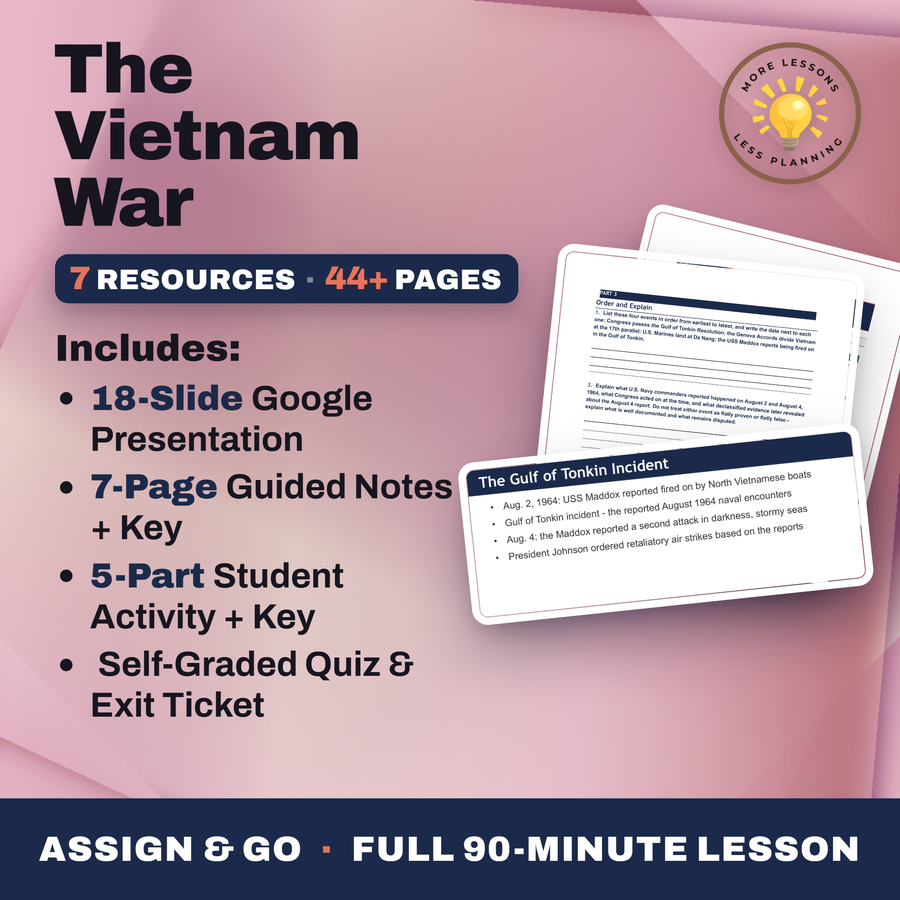
- 11 ready-to-teach files
- Format
- Word (.docx) · PowerPoint (.pptx)
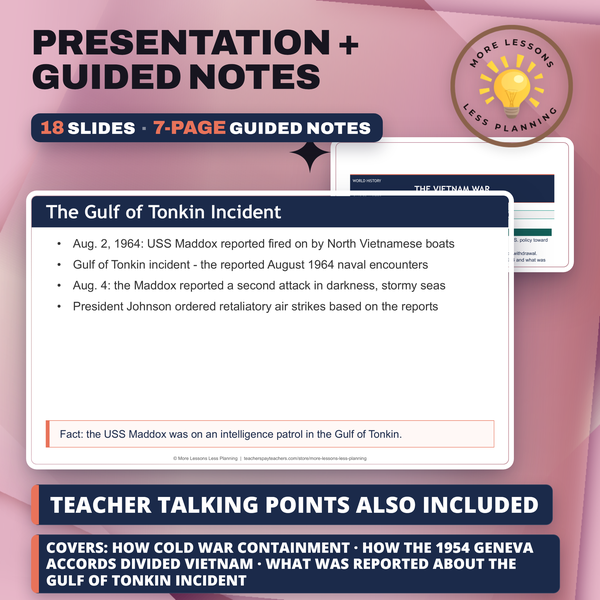
- Slide deck
- Guided notes
- Guided notes teacher key
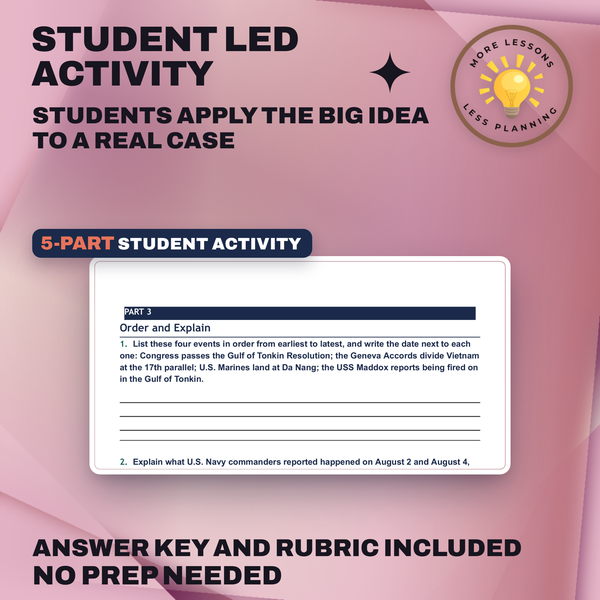
- Activity + answer key
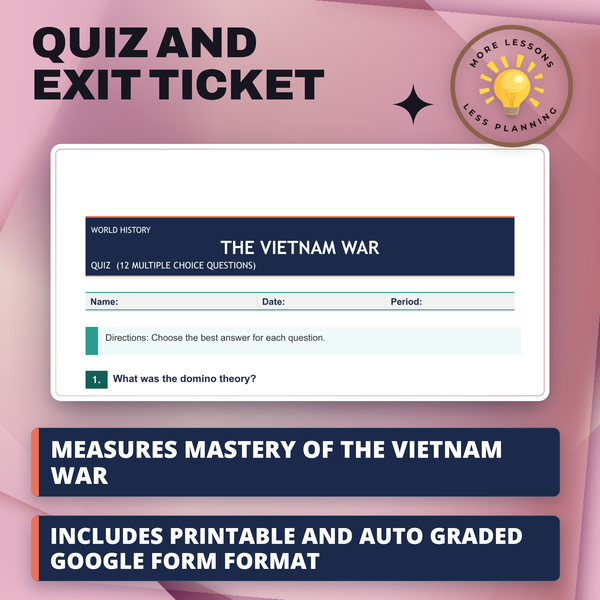
- Quiz + answer key
- Exit ticket + answer key
- Teacher guide
- Teacher presentation notes
What students do
- Trace how Cold War containment and the domino theory pulled the United States into a divided Vietnam
- Read the Gulf of Tonkin Resolution's actual legal text to determine what power it gave the President
- Weigh what was reported about the August 1964 Gulf of Tonkin incident against what declassified evidence later concluded
- Argue how much power Congress should hand a President based on one reported incident
What it covers
- The 1954 Geneva Accords and the divide at the 17th parallel that set up the war
- How the resolution's broad wording opened the door to escalation, from military advisors to Rolling Thunder
- The war's cost, its end in 1975, and the credibility gap it left behind
Learning targets
- Explain how Cold War containment and the domino theory shaped early U.S. policy toward Vietnam.
- Describe how the 1954 Geneva Accords divided Vietnam after the French withdrawal.
- Explain what was reported about the Gulf of Tonkin incident in August 1964 and what was later concluded from declassified evidence.
- Analyze the Gulf of Tonkin Resolution as a primary source and explain what power it gave the President.
- Explain how the resolution led to escalation and describe the war's cost and its end in 1975.
Peek inside
After 1945, U.S. policy aimed to contain communism, not defeat the USSR
Containment - the strategy of stopping communism without full-scale war
Domino theory - if one country fell to communism, neighbors would too
U.S. leaders applied both ideas to Vietnam, a French colony
Key Concept: containment shaped nearly every Cold War decision, Vietnam included.
Two Ideas Behind Every Vietnam Decision
is the Cold War strategy of stopping the spread of communism without full-scale war.
The is the idea that if one country fell to communism, neighboring countries would fall too.
Vietnam was a colony fighting for independence before the U.S. became involved.
After World War II ended in , U.S. Cold War policy aimed to contain the spread of communism.
1. U.S. leaders wanted to stop the spread of communism without starting a full-scale war against the Soviet Union. That Cold War strategy was called .
Why this matters
The 1954 Geneva Accords drew a line at the 17th parallel, and that single line is what set up everything the rest of this war became. A country split in two on paper in 1954 was still split by weapons and politics for the next two decades, until the war finally ended in 1975.
Students read the resolution's actual legal text for themselves rather than a summary of what it did, and the wording turns out broad enough to justify nearly any escalation. That distinction is the argument I want them to carry into the writing task, deciding how much authority one incident should hand over.
From one teacher to another
Congress passed the resolution just days after the August 1964 clash in the Gulf of Tonkin, and its wording turned out broad enough that one vote could authorize years of war without asking Congress again. Students read that wording for themselves, weigh what was reported about the clash against what declassified records later concluded, and trace how the war grew step by step, a handful of advisors first, then the sustained bombing known as Rolling Thunder, before it ended in 1975. I close on the credibility gap that outlasted the war, since it's still the reason lawmakers argue over how much power a vote like that should hand a President.
Every file in this toolkit
Download
Where should I send the next one?
Everything here is free and it stays that way. Leave your email and I'll send you the new lessons as they go up. You can unsubscribe from any one of them.
Related resources
Decolonization in Africa
Decolonization in Asia
Globalization and the Modern World
Origins of the Cold War
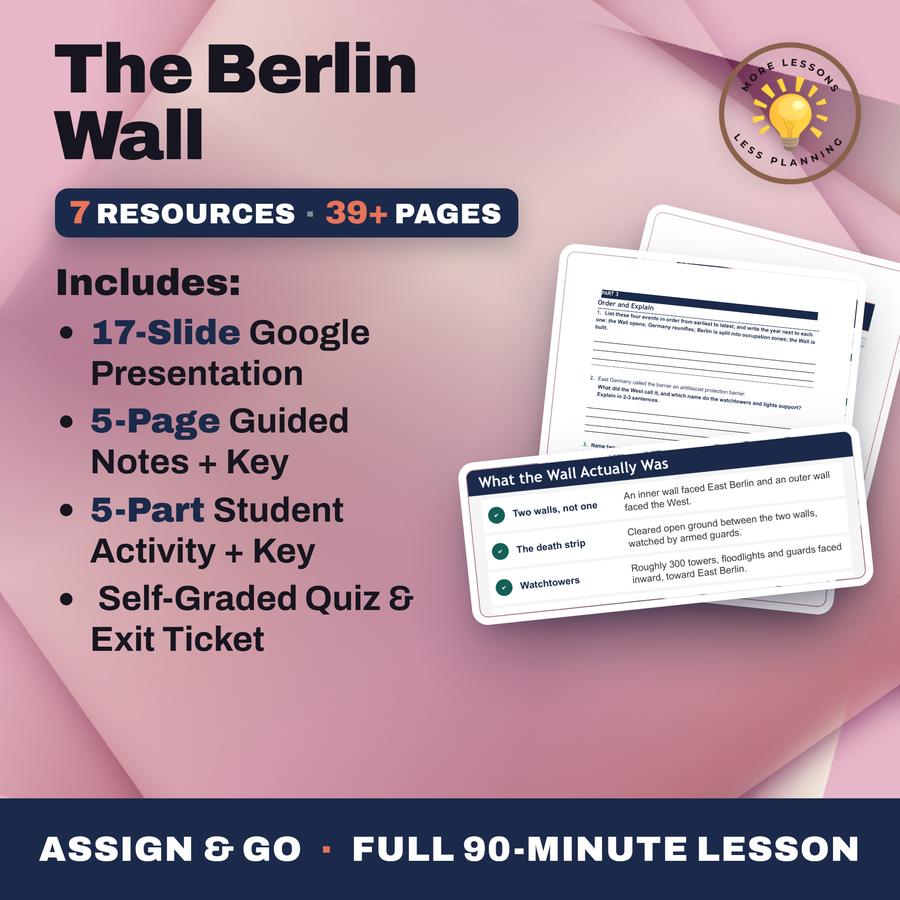
The Berlin Wall
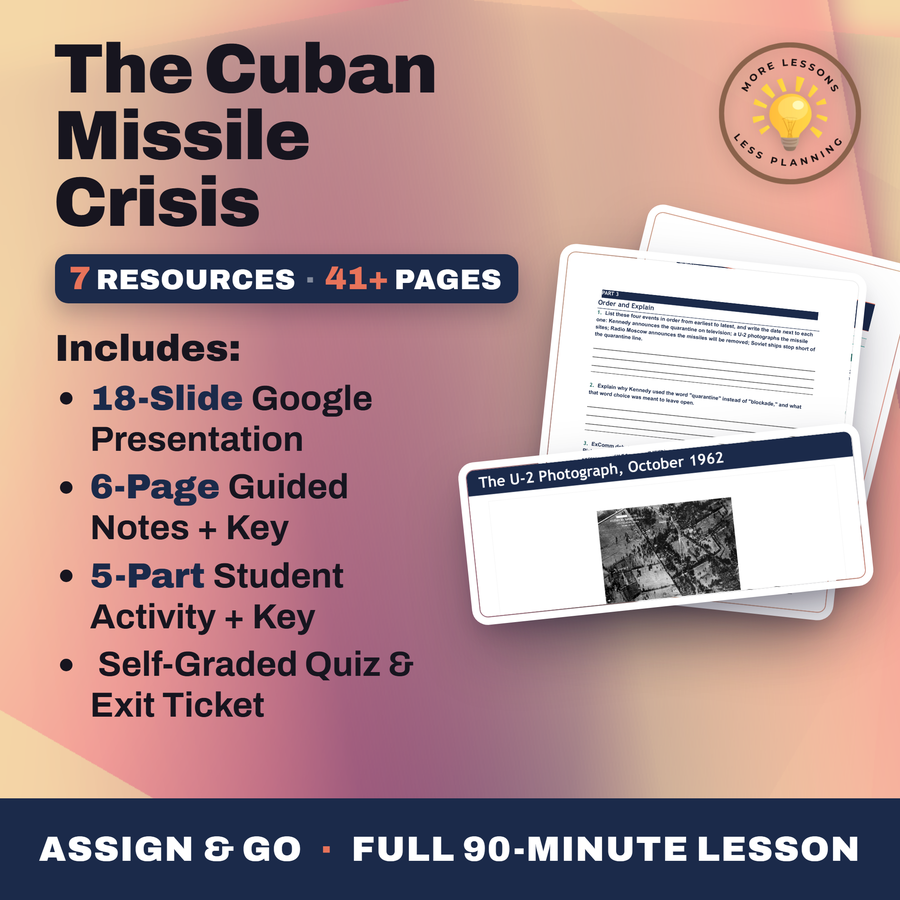
The Cuban Missile Crisis
Every lesson on this site is free to download and use. If one of them saved you a prep period, you can chip in a few bucks toward my three kids' daycare fund. That's genuinely where tips go.