Decolonization in Africa
- Grades
- Grades 9-12
- Time
- About two 50-minute class periods
- Includes
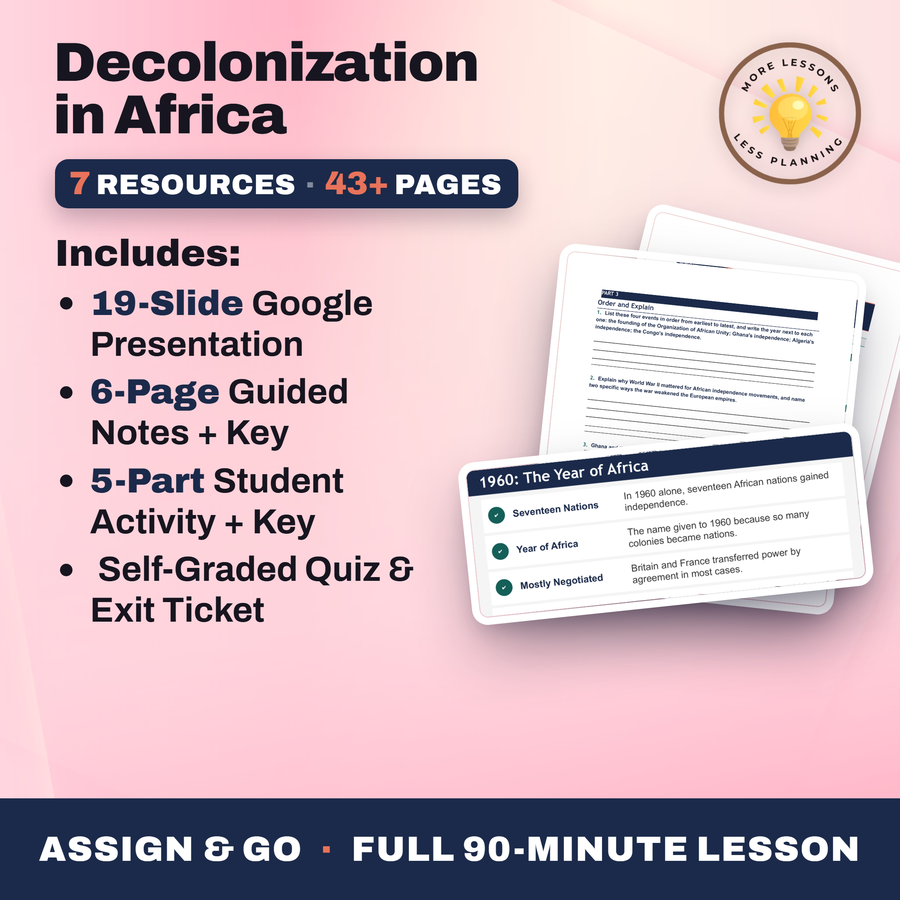
- 11 ready-to-teach files
- Format
- Word (.docx) · PowerPoint (.pptx)
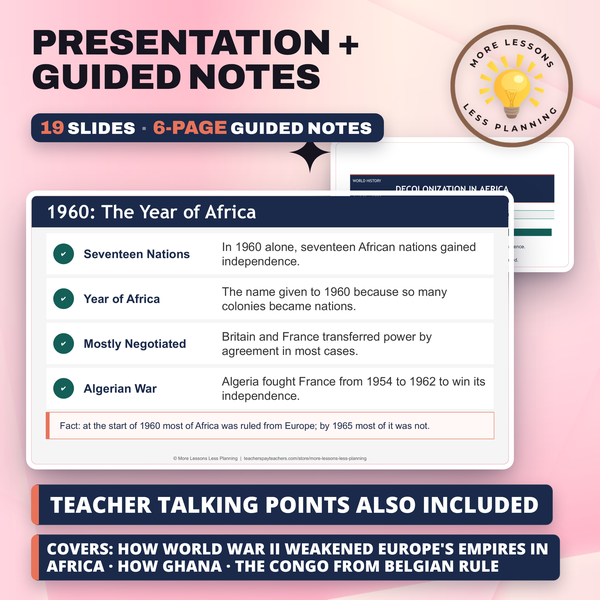
- Slide deck
- Guided notes
- Guided notes teacher key
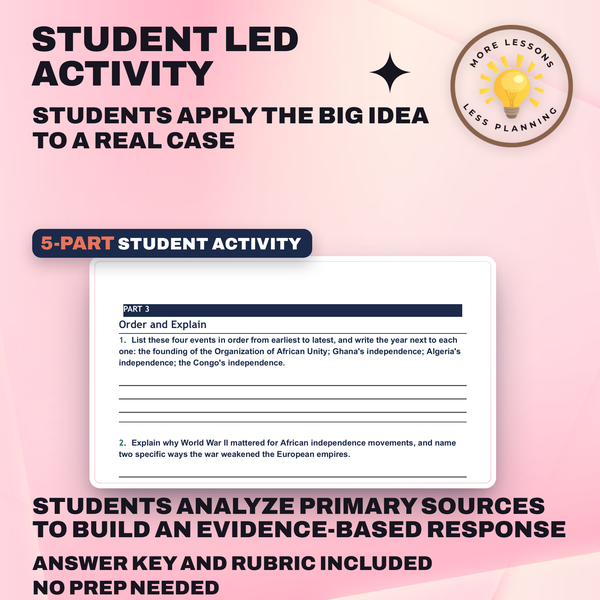
- Activity + answer key
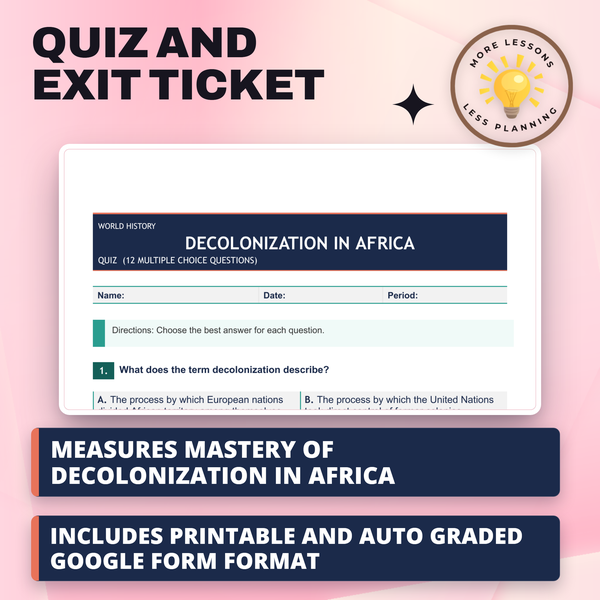
- Quiz + answer key
- Exit ticket + answer key
- Teacher guide
- Teacher presentation notes
What students do
- Explain how World War II weakened European control over African colonies
- Trace Ghana's 1957 independence and the seventeen nations that gained independence in the 1960 Year of Africa
- Analyze how Cold War rivalry shaped the choices facing new African leaders
- Read a July 1960 U.S. embassy telegram reporting a private meeting with Patrice Lumumba
What it covers
- The Congo's independence on June 30, 1960 and the crisis that followed within days
- What nonalignment meant for leaders like Kwame Nkrumah
- What building a working state required beyond lowering a colonial flag
Learning targets
- Explain how World War II weakened Europe's empires in Africa.
- Describe how Ghana in 1957 and the 1960 Year of Africa spread independence.
- Trace the Congo from Belgian rule to independence and into crisis.
- Analyze how Cold War rivalry shaped the choices new African leaders faced.
- Evaluate what independence required beyond lowering a colonial flag.
Peek inside
World War II left Britain, France, and Belgium exhausted and in debt
African soldiers fought for those empires and came home wanting change
The 1945 United Nations Charter endorsed self-determination
Decolonization is the process of colonies becoming independent nations
Holding colonies now cost more than the empires could easily afford
Why the Empires Weakened
World War II left Britain, France, and exhausted and deep in debt.
is the process by which colonies won independence from European empires and became self-governing nations.
The 1945 United Nations Charter endorsed , the principle that a people should govern themselves and choose their own government.
1. Between 1957 and 1965, one African colony after another became an independent nation. Historians call that whole process .
Why this matters
Ghana became independent in 1957. By 1960, seventeen more African nations had followed, a wave large enough that historians call it the Year of Africa. That pace is far faster than empires are usually assumed to unwind.
Kwame Nkrumah and other new leaders were not simply choosing a side in the Cold War through nonalignment, they were trying to avoid choosing one at all while still needing aid from both. That balancing act separates independence from running a country, since lowering a colonial flag turned out to be the easier half.
From one teacher to another
On June 30, 1960, the Congo became independent, and the crisis that broke out within days is the part I want students to sit with, since independence was never just a flag coming down. They read an actual July 1960 embassy telegram describing a closed-door meeting with Patrice Lumumba, so that crisis comes from a real document instead of a textbook paraphrase. By the end they've weighed how Cold War rivalry shaped the choices facing new African leaders and can explain what building a working state actually required.
Every file in this toolkit
Download
Where should I send the next one?
Everything here is free and it stays that way. Leave your email and I'll send you the new lessons as they go up. You can unsubscribe from any one of them.
Related resources
Decolonization in Asia
Globalization and the Modern World
Origins of the Cold War
The Berlin Wall
The Cuban Missile Crisis
The Korean War
Every lesson on this site is free to download and use. If one of them saved you a prep period, you can chip in a few bucks toward my three kids' daycare fund. That's genuinely where tips go.