Decolonization in Asia
- Grades
- Grades 9-12
- Time
- About two 50-minute class periods
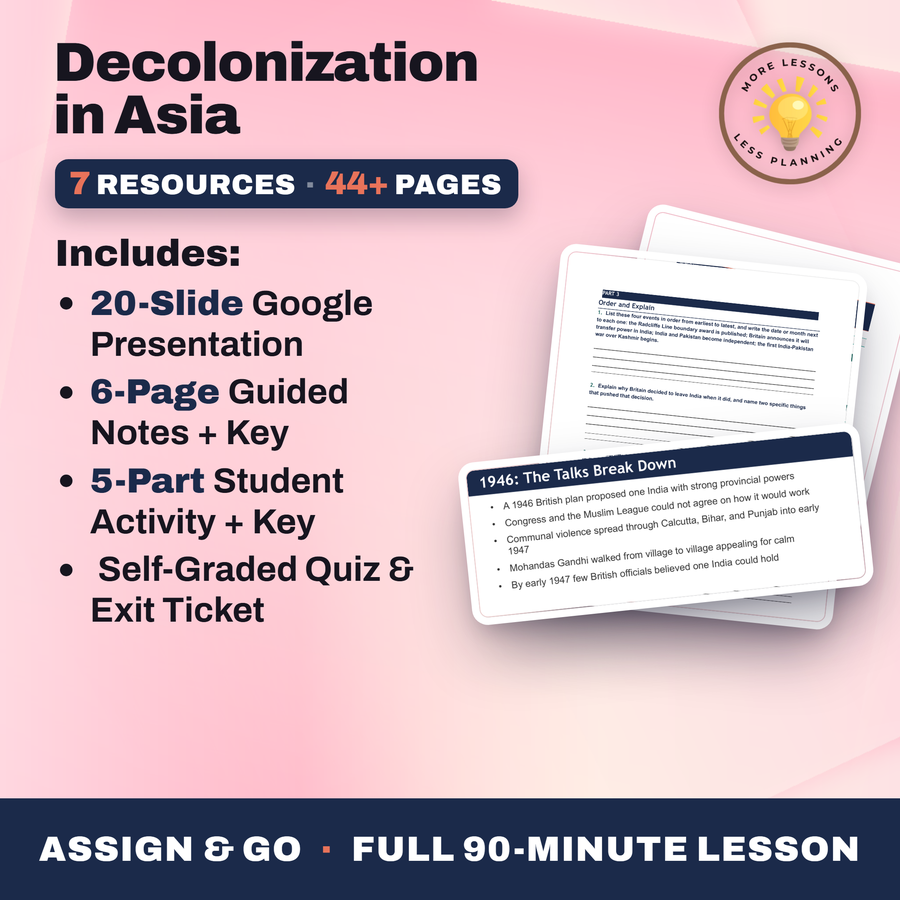
- Includes
- 11 ready-to-teach files
- Format
- Word (.docx) · PowerPoint (.pptx)
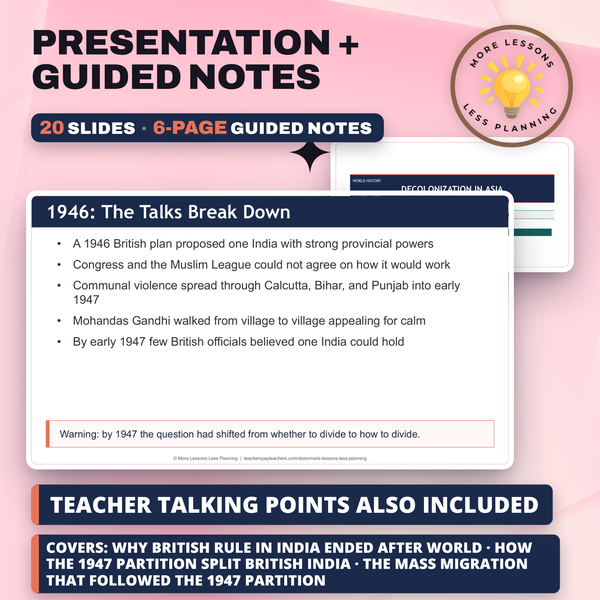
- Slide deck
- Guided notes
- Guided notes teacher key
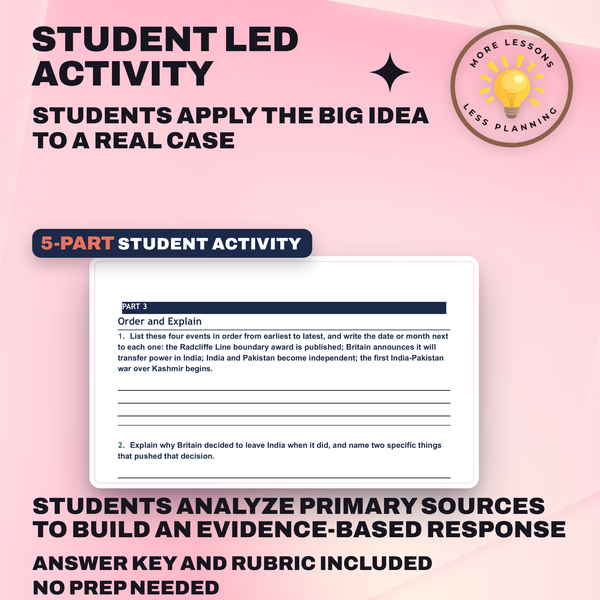
- Activity + answer key
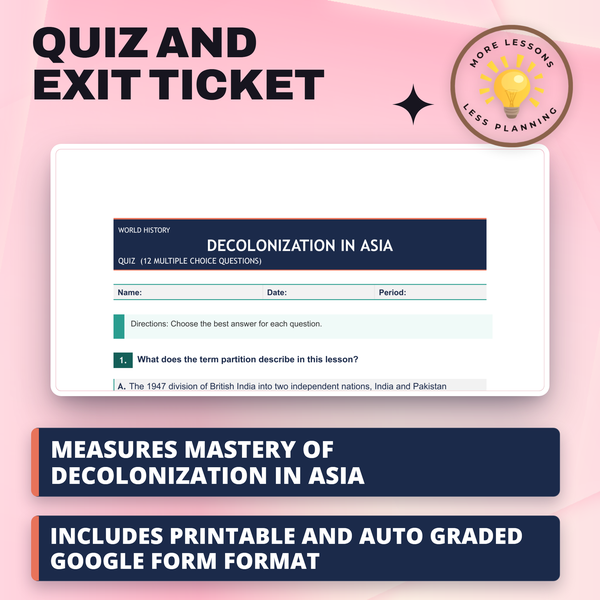
- Quiz + answer key
- Exit ticket + answer key
- Teacher guide
- Teacher presentation notes
What students do
- Explain why British rule in India ended after World War II
- Trace how the 1947 partition split British India into two nations
- Analyze how the Radcliffe Line was drawn and by whom
- Read a secret October 1947 telegram requesting transport planes to move 50,000 refugees
What it covers
- The mass migration that followed partition, roughly 10 to 15 million people
- The Kashmir dispute and the war it triggered in 1947-48
- Why the Radcliffe Line's timing, published two days after independence, mattered
Learning targets
- Explain why British rule in India ended after World War II.
- Describe how the 1947 partition split British India into two nations.
- Trace the mass migration that followed the 1947 partition.
- Analyze how the partition boundary was drawn and by whom.
- Evaluate the lasting consequences of partition in South Asia.
Peek inside
World War II shattered European control across South and Southeast Asia
Japan's wartime occupation had shown the empires could be pushed out
Independence movements across Asia demanded power now, not later
Britain came out of the war exhausted and deeply in debt
Between 1946 and 1949 six Asian nations became self-governing
The Empires Pull Back
World War II shattered European control across South and Southeast , and Japan's wartime occupation had shown the empires could be pushed out.
is the process by which colonies won independence from European empires and became self-governing nations.
Britain came out of the war exhausted and deeply in , which made holding an empire far harder.
1. Between 1946 and 1949 the Philippines, India, Pakistan, Burma, Ceylon, and Indonesia all became self-governing nations. Historians call that whole process .
Why this matters
The Radcliffe Line, the border splitting British India into two nations, was not published until two days after independence took effect. People went to bed in one country and woke up unsure which side of a new border their town had landed on.
Between 10 and 15 million people were displaced by partition, a scale that deserves more attention than the telegrams and speeches usually get. The Kashmir dispute that followed shows the border's damage did not end with the migration, since the same line triggered a war that same year.
From one teacher to another
I teach decolonization in Africa and Asia as two separate lessons on purpose, because the paths out of empire didn't run the same course on either continent. This one stays on South Asia, and it doesn't let partition stay abstract: students read an actual October 1947 telegram asking Washington for planes to move 50,000 refugees, not a casualty count on a slide. That's the number I want them to sit with when the lesson is over.
Every file in this toolkit
Download
Where should I send the next one?
Everything here is free and it stays that way. Leave your email and I'll send you the new lessons as they go up. You can unsubscribe from any one of them.
Related resources
Decolonization in Africa
Globalization and the Modern World
Origins of the Cold War
The Berlin Wall
The Cuban Missile Crisis
The Korean War
Every lesson on this site is free to download and use. If one of them saved you a prep period, you can chip in a few bucks toward my three kids' daycare fund. That's genuinely where tips go.