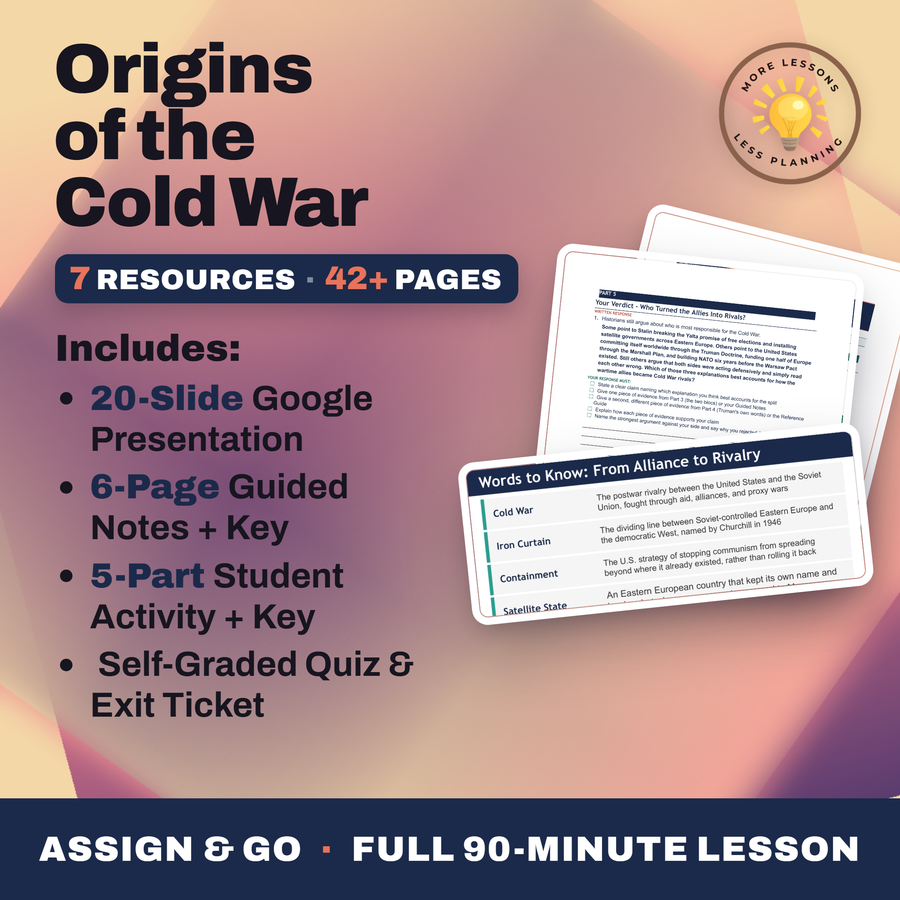
Origins of the Cold War
- Slide deck
- Guided notes
- Guided notes teacher key
- Activity + answer key
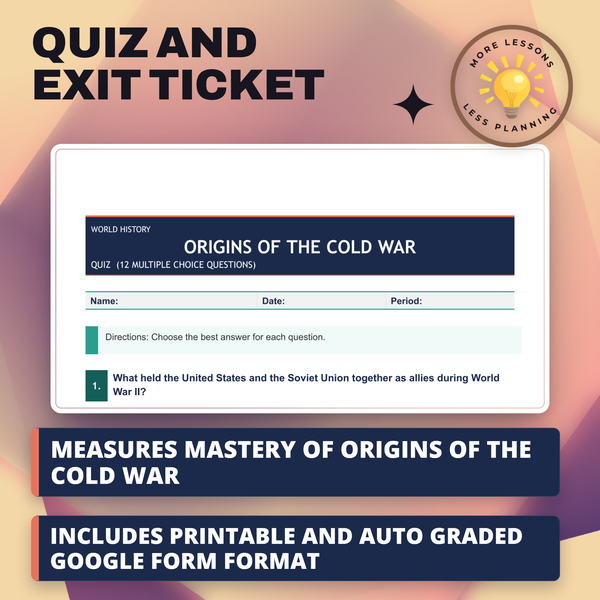
- Quiz + answer key
- Exit ticket + answer key
- Teacher guide
- Teacher presentation notes
Where should I send the next one?
Everything here is free and it stays that way. Leave your email and I'll send you the new lessons as they go up. You can unsubscribe from any one of them.
Every file in this toolkit
Related resources
Decolonization in Africa
Decolonization in Asia
Globalization and the Modern World
The Berlin Wall
The Cuban Missile Crisis
The Korean War
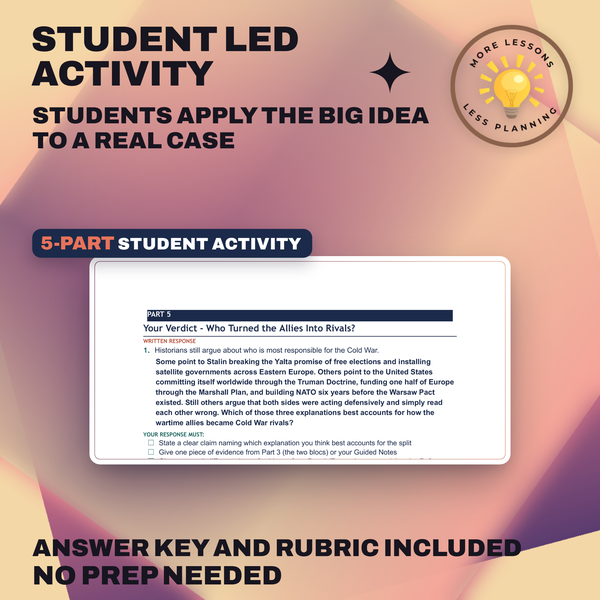
What students do
- Compare what was promised at Yalta in February 1945 to what actually happened in Eastern Europe by 1948
- Analyze Truman's March 12, 1947 address to Congress asking for aid to Greece and Turkey
- Define containment and trace how it drove the Truman Doctrine, the Marshall Plan, and the Berlin Airlift
- Explain how NATO and the Warsaw Pact split Europe into two armed alliances by 1955
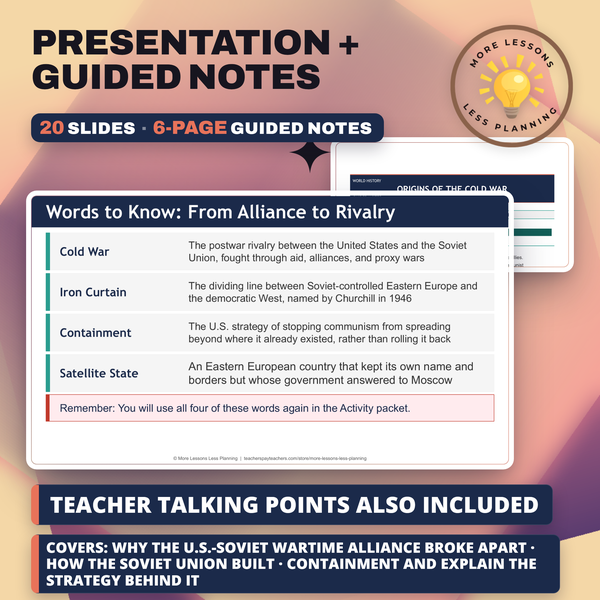
What it covers
- Why the wartime alliance between the US and the Soviet Union had nothing holding it together once Germany fell
- How Eastern European countries became satellite states through rigged votes and pressure rather than outright invasion
- What containment meant in practice, from Greece and Turkey to the airlift that kept West Berlin fed
Learning targets
- Explain why the U.S.-Soviet wartime alliance broke apart after 1945.
- Describe how the Soviet Union built a bloc of satellite states.
- Define containment and explain the strategy behind it.
- Explain what the Truman Doctrine promised and what triggered it.
- Explain how the Marshall Plan used economic aid as a Cold War tool.
From one teacher to another
Most students refuse to believe the US and the Soviet Union were ever actually allies, so that's where this lesson starts, with the wartime alliance itself. Two countries that had just finished fighting the same war together spend almost no time before treating each other as the next threat, and figuring out why that happened this fast is more interesting than any list of events that follows. This opens my last unit of the course, and I built it to set the terms the rest of the unit keeps coming back to: ideology, distrust, and two competing versions of the postwar world.
Every lesson on this site is free to download and use. If one of them saved you a prep period, you can chip in a few bucks toward my three kids' daycare fund. That's genuinely where tips go.