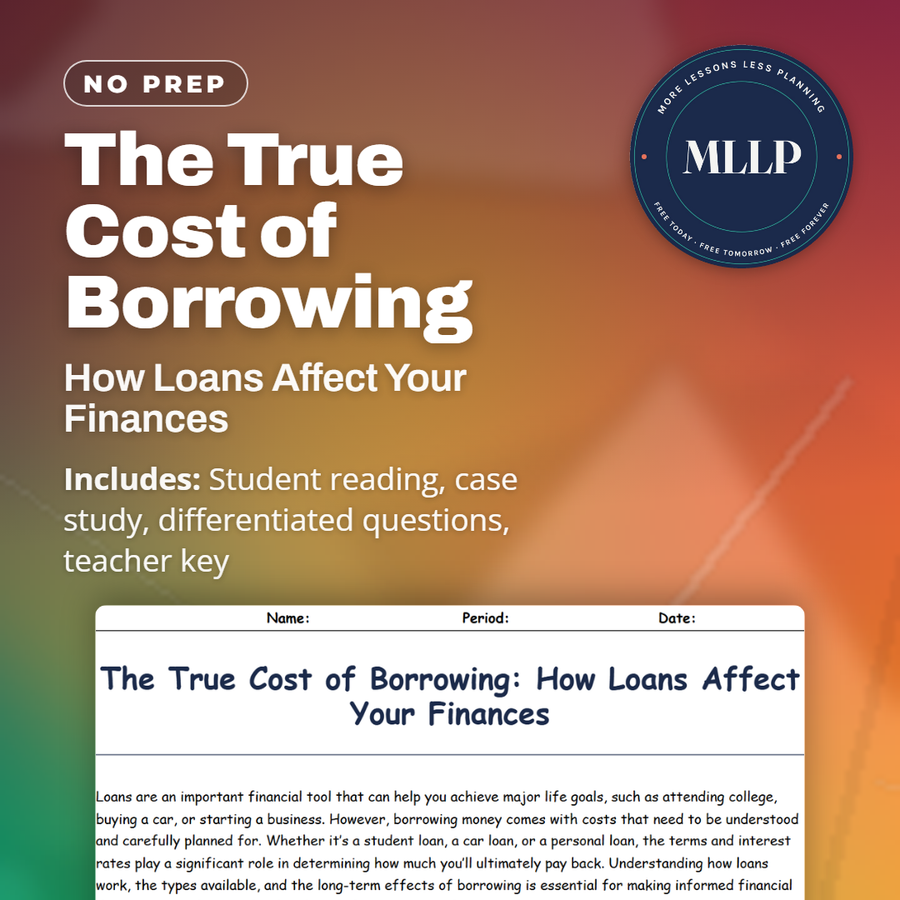
The True Cost of Borrowing: How Loans Affect Your Finances
Quality reviewed September 2026
Facts verified September 24, 2026
- Subject
- Career & Life Skills
- Grades
- Grades 9-12
- Length
- 7-page student worksheet
- Time
- About one 50-minute class period
- Great for
- Sub plans and independent work
- Includes
- Reading passage, comprehension questions + full answer key
- Format
- Print-and-go PDF
What students do
- Match principal and loan term to definitions like the original amount borrowed and the length of time to repay a loan, plus a fixed interest rate, a monthly installment, and total cost to their own definitions
- Fill in the blanks on what kind of interest rate changes over time, what cost borrowers should focus on beyond the monthly payment, and how shorter loan terms compare on total cost
- Answer multiple choice questions on the primary purpose of a loan, the difference between fixed and variable interest rates, and which loan type usually carries the highest interest rate
- Write short answers on how longer repayment terms change total cost, why shopping around for a loan matters, and how Sarah's five-year auto loan ended up costing her $780 more in interest than the three-year option
What it covers
- How loans work, including principal, interest rates, and repayment terms
- A comparison of student, auto, and personal loans and what typically drives their interest rates
- A case study on Sarah, who chose a five-year auto loan over a three-year one and paid $780 more in interest for the lower monthly payment
Start reading this worksheet
Loans are an important financial tool that can help you achieve major life goals, such as attending college, buying a car, or starting a business. However, borrowing money comes with costs that need to be understood and carefully planned for. Whether it’s a student loan, a car loan, or a personal loan, the terms and interest rates play a significant role in determining how much you’ll ultimately pay back. Understanding how loans work, the types available, and the long-term effects of borrowing is essential for making informed financial decisions. Let’s look at the details to help you navigate loans wisely.
How Loans Work
A loan is a sum of money borrowed from a lender with the agreement that it will be paid back over time, usually with added interest. Interest is the cost of borrowing money, expressed as a percentage of the loan amount, known as the principal. When you take out a loan, you’ll agree to a repayment term, which is the length of time you have to pay it back, and an interest rate, which determines how much extra you’ll pay on top of the principal. Repayments are usually made in monthly installments, which include both principal and interest. For example, if you borrow $10,000 at a 5% annual interest rate over five years, your monthly payment will include a portion of the original loan plus the interest accrued over time. While loans make it possible to afford expensive items, the total cost of borrowing can add up quickly if you don’t pay attention to the details.
Understanding Interest Rates and Repayment Terms
Interest rates come in two main types: fixed and variable. Fixed Interest Rates: These stay the same throughout the life of the loan, making your monthly payments predictable. Variable Interest Rates: These can change over time based on market conditions, which means your payments could increase or decrease. The repayment term also affects the cost of borrowing. Longer terms lower your monthly payments but increase the total interest paid over time. Shorter terms require higher monthly payments but reduce the overall cost of the loan. Here’s an example to illustrate the difference: A $20,000 car loan at 4% interest for five years will have monthly payments of $368 and a total cost of $22,080. The same loan over seven years will lower the monthly payment to $273 but increase the total cost to $22,932. This example shows that longer terms may seem more affordable each month but end up costing more in the long run.
Like what you read? The full reading, the case study, and every question set are in the free download below, along with the answer key.
Why this matters
A loan's monthly payment is the number most people focus on, but Sarah's case shows how that same focus can hide hundreds of dollars in extra cost over the life of the loan. Anyone taking out a student loan, financing a car, or even comparing credit card offers is making the same trade-off Sarah did, between what's easier to pay now and what costs less overall. Learning to check the total cost of a loan instead of only the monthly number is a habit that applies to nearly every major purchase made on credit.
From one teacher to another
Principal, interest, and repayment term are the building blocks the reading uses to explain how a loan actually works, along with the difference between a fixed rate that stays the same and a variable one that can change. It compares student loans, auto loans, and personal loans side by side, along with a table showing how the same idea plays out across different loan amounts and terms, and covers extra costs like origination fees and prepayment penalties that add to what you actually pay back. Sarah needs a car for a new job in the case study and picks a five-year auto loan over a three-year one because of the lower monthly payment, then finds out it cost her $780 more in interest.
What you get
Download
Where should I send the next one?
Everything here is free and it stays that way. Leave your email and I'll send you the new lessons as they go up. You can unsubscribe from any one of them.
Related resources
Debit vs. Credit Cards: How to Choose the Right Payment Method
Financial Scams Teens Should Know: Spotting and Avoiding Fraud
How to Build a Strong Credit Score from Day One
How to Read a Paycheck: Understanding Deductions and Net Pay
How to Start Saving for Retirement as a Teen
Insurance for Beginners: What Teens Need to Know About Coverage
Every lesson on this site is free to download and use. If one of them saved you a prep period, you can chip in a few bucks toward my three kids' daycare fund. That's genuinely where tips go.