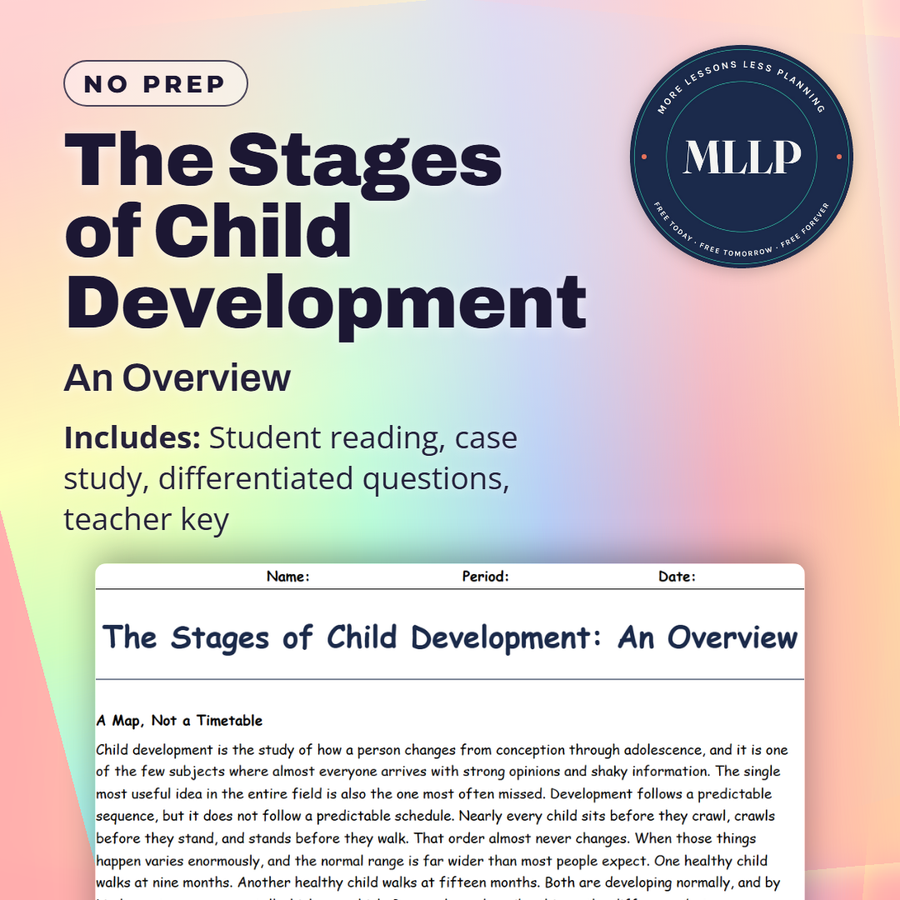
The Stages of Child Development: An Overview
Quality reviewed September 2026
Facts verified September 23, 2026
- Subject
- Career & Life Skills
- Grades
- Grades 9-12
- Length
- 9-page student worksheet
- Time
- About one 50-minute class period
- Great for
- Sub plans and independent work
- Includes
- Reading passage, comprehension questions + full answer key
- Format
- Print-and-go PDF
What students do
- Sequence and rate get separated using the reading's own walking examples, since order almost never changes while timing varies enormously
- Identify the four domains of development, physical, cognitive, social-emotional and language
- Marisol's steady progress through standing, cruising and walking shows the difference between a slow rate and a real warning sign
- Explain the cephalocaudal and proximodistal patterns using the reading's own examples
What it covers
- The difference between developmental sequence, which stays consistent, and rate, which varies widely
- The four domains of development, physical, cognitive, social-emotional and language, and how they overlap
- Why the nature versus nurture debate is described as a tie rather than a contest
Start reading this worksheet
A Map, Not a Timetable
Child development is the study of how a person changes from conception through adolescence, and it is one of the few subjects where almost everyone arrives with strong opinions and shaky information. The single most useful idea in the entire field is also the one most often missed. Development follows a predictable sequence, but it does not follow a predictable schedule. Nearly every child sits before they crawl, crawls before they stand, and stands before they walk. That order almost never changes. When those things happen varies enormously, and the normal range is far wider than most people expect. One healthy child walks at nine months. Another healthy child walks at fifteen months. Both are developing normally, and by kindergarten no one can tell which was which. Researchers describe this as the difference between sequence and rate. Sequence is the order of steps, and it is remarkably consistent across children, cultures, and centuries. Rate is the speed a particular child moves through those steps, and it is shaped by genetics, health, nutrition, opportunity, and plain individual variation. Confusing the two is where a great deal of unnecessary parental panic comes from. A child who skips a step entirely, or who loses a skill they previously had, is a genuine reason to talk to a doctor. A child who is simply slower along the ordinary path usually is not. Understanding that distinction is the difference between informed observation and anxious guessing, and it is the foundation everything else in this unit is built on. It is also the reason experienced pediatricians ask what a child is doing now and what they were doing three months ago, rather than reaching for a single number on a chart and treating it as a verdict.
Six Stages From Conception to Adulthood
Developmental scientists divide childhood into stages, and while the exact boundaries shift slightly from textbook to textbook, the basic structure is standard. The prenatal stage runs from conception to birth, roughly forty weeks, and it is the period of the fastest growth a human being will ever experience. Infancy covers birth to about age one, a year defined by explosive physical growth and the formation of the child's first relationships. Toddlerhood runs from about one to three, dominated by walking, talking, and the discovery that the child is a separate person with their own opinions about things. The preschool years, roughly three to five, are the years of imagination, questions, and rapidly expanding social skill. The school-age years, about six to twelve, shift the child's world outward toward friends, teachers, and measurable competence at real tasks. Adolescence, roughly thirteen to eighteen, brings puberty, abstract thinking, and the long project of building an identity. These stages are conveniences rather than hard walls. No child wakes up on their third birthday and becomes a preschooler. The transitions blur, and a single child can be advanced in one area while still catching up in another. What the stages do provide is a shared vocabulary and a set of reasonable expectations, so that a caregiver knows roughly what to look for and, just as importantly, what not to worry about yet. Stages also carry a quiet warning. Because they are built from averages, they describe a child who does not exist, and every real child will be ahead of the description in some places and behind it in others.
Four Domains, One Child
Development is usually broken into four domains, which are simply the different areas in which a child grows. Physical development covers the body: height, weight, coordination, and the two kinds of motor skills. Gross motor skills use the large muscles, so crawling, walking, running, and throwing all qualify. Fine motor skills use the small muscles, especially in the hands, and cover grasping, scribbling, buttoning, and eventually handwriting. Cognitive development covers thinking, meaning memory, problem solving, attention, reasoning, and understanding how the world works. Social and emotional development covers relationships and feelings, including attachment to caregivers, friendship, empathy, self-control, and the slow work of managing strong emotions. Language development covers communication in both directions, both understanding words and producing them. Dividing development this way is genuinely useful for observation, because it gives an adult something specific to watch. It is also, taken literally, misleading. A real child does not develop in four separate compartments, and the domains constantly feed one another. A toddler who learns to walk gains access to places, objects, and people that drive cognitive and social growth. A child who cannot yet express frustration in words is far more likely to express it by hitting, which looks like a behavior problem but is often a language problem wearing a disguise. Skilled caregivers and teachers learn to ask which domain is actually underneath the behavior they are seeing. That question changes the response entirely. A child punished for hitting learns only that hitting is punished, while a child given the words for what they wanted gains the tool that made the hitting unnecessary.
Like what you read? The full reading, the case study, and every question set are in the free download below, along with the answer key.
Why this matters
This is the reading I hand out first in the unit, because sequence versus rate is the one idea that keeps coming back in every later passage, from prenatal timing to school-age puberty. Students who plan to babysit or work with kids professionally get asked developmental questions constantly, and the honest answer to most of them is some version of Deshawn's answer to Marisol's mother, the order matters, the calendar mostly does not. The nature versus nurture material closes on something genuinely useful for a future parent or caregiver to carry around, that nobody controls a child's genes but the environment around that child gets built by the adults in it every single day.
From one teacher to another
This overview reading is built to be read before the rest of the unit, since it lays out the six stages from prenatal through adolescence and the four domains, physical, cognitive, social-emotional and language, that show up inside every one of them. A full passage draws out the difference between sequence, the order of steps, which barely changes, and rate, the timing, which varies enormously between healthy kids. Another passage covers the principles that hold at every age, cephalocaudal and proximodistal development, and why milestones work as a pattern rather than a single pass or fail date. The case study follows Deshawn, a toddler room aide, walking a worried parent through exactly why her daughter's slower walking timeline is not something to panic about. A closing passage retires the old nature versus nurture argument in favor of how the two actually interact.
What you get
Download
Where should I send the next one?
Everything here is free and it stays that way. Leave your email and I'll send you the new lessons as they go up. You can unsubscribe from any one of them.
Related resources
Brain Development in Early Childhood

How Children Learn Language
Infant Development: The First Year
Prenatal Development and a Healthy Pregnancy

School-Age Development
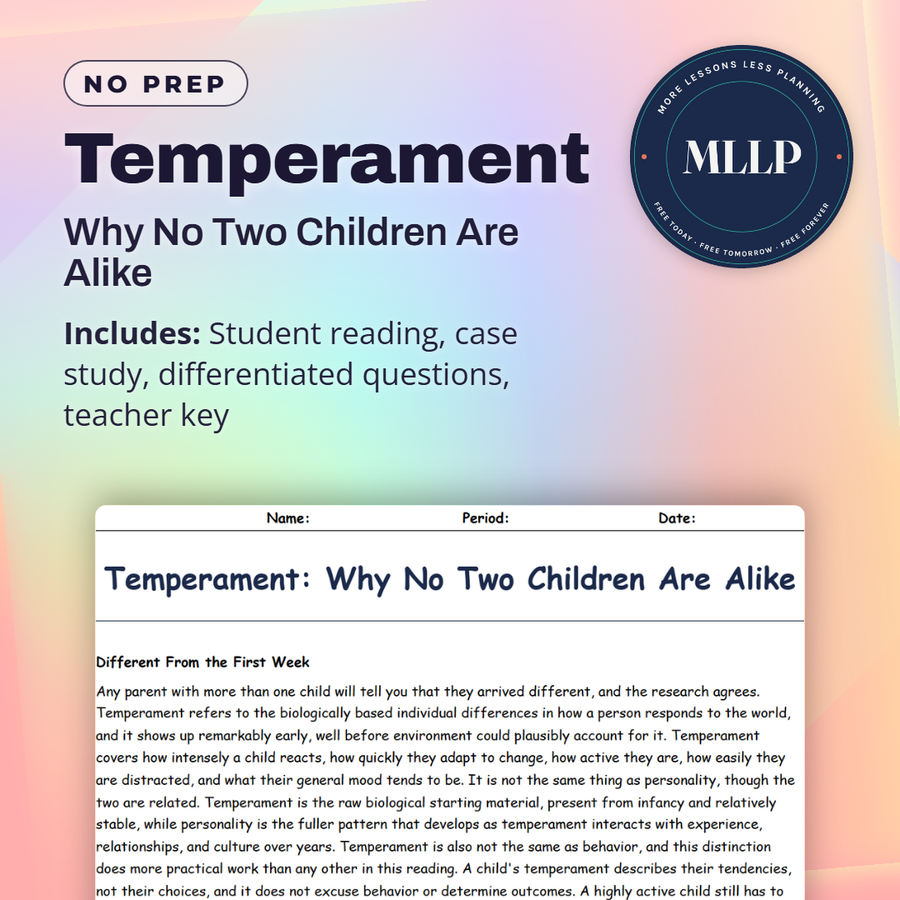
Temperament: Why No Two Children Are Alike
Every lesson on this site is free to download and use. If one of them saved you a prep period, you can chip in a few bucks toward my three kids' daycare fund. That's genuinely where tips go.