The Space Race
- Grades
- Grades 9-12
- Time
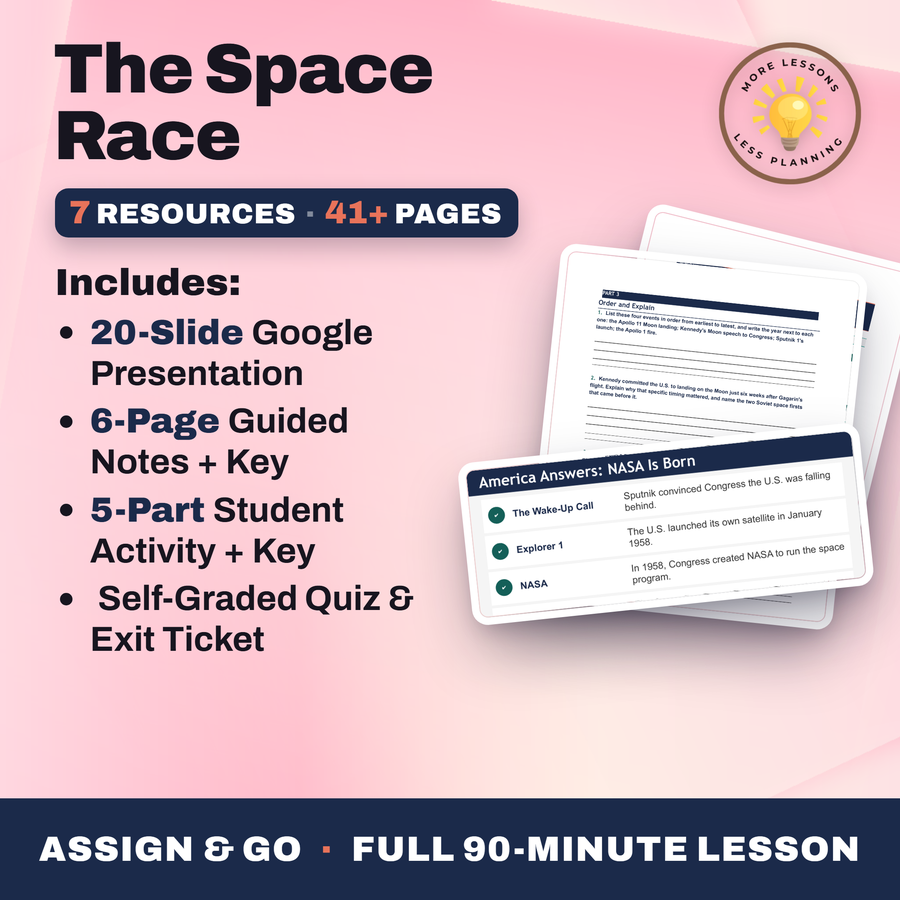
- About two 50-minute class periods
- Includes
- 11 ready-to-teach files
- Format
- Word (.docx) · PowerPoint (.pptx)
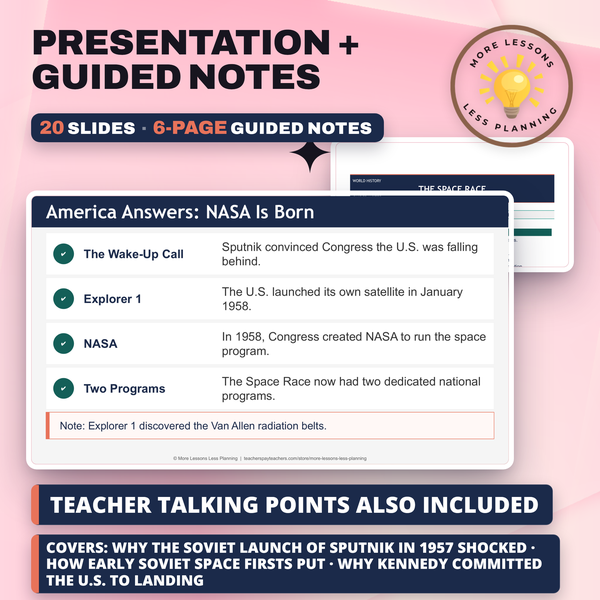
- Slide deck
- Guided notes
- Guided notes teacher key
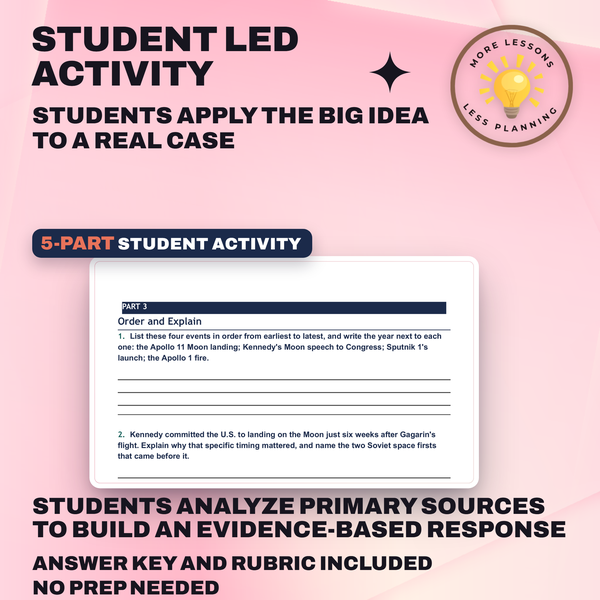
- Activity + answer key
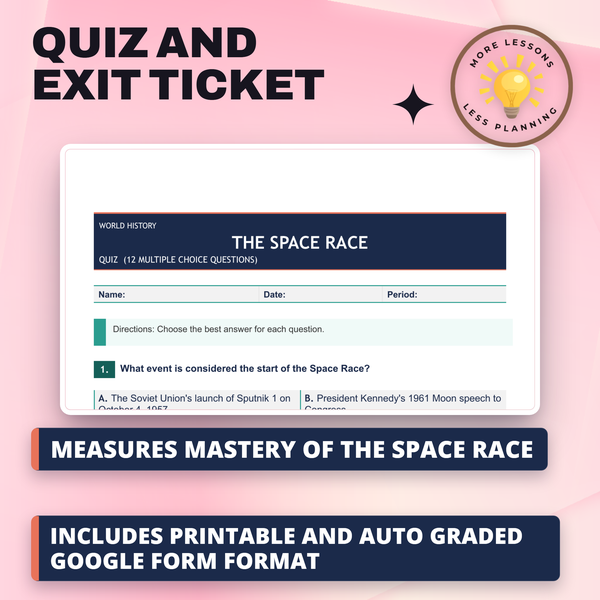
- Quiz + answer key
- Exit ticket + answer key
- Teacher guide
- Teacher presentation notes
What students do
- Trace the Space Race from Sputnik's 1957 launch through Gagarin's 1961 flight to the Apollo 11 landing
- Explain why Kennedy committed the United States to reaching the Moon
- Read NASA's actual July 1969 press kit to analyze how the Apollo 11 mission was presented before its outcome was known
- Evaluate what the Space Race reveals about Cold War rivalry and eventual cooperation
What it covers
- The Apollo program's setbacks, including the Apollo 1 launch pad fire
- Kennedy's Moon commitment and the July 1969 landing
- The 1975 Apollo-Soyuz mission that eased Cold War tensions in space
Learning targets
- Explain why the Soviet launch of Sputnik in 1957 shocked the United States.
- Describe how early Soviet space firsts put the U.S. on the defensive.
- Explain why Kennedy committed the U.S. to landing a man on the Moon.
- Trace the Apollo program from its setbacks to the July 1969 Moon landing.
- Evaluate what the Space Race reveals about Cold War rivalry and cooperation.
Peek inside
After 1945, the U.S. and Soviet Union became Cold War rivals
Both built long-range rockets to deliver nuclear weapons
Those same rockets could also launch satellites into orbit
Leading in space became a way to prove a nation's power
This competition became known as the Space Race
Rivals Reach for the Sky
After 1945, the U.S. and the became Cold War rivals.
Both nations built long-range to deliver nuclear weapons.
The Cold War competition to achieve firsts in spaceflight became known as the , the subject of this whole lesson.
1. The Cold War competition between the U.S. and USSR to achieve firsts in spaceflight was known as the .
Why this matters
The Apollo 1 launch pad fire happened years before Apollo 11 reached the Moon that most people remember this program for. A space race told only through its victory leaves that fire out, and leaving it out misses much of what the program actually cost.
By the time Kennedy committed the country to reaching the Moon, the Soviet Union already had Sputnik in 1957 and Gagarin in orbit by 1961, firsts the United States had not matched. I ask students to explain that commitment as a response to a losing streak, not pure ambition.
From one teacher to another
The space race lands with students who've gone a little numb on the Cold War's military lessons, because for once the competition plays out in rockets instead of troop counts. I keep every launch tied back to the rivalry, right down to having students read NASA's own 1969 press kit for how the agency framed the mission before anyone knew Apollo 11 would work. Ending on the 1975 Apollo-Soyuz handshake lets the unit close on cooperation instead of just competition.
Every file in this toolkit
Download
Where should I send the next one?
Everything here is free and it stays that way. Leave your email and I'll send you the new lessons as they go up. You can unsubscribe from any one of them.
Related resources
Decolonization in Africa
Decolonization in Asia
Globalization and the Modern World
Origins of the Cold War
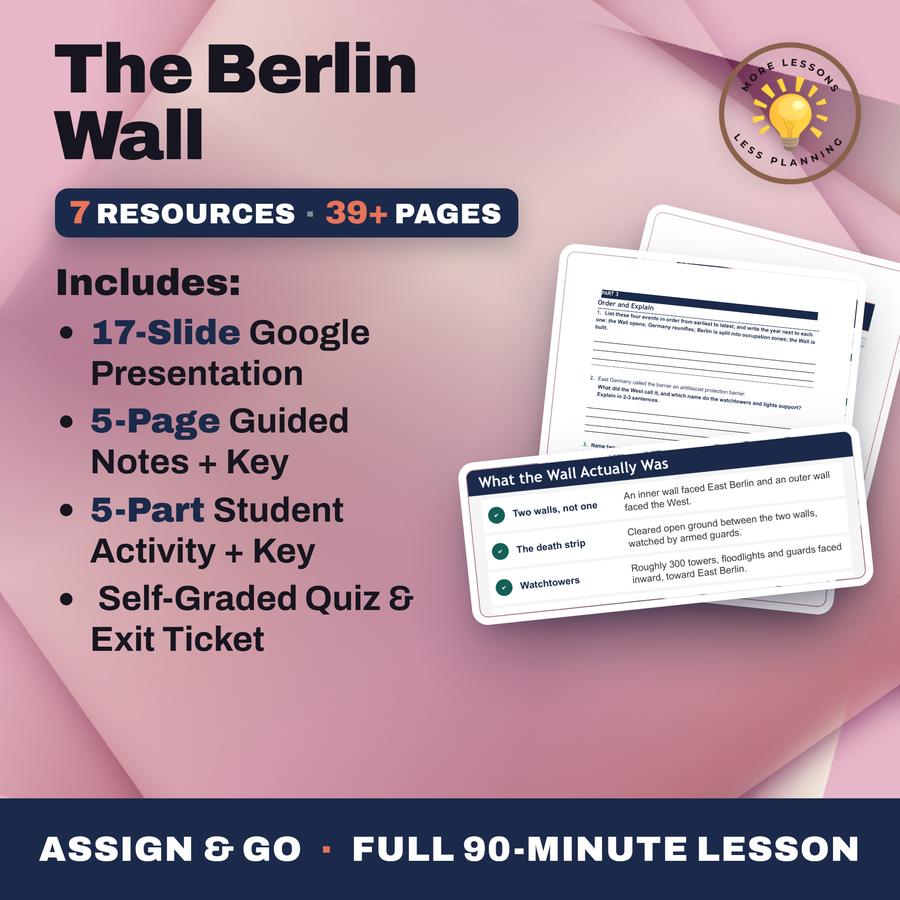
The Berlin Wall
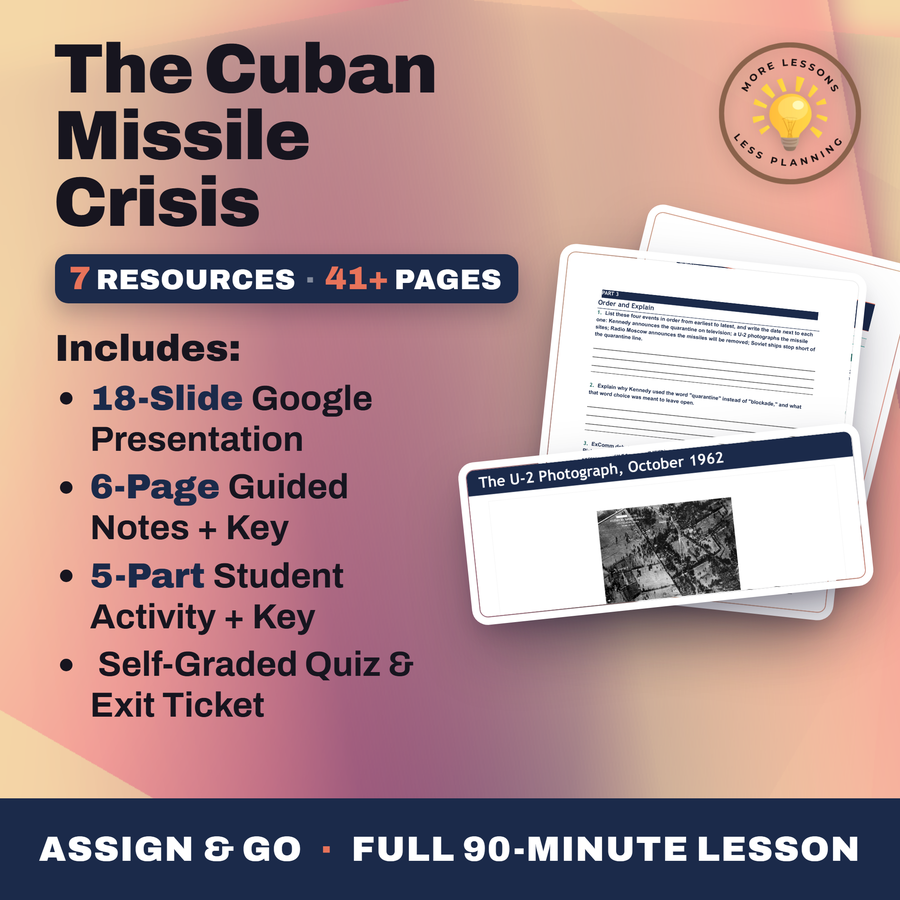
The Cuban Missile Crisis
Every lesson on this site is free to download and use. If one of them saved you a prep period, you can chip in a few bucks toward my three kids' daycare fund. That's genuinely where tips go.