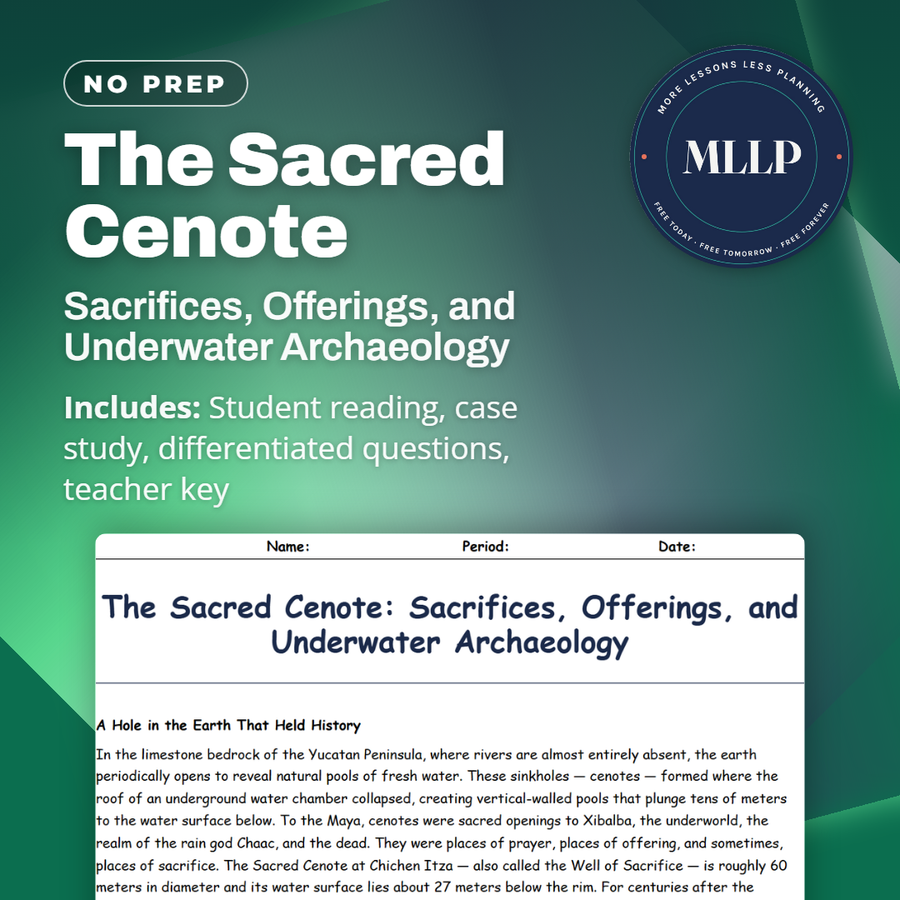
The Sacred Cenote: Sacrifices, Offerings, and Underwater Archaeology
Quality reviewed September 2026
Facts verified September 21, 2026
- Subject
- Social Studies
- Grades
- Grades 9-12
- Length
- 8-page student worksheet
- Time
- About one 50-minute class period
- Great for
- Sub plans and independent work
- Includes
- Reading passage, comprehension questions + full answer key
- Format
- Print-and-go PDF
What students do
- Edward Thompson's 1904 dredging operation and what it recovered get compared against what it destroyed
- The isotope analysis of bones from the cenote complicates the simple "virgin sacrifice" story that early researchers pushed
- Trace how gold and copper objects found in the cenote point to a Maya trade network reaching Colombia and Panama
- Answer short-answer questions connecting the underwater archaeologist's careful documentation to what Thompson's dredge destroyed
What it covers
- Edward Thompson's 1904 dredging of the Sacred Cenote and the archaeological context his method destroyed
- What gold, jade, and human remains recovered from the cenote reveal about Maya trade networks and ritual practice
- Modern underwater archaeology methods, shown through a case study of a diver documenting a jade mask before touching it
Start reading this worksheet
A Hole in the Earth That Held History
In the limestone bedrock of the Yucatan Peninsula, where rivers are almost entirely absent, the earth periodically opens to reveal natural pools of fresh water. These sinkholes (cenotes) formed where the roof of an underground water chamber collapsed, creating vertical-walled pools that plunge tens of meters to the water surface below. To the Maya, cenotes were sacred openings to Xibalba, the underworld, the realm of the rain god Chaac, and the dead. They were places of prayer, places of offering, and sometimes, places of sacrifice. The Sacred Cenote at Chichen Itza, also called the Well of Sacrifice, is roughly 60 meters in diameter and its water surface lies about 27 meters below the rim. For centuries after the Spanish conquest, local stories spoke of offerings and human bodies thrown into the cenote, but these were dismissed by colonial authorities as indigenous superstition. It would take the eccentric determination of an American diplomat named Edward Thompson to prove otherwise, and his methods would raise ethical questions that still echo through Maya archaeology today.
Edward Thompson and the Dredge
Edward Thompson arrived in the Yucatan in 1885 as the United States consul in Merida and became obsessed with Chichen Itza. He purchased the hacienda that included the ruins and spent decades exploring the site. In 1904, having read the account of Diego de Landa's description of offerings thrown into the cenote, Thompson imported a dredge and began mechanically scooping the bottom of the Sacred Cenote. What the dredge brought up was extraordinary: gold discs and figurines, jade ornaments, bells of copper, rubber balls, copal incense, carved bone objects, and pottery. Among the material were human skeletal remains: skulls, limb bones, and other fragments representing dozens of individuals. Thompson shipped the most valuable objects to the Peabody Museum at Harvard University without permission from Mexican authorities. This act of unilateral removal would later generate a major diplomatic controversy between the United States and Mexico, with Mexico eventually recovering some (but not all) of the objects. The dredging method was also archaeologically destructive. The mechanical dredge mixed objects from different time periods, destroyed contextual associations, and damaged fragile artifacts. Thompson retrieved objects, but he lost the information that careful excavation would have preserved: which objects were found together, at what depths, in what configurations. By modern standards, the Sacred Cenote operation was a salvage disaster masquerading as archaeology.
Underwater Archaeology Takes Over
Scientific diving became possible in the mid-20th century, and archaeologists began to see cenotes differently, as sites that could be excavated carefully underwater, with the same attention to context and stratigraphy that fieldwork on land required. CEDAM, a Mexican underwater exploration group, conducted diving operations at the Sacred Cenote in the 1960s and recovered additional objects that Thompson's dredge had missed or damaged. More rigorous underwater archaeology followed. Archaeologists trained in both excavation and diving developed methods for working on the cenote floor: mapping grid systems underwater, photographing finds in situ before removal, logging depths and positions carefully. The challenges are enormous. Visibility in cenotes can be poor, silt is easily disturbed by movement, and delicate organic materials can be destroyed if mishandled. But the rewards are also extraordinary: cenotes preserve organic materials that would never survive in open air.
Like what you read? The full reading, the case study, and every question set are in the free download below, along with the answer key.
Why this matters
Dr. Sousa's decision to leave the jade mask untouched is a small moment that carries the whole reading's argument: an object without its context is just a pretty thing, but an object logged in place can tell you who put it there, when, and why. This is also a good place for students to sit with the ethics side of the story, since Thompson shipped Sacred Cenote artifacts to Harvard without Mexican authorization, which sparked a real diplomatic dispute over who actually owns recovered heritage objects.
From one teacher to another
Sixty meters wide and dropping 27 meters down to the water, the Sacred Cenote at Chichen Itza held centuries of Maya offerings to the rain god Chaac before an American consul named Edward Thompson bought the site and started dredging it in 1904. The reading covers what his mechanical dredge pulled up, gold discs, jade, copper bells, and human remains, and is direct about the cost of his method: dredging mixed centuries of material together and destroyed the context that would tell archaeologists what was offered together and when. Students move from Thompson's disaster into how scientific diving changed the picture in the 1960s and after, letting archaeologists map, photograph, and log finds in place before ever touching them. The case study follows a Mexican underwater archaeologist finding a jade mask in a cenote near Tulum and choosing to leave it exactly where it lies until she's documented everything around it.
What you get
Download
Where should I send the next one?
Everything here is free and it stays that way. Leave your email and I'll send you the new lessons as they go up. You can unsubscribe from any one of them.
Related resources
Chichen Itza: Where Tourists Meet the Ancient World
LiDAR and the Maya: Finding Hidden Cities from the Sky
Maya Agriculture: Feeding Cities in the Jungle
Maya Mathematics and the Calendar: Zero and the End of the World
Maya Writing: Cracking the Hieroglyphic Code
Palenque and King Pakal: A Royal Tomb Inside a Pyramid
Every lesson on this site is free to download and use. If one of them saved you a prep period, you can chip in a few bucks toward my three kids' daycare fund. That's genuinely where tips go.