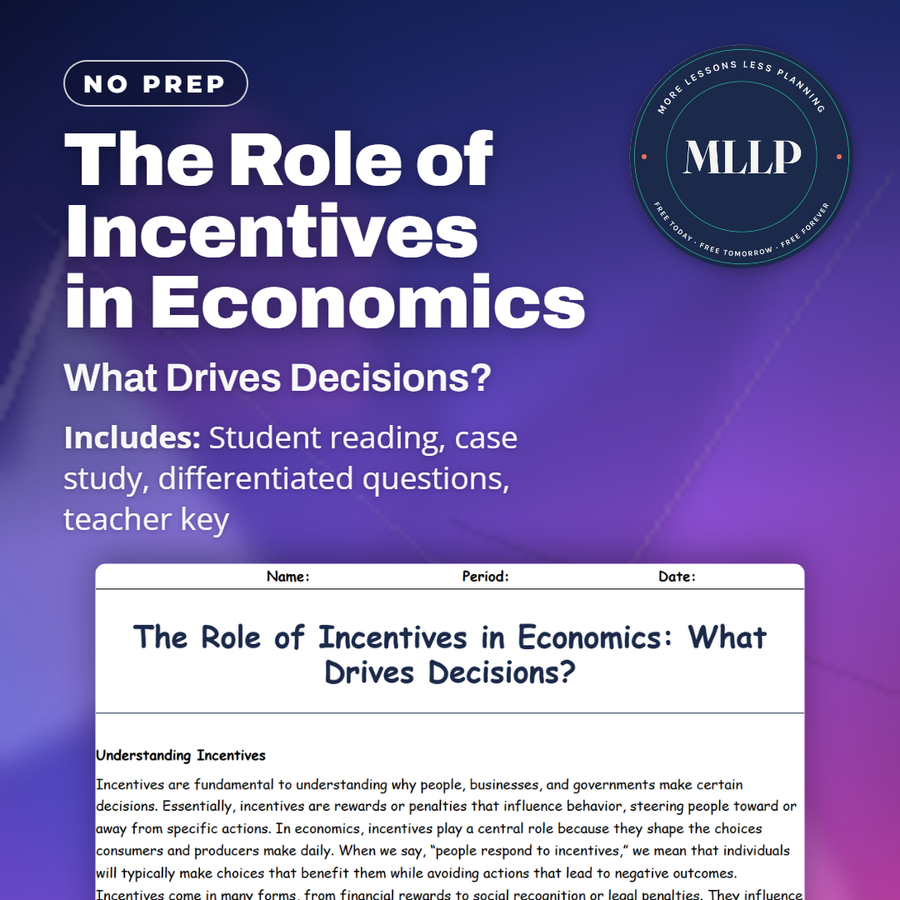
The Role of Incentives in Economics: What Drives Decisions?
Quality reviewed September 2026
Facts verified September 8, 2026
- Grades
- Grades 9-12
- Length
- 7-page student worksheet
- Time
- About one 50-minute class period
- Great for
- Sub plans and independent work
- Includes
- Reading passage, comprehension questions + full answer key
- Format
- Print-and-go PDF
What students do
- Distinguish between positive incentives (sales discounts, scholarships, tax credits) and negative incentives (fines, fees, taxes) and predict their effects on behavior
- Analyze how a city's recycling program uses both a discount for recyclers and a fee for non-recyclers to successfully increase participation and achieve environmental goals
- Evaluate business incentives like employee bonuses for meeting goals or loyalty programs that reward repeat customers to see how they drive desired behaviors
- Trace how government incentives like tax rebates for solar panels or sin taxes on cigarettes shape consumer choices toward sustainability and health
What it covers
- Two main types of incentives: positive rewards that encourage behavior and negative penalties that discourage it
- How consumers, businesses, and governments all respond to incentives, from shopping discounts to hiring decisions to environmental policies
- Real-world recycling case study showing how combining positive incentives (discount) with negative incentives (fee) creates stronger behavior change than using either alone
Start reading this worksheet
Understanding Incentives
Incentives are fundamental to understanding why people, businesses, and governments make certain decisions. Essentially, incentives are rewards or penalties that influence behavior, steering people toward or away from specific actions. In economics, incentives play a central role because they shape the choices consumers and producers make daily. When we say, “people respond to incentives,” we mean that individuals will typically make choices that benefit them while avoiding actions that lead to negative outcomes. Incentives come in many forms, from financial rewards to social recognition or legal penalties. They influence nearly every aspect of our lives, from career choices to spending habits. For instance, a tax break for buying energy-efficient appliances serves as an incentive for consumers to make eco-friendly purchases.
Positive vs. Negative Incentives
Incentives can be divided into two main categories: positive and negative. Each type has a unique impact on behavior. Positive Incentives: These are rewards that encourage certain behaviors. Examples include bonuses, discounts, scholarships, and tax credits. A positive incentive provides a benefit for taking a particular action, making it more attractive. Negative Incentives: These involve penalties or costs designed to discourage specific behaviors. Common examples are fines, late fees, and taxes. Negative incentives make certain actions less appealing by imposing a cost on them. Understanding these distinctions is key to seeing how incentives work in real-world scenarios. Governments and businesses use both positive and negative incentives to guide choices and drive desired outcomes. This table shows some common incentives and their intended effects, demonstrating how incentives influence both consumer and producer behavior.
How Incentives Influence Consumers
For consumers, incentives impact buying decisions and lifestyle choices. Businesses frequently use incentives like discounts and promotions to increase sales. A clothing store, for example, might offer a “buy one, get one free” deal to encourage customers to buy more items. By making the purchase feel like a better deal, the store motivates consumers to buy things they might otherwise have skipped. Government incentives also shape consumer choices. For instance, tax deductions for home energy improvements are a positive incentive encouraging homeowners to make eco-friendly upgrades. On the other hand, sin taxes—extra taxes on goods like cigarettes and sugary drinks—serve as negative incentives aimed at reducing consumption of items associated with health risks.
Like what you read? The full reading, the case study, and every question set are in the free download below, along with the answer key.
Why this matters
Offering a discount for recycling was not enough on its own for one city trying to raise participation, so it added a fee for households that refused. Together the two changed behavior more than either alone. That pairing is exactly what economists mean by incentives: rewards and penalties, both steering choices in predictable directions.
Once students see the recycling example, they start spotting incentives everywhere: employee bonuses, loyalty programs, solar panel tax rebates, a cigarette tax meant to discourage smoking. I use this reading to reframe incentives as neither manipulation nor magic, just a government, business, or city acknowledging how people actually respond.
From one teacher to another
I use this worksheet when teaching that people respond predictably to incentives. Not always happily, but predictably. My students see the recycling program in action: the discount on waste bills rewards participation, and the fee for non-recyclers nudges the holdouts. Together, these incentives changed behavior better than either alone would have. We analyze how businesses use incentives constantly: discounts to boost sales, employee bonuses to meet targets, loyalty programs to bring customers back. Then we zoom out to see government incentives like tax credits for solar panels or "sin taxes" on cigarettes. The matching and multiple-choice sections help students recognize incentives in their own lives and understand why they respond to them. By the end, students get that incentives aren't manipulation. They're just acknowledging how humans actually decide.
What you get
- Answer Key
-
Student Worksheet
Smokers taxed extra on cigarettes may also pay higher health insurance premiums, a second penalty layered onto one behavior. Tax deductions for home energy upgrades and workplace wellness programs that reward exercise or preventive screening work the opposite way, alongside loyalty programs and employee bonuses tied to performance goals, each one a reward aimed at a behavior someone wants more of.
Download
Where should I send the next one?
Everything here is free and it stays that way. Leave your email and I'll send you the new lessons as they go up. You can unsubscribe from any one of them.
Related resources
Comparing Economic Systems: Market, Command, and Mixed
Economic Models and Theories: Simplifying Complex Concepts
Factors of Production: Building Blocks of the Economy
Marginal Analysis: Making the Most of Every Decision
Opportunity Cost: The True Cost of Every Decision
Production Possibilities Curve: Visualizing Choices and Trade-Offs
Every lesson on this site is free to download and use. If one of them saved you a prep period, you can chip in a few bucks toward my three kids' daycare fund. That's genuinely where tips go.