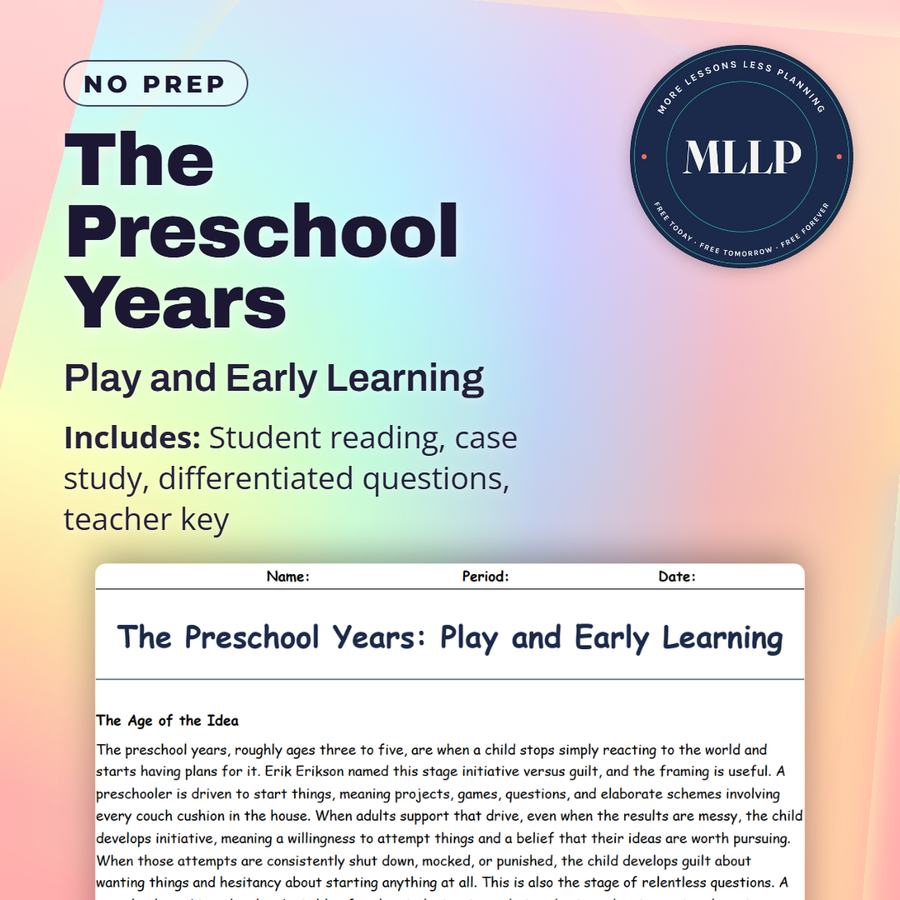
The Preschool Years: Play and Early Learning
Quality reviewed September 2026
Facts verified September 23, 2026
- Subject
- Career & Life Skills
- Grades
- Grades 9-12
- Length
- 9-page student worksheet
- Time
- About one 50-minute class period
- Great for
- Sub plans and independent work
- Includes
- Reading passage, comprehension questions + full answer key
- Format
- Print-and-go PDF
What students do
- The link between dramatic play and gains in self-regulation gets explained from the reading
- Symbolic thought, letting a banana stand in for a telephone, gets tied to how language, reading and math all work
- Nia's total confidence that the taller glass holds more juice shows exactly what centration looks like
- Explain why phonological awareness predicts later reading success better than flashcards do
What it covers
- Piaget's preoperational stage, including symbolic thought, egocentrism, centration and animism
- How preschool play moves from associative to cooperative, and what dramatic play builds along the way
- The fine motor and preliteracy skills, like phonological awareness, that predict school readiness
Start reading this worksheet
The Age of the Idea
The preschool years, roughly ages three to five, are when a child stops simply reacting to the world and starts having plans for it. Erik Erikson named this stage initiative versus guilt, and the framing is useful. A preschooler is driven to start things, meaning projects, games, questions, and elaborate schemes involving every couch cushion in the house. When adults support that drive, even when the results are messy, the child develops initiative, meaning a willingness to attempt things and a belief that their ideas are worth pursuing. When those attempts are consistently shut down, mocked, or punished, the child develops guilt about wanting things and hesitancy about starting anything at all. This is also the stage of relentless questions. A preschooler asking why the sky is blue for the ninth time is not being obstinate but is running the primary cognitive tool available at this age, since asking is how they build a working model of how the world operates. Physical growth continues at a slower, steadier rate than in the toddler years, and the body's proportions change noticeably as the round toddler shape lengthens into something recognizably child-shaped. What changes most is not size but capability, since this is the stage where children become genuinely competent at ordinary tasks and, importantly, begin to know it. That awareness is the part adults underuse. A preschooler who is allowed to pour their own drink and clean up the spill gets a lesson in capability that no amount of praise for being a big kid can substitute for.
Thinking in Symbols, Reasoning in Puddles
Jean Piaget called this stage preoperational thought, and while parts of his theory have been revised, his descriptions of how preschoolers think remain remarkably accurate. The great achievement of this stage is symbolic thought, meaning the ability to let one thing stand for another. A banana becomes a telephone, a stick becomes a sword, a cardboard box becomes a rocket. This same capacity underlies language, since words are symbols, and it is the foundation for later reading and math where letters and numerals stand for sounds and quantities. Alongside that achievement sit some limitations that look like errors and are actually just the stage. Egocentrism means difficulty taking another person's viewpoint, and it is not selfishness. A four-year-old on the phone who nods in answer to a question genuinely has not yet grasped that the listener cannot see them. Centration means focusing on one feature of a situation while ignoring the rest, which produces the famous conservation errors. Pour the same water from a short wide glass into a tall thin one and the preschooler says there is now more, because they attend to height alone. Animism means attributing feelings and intentions to objects, so the table is mean because it hurt them. None of these are misunderstandings to be corrected by explanation. They resolve as the brain matures. This is genuinely difficult for adults to accept, because the child sounds perfectly reasonable right up until the moment they do not. The temptation is to explain harder, and explaining harder has never once accelerated the timeline.
Play Grows Up
Social play changes more in these two years than in any comparable stretch. The parallel play of toddlerhood gives way to associative play, in which children play alongside one another and share materials and conversation without a common goal, and then to cooperative play, in which children genuinely coordinate toward something shared. Cooperative play requires real cognitive machinery, meaning agreeing on roles, following rules, negotiating disputes, and holding a shared idea in mind while acting it out. Dramatic play, sometimes called pretend or sociodramatic play, is the dominant form and the most developmentally productive. Children playing house, restaurant, doctor, or superhero are rehearsing social roles, practicing language, and repeatedly negotiating rules with peers. Research links this kind of play to gains in self-regulation, and the mechanism is intuitive once stated. A child playing the role of a sleeping baby must stay still because the role demands it, which is far harder and far more motivating than being told to sit still. Friendships appear during these years, though preschool friendship is built on proximity and shared activity rather than the loyalty and shared values that define it later. Conflicts are frequent and are a feature rather than a bug, since negotiating disputes with a peer who has equal power is a skill that cannot be learned from adults. Adults who settle every preschool dispute immediately remove the practice. The useful middle position is staying close enough to keep it safe while letting the children do as much of the negotiating as they can manage.
Like what you read? The full reading, the case study, and every question set are in the free download below, along with the answer key.
Why this matters
The conservation demonstration in Nia's case study is one students can run themselves on any four-year-old they know, and watching a kid confidently insist the taller glass holds more juice does more to teach Piaget's stages than any lecture could. This reading also pushes back on a specific assumption a lot of future parents and caregivers walk in with, that academic readiness comes from flashcards and drilling rather than from rhyming games, being read to daily and ordinary conversation. Knowing that egocentrism, centration and animism are temporary features of a developing brain rather than a kid being difficult changes how a future caregiver responds the fifth time a four-year-old insists the table is mean because it hurt them.
From one teacher to another
Preschoolers turn bananas into telephones and cardboard boxes into rockets, and this reading uses Piaget's preoperational stage to explain what that kind of play is actually doing for a developing brain. A full passage works through symbolic thought alongside egocentrism, centration and animism, the reasoning patterns that look like errors and are really just where a four-year-old's thinking currently sits. Another passage tracks how play itself grows up, from associative play into genuinely cooperative play with shared roles and rules. The case study follows Jamal, an observation student running a classic conservation test on four-year-old Nia, and her total confidence that the taller glass holds more. A closing passage covers the fine motor and preliteracy skills, including phonological awareness, that quietly set up how the first year of school will go.
What you get
Download
Where should I send the next one?
Everything here is free and it stays that way. Leave your email and I'll send you the new lessons as they go up. You can unsubscribe from any one of them.
Related resources
Brain Development in Early Childhood
How Children Learn Language
Infant Development: The First Year
Prenatal Development and a Healthy Pregnancy
School-Age Development
Temperament: Why No Two Children Are Alike
Every lesson on this site is free to download and use. If one of them saved you a prep period, you can chip in a few bucks toward my three kids' daycare fund. That's genuinely where tips go.