

The Persian Wars and Marathon
Quality reviewed September 2026
- Subject
- World History
- Grades
- Grades 9-12
- Time
- About two 50-minute class periods
- Includes
- 11 ready-to-teach files
- Format
- Word (.docx) · PowerPoint (.pptx)
- Slide deck
- Guided notes
- Guided notes teacher key
- Activity + answer key
- Quiz + answer key
- Exit ticket + answer key
- Teacher guide
- Teacher presentation notes
What students do
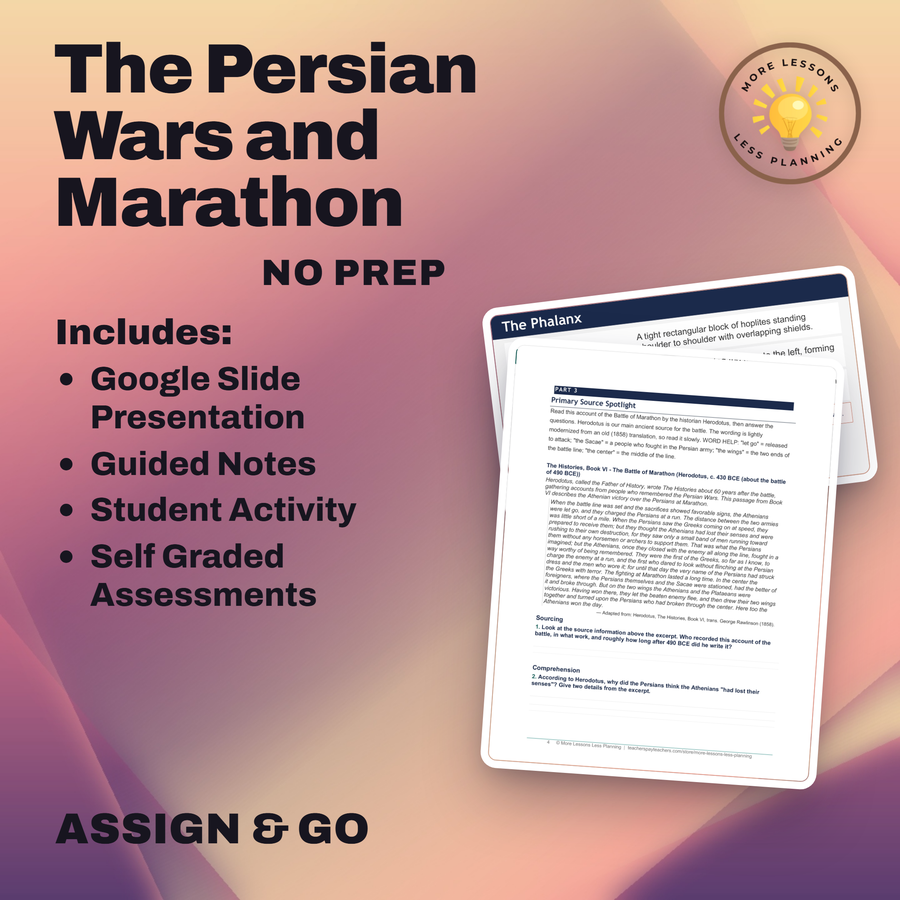
- Explain why Darius I invaded Greece in 490 BCE and how badly the Greeks were outnumbered at Marathon
- Describe how the hoplite phalanx fought and why Miltiades thinned the center to strengthen the wings
- Analyze why the Greeks charged the last stretch of the battlefield at a run instead of marching
- Separate Herodotus's real account of Pheidippides's run to Sparta from the later legend of a runner who died in Athens
What it covers
- Darius I's invasion and the roughly 10,000 Athenians and 1,000 Plataeans who met it at Marathon
- The hoplite phalanx and Miltiades's plan to thin the center and strengthen the wings
- Pheidippides's real 140-mile run to Sparta, as Herodotus actually records it
- The Soros, the burial mound over the 192 Athenian dead, still standing on the plain today
Learning targets
- Explain why the Persian Empire under Darius I invaded Greece and describe the forces that met at Marathon in 490 BCE.
- Describe how Athenian hoplites and the phalanx formation fought, and why the Greeks were badly outnumbered.
- Analyze Miltiades's battle plan - the strengthened wings and envelopment - and the swift charge that won the day.
- Explain why the victory at Marathon mattered for Greek independence and morale, and identify Herodotus as our main source.
Peek inside
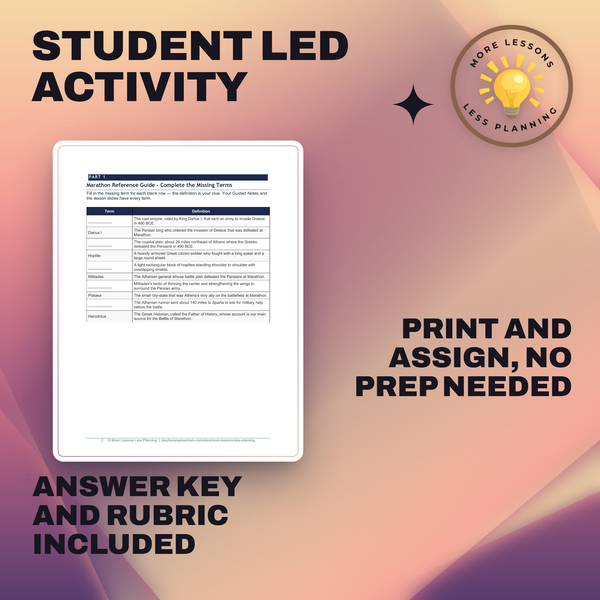
Persian Empire
The vast empire, ruled by King Darius I, that sent an army to invade Greece in 490 BCE.
Darius I
The Persian king who ordered the invasion of Greece that was defeated at Marathon.
Key Concept: The PERSIAN EMPIRE, ruled by DARIUS I, invaded Greece in 490 BCE to punish Athens.
The Invasion of 490 BCE
The PERSIAN EMPIRE was the largest and richest empire in the world, ruled by King Darius I, and it invaded Greece in BCE.
DARIUS I was the Persian king who ordered the invasion of Greece to Athens for helping the Ionian Greeks revolt.
1. Look at the source information above the excerpt. Who recorded this account of the battle, in what work, and roughly how long after 490 BCE did he write it?
Why this matters
The Soros, the burial mound holding Marathon's 192 Athenian dead, still stands on the plain today, from a battle where the whole Greek force numbered only about 10,000 Athenians and 1,000 Plataeans against a much larger invasion. A mound that old surviving into the present makes the risk feel less abstract than a casualty count alone.
Charging the final stretch at a run looks reckless until you consider what it protected against: every extra second in the open exposed the line to Persian archers, so speed was the safer choice, not the risky one. That inversion is worth slowing down for before moving on.
From one teacher to another
Every year at least one student brings up the runner who supposedly gasped "Victory!" and dropped dead in Athens, and every year I get to tell them that story isn't in Herodotus at all - his runner, Pheidippides, ran to Sparta for help before the battle, not to Athens after it. That correction sets up the real history: about 10,000 Athenians and 1,000 Plataeans facing down the largest empire on earth, saved by Miltiades's plan to thin his center and let the strengthened wings fold around the Persian line. Students work through why charging at a run actually protected the Greeks from Persian archers rather than exposing them, then read Herodotus's own account of the battle that kept Greece independent. It's a good lesson for teaching kids to separate a source from the legend that grew up around it.
Every file in this toolkit
Download
Where should I send the next one?
Everything here is free and it stays that way. Leave your email and I'll send you the new lessons as they go up. You can unsubscribe from any one of them.
Related resources
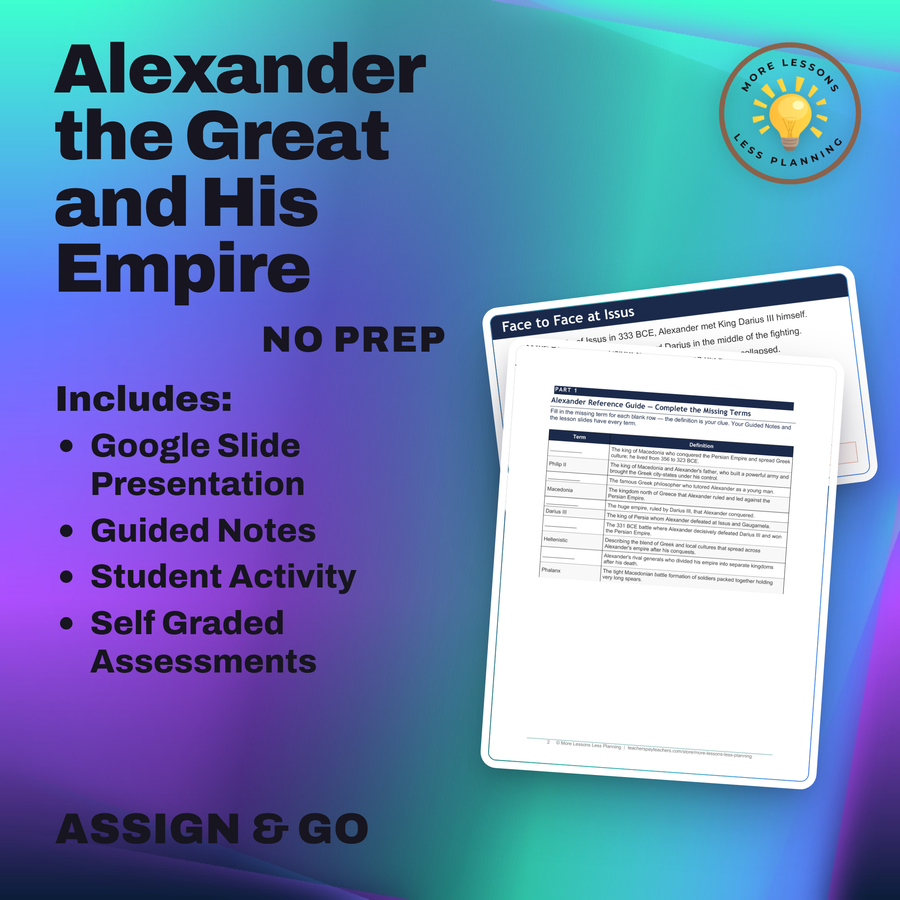
Alexander the Great and His Empire
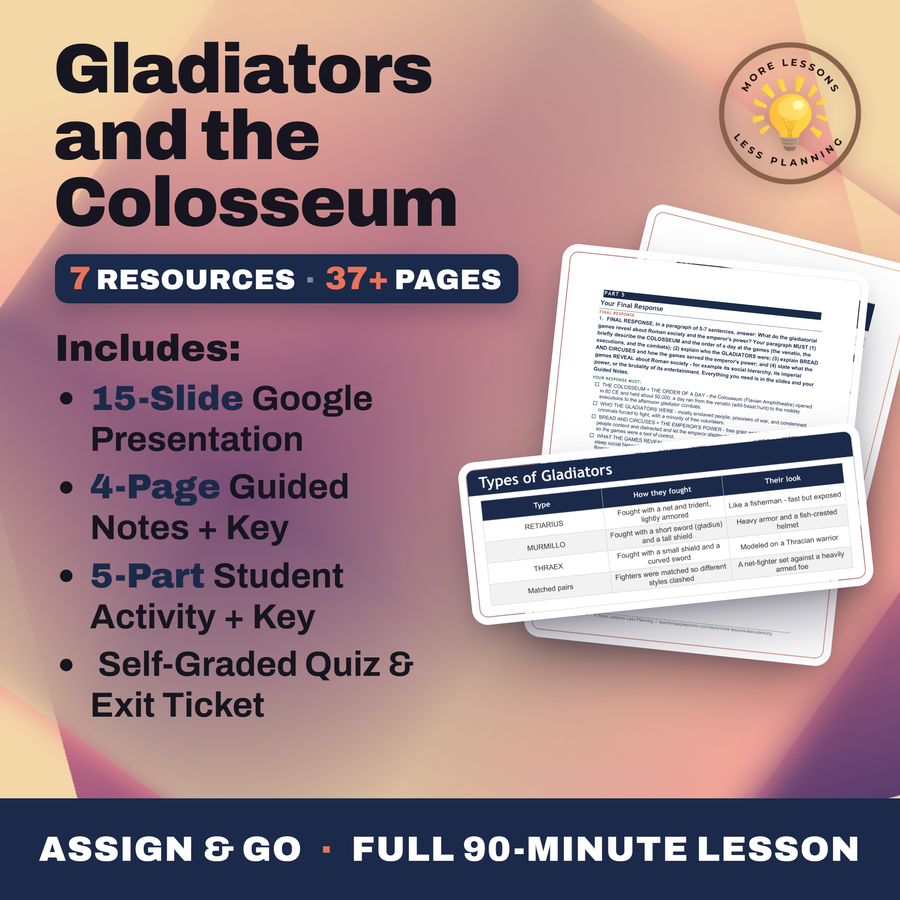
Gladiators and the Colosseum

Pompeii Frozen in Time
Socrates and the Trial of a Philosopher
The Fall of Rome
The Olympic Games of Ancient Greece
Every lesson on this site is free to download and use. If one of them saved you a prep period, you can chip in a few bucks toward my three kids' daycare fund. That's genuinely where tips go.