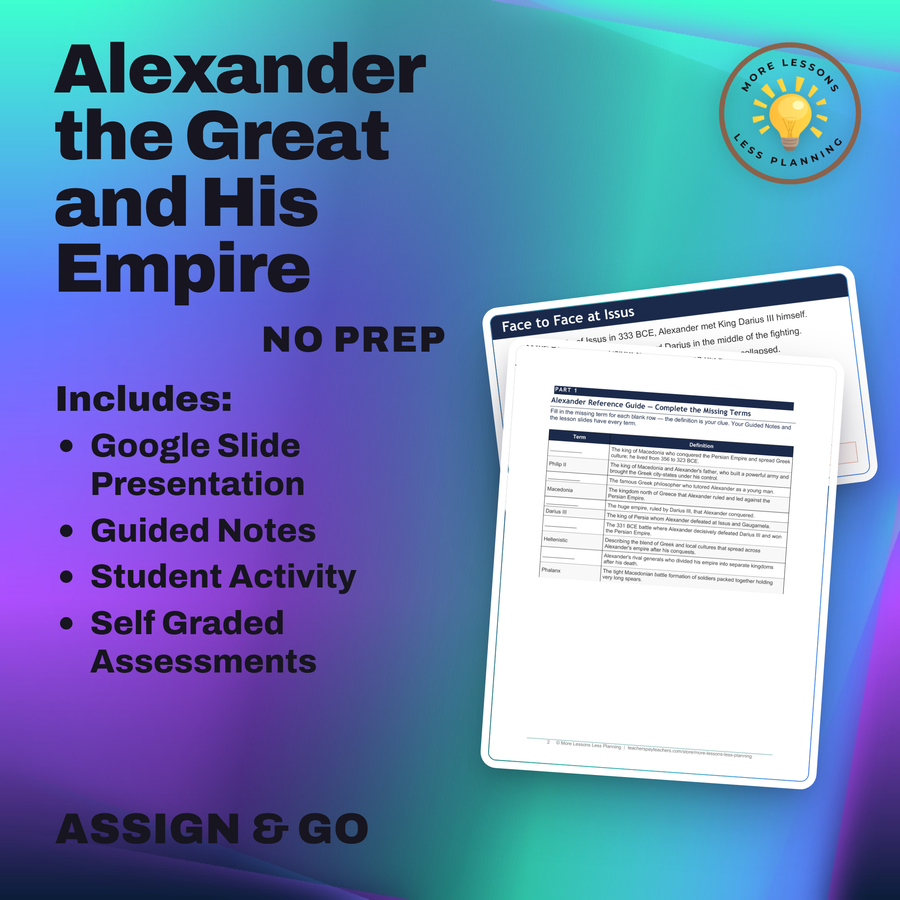

Alexander the Great and His Empire
Quality reviewed September 2026
- Subject
- World History
- Grades
- Grades 9-12
- Time
- About two 50-minute class periods
- Includes
- 11 ready-to-teach files
- Format
- Word (.docx) · PowerPoint (.pptx)
- Slide deck
- Guided notes
- Guided notes teacher key
- Activity + answer key
- Quiz + answer key
- Exit ticket + answer key
- Teacher guide
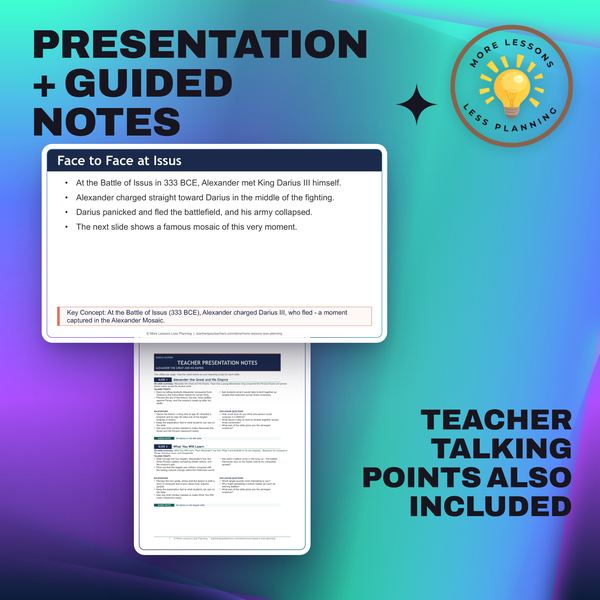
- Teacher presentation notes
What students do
- Sequence Alexander's conquest of Persia through Granicus, Issus, and Gaugamela before Darius III's empire falls
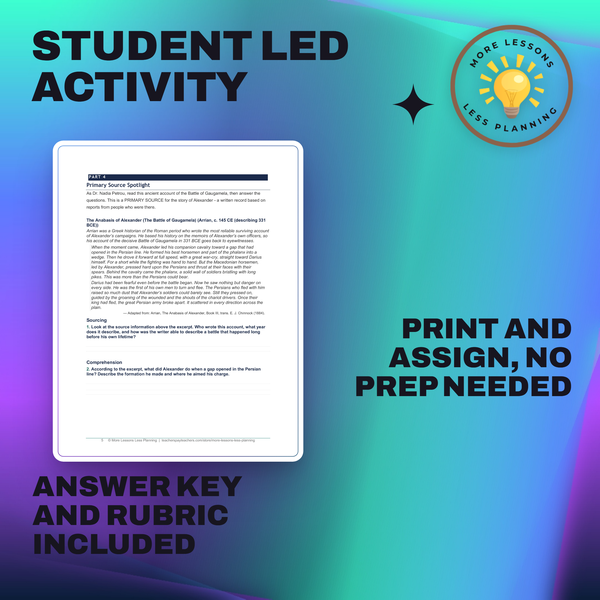
- Read Arrian's Anabasis account of Gaugamela and check it against what the Alexander Mosaic actually shows
- Fill in a reference guide on Philip II, Aristotle, and the phalanx before applying those terms to Alexander's rise
- Build an exhibit summary that has to name Alexander's empire, the Hellenistic spread, and the Diadochi split
What it covers
- The three battles, Granicus, Issus, and Gaugamela, that broke the Persian Empire's field armies one by one
- Arrian's Anabasis (trans. Chinnock, 1884) and its account of Darius fleeing at Gaugamela
- How Aristotle's tutoring and Philip II's army set up a 20-year-old king to inherit Macedonia
- Why the empire split among the Diadochi generals within years of Alexander's death at 32
Learning targets
- Trace Alexander's rise to power from his father Philip II and his tutor Aristotle to his own kingship of Macedonia.
- Sequence Alexander's conquest of the Persian Empire through the battles of Granicus, Issus, and Gaugamela.
- Explain how Alexander's conquests spread Greek culture and created the Hellenistic world.
- Describe how Alexander's empire fragmented after his death among his rival generals, the Diadochi.
Peek inside
✔
Macedonia
The kingdom north of Greece that Alexander ruled and led against Persia.
✔
Philip II
Why this matters
An empire built across three battles, Granicus, Issus, and then Gaugamela, fell apart within years of the king's death, split among his own generals instead of passing to an heir. That speed says something Alexander's conquests alone don't: winning territory and holding it turned out to be two entirely different skills.
The generals who carve up the empire within years of Alexander's death are not outside conquerors, they are the Diadochi he trained and trusted himself. An empire this large falling to insiders instead of enemies says more about succession planning than about the conquest that built it.
From one teacher to another
Every year I ask my students how old Alexander was when he died, and the guess is never close to 32, since he built one of the largest empires in history before some of my seniors' parents would even call him middle-aged. This lesson doesn't let that scale go unexamined: students read Arrian's account of the battle of Gaugamela, then hold it up against the Alexander Mosaic showing the same moment, checking where the ancient text and the ancient image actually agree. By the time they reach the reference guide on Philip II and Aristotle, they've already seen how fast one king's training can turn into an empire, and how fast an empire can fall apart once he's gone.
Every file in this toolkit
Download
Where should I send the next one?
Everything here is free and it stays that way. Leave your email and I'll send you the new lessons as they go up. You can unsubscribe from any one of them.
Related resources
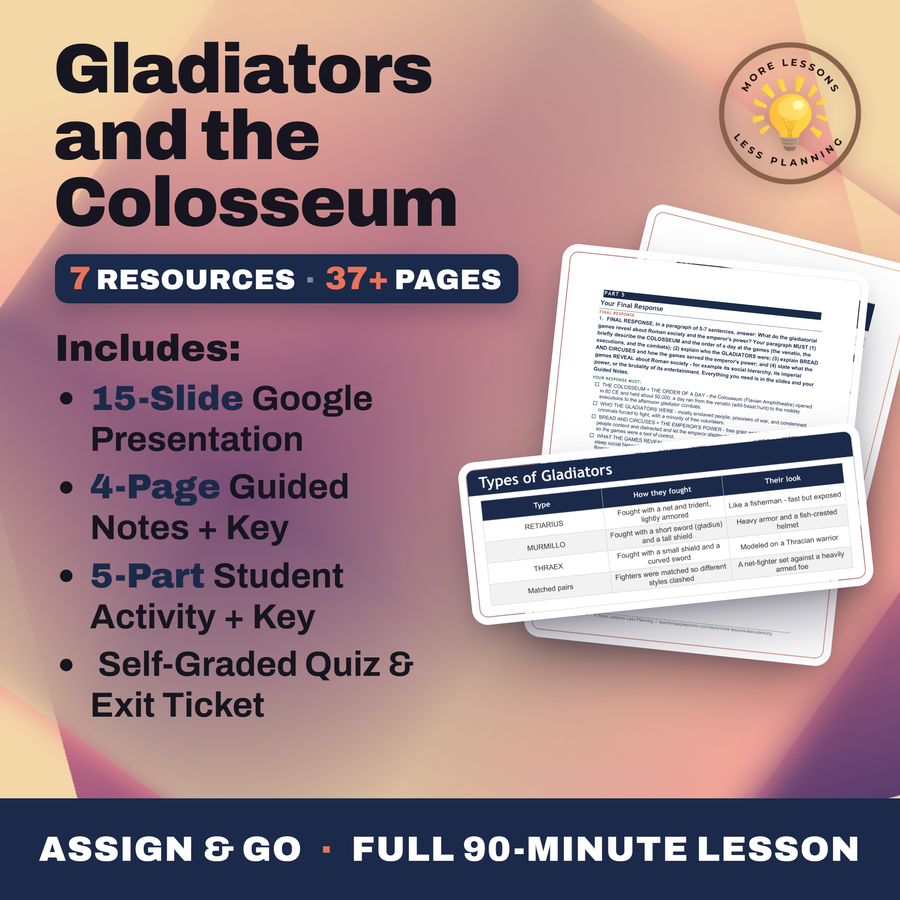
Gladiators and the Colosseum
Pompeii Frozen in Time
Socrates and the Trial of a Philosopher
The Fall of Rome
The Olympic Games of Ancient Greece
The Persian Wars and Marathon
Every lesson on this site is free to download and use. If one of them saved you a prep period, you can chip in a few bucks toward my three kids' daycare fund. That's genuinely where tips go.