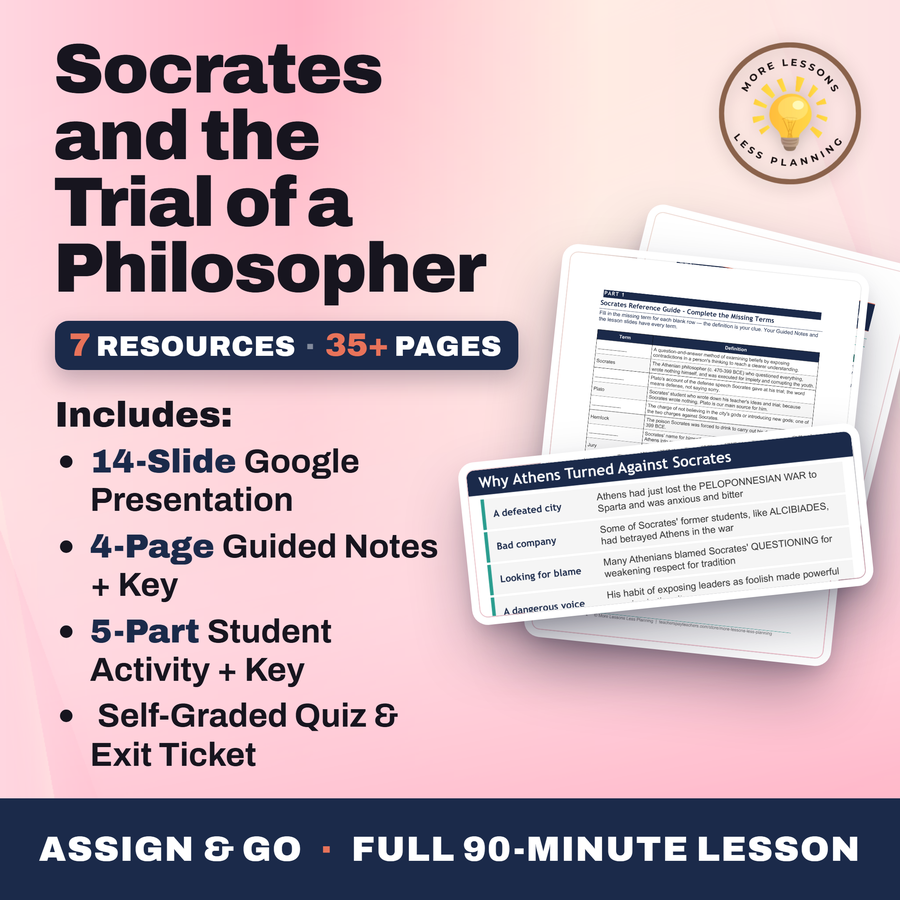
Socrates and the Trial of a Philosopher
Quality reviewed September 2026
- Subject
- World History
- Grades
- Grades 9-12
- Time
- About two 50-minute class periods
- Includes
- 11 ready-to-teach files
- Format
- Word (.docx) · PowerPoint (.pptx)
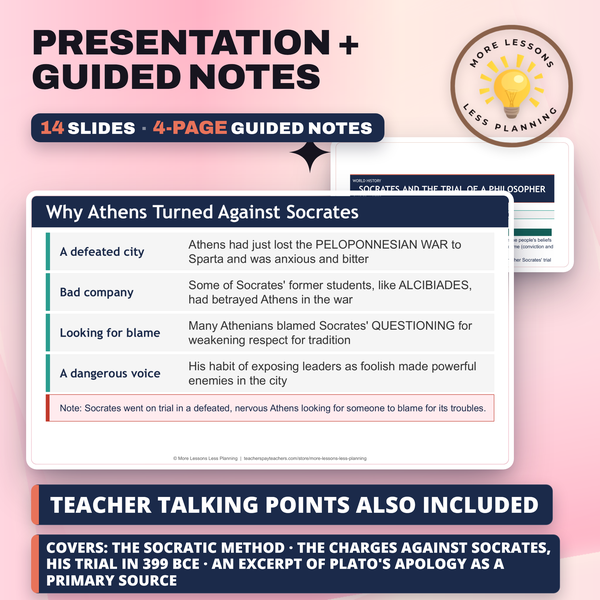
- Slide deck
- Guided notes
- Guided notes teacher key
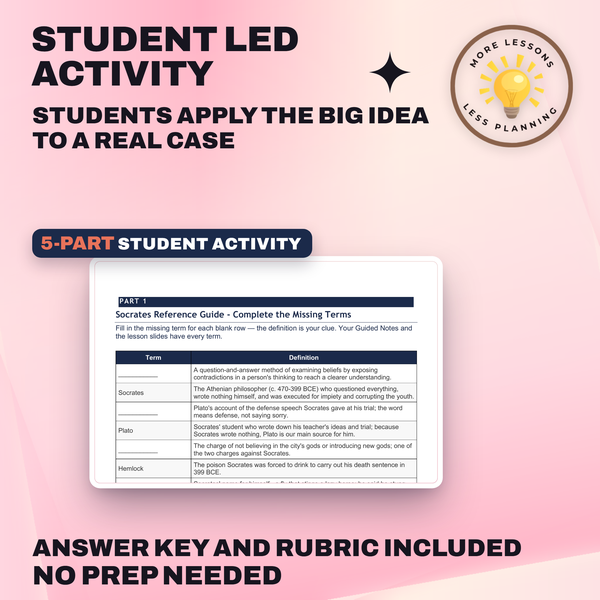
- Activity + answer key
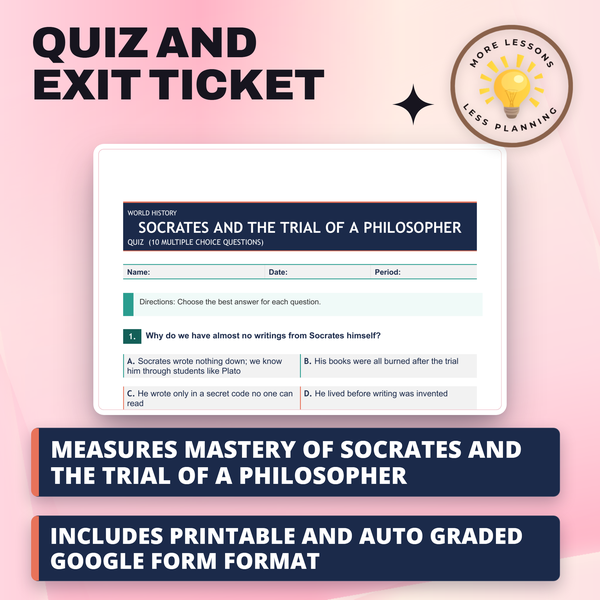
- Quiz + answer key
- Exit ticket + answer key
- Teacher guide
- Teacher presentation notes
What students do
- Practice the Socratic method by tracing how Socrates exposed contradictions in people's beliefs
- Read Plato's Apology and hear Socrates call himself Athens' gadfly in his own defense
- Explain the two charges, impiety and corrupting the youth, that sent him before a jury of 500
- Take a position on whether Socrates' trial and death sentence were just
What it covers
- The Socratic method, and why teaching by questions can make powerful people angry
- The two charges against Socrates and the jury of about 500 who convicted him
- Socrates' gadfly speech and his claim that the unexamined life is not worth living
- Why Socrates refused the safe exile his friends offered him and chose hemlock instead
Learning targets
- Explain the Socratic method and how Socrates used questioning to examine people's beliefs
- Describe the charges against Socrates, his trial in 399 BCE, and the outcome (conviction and execution by hemlock)
- Analyze an excerpt of Plato's Apology as a primary source and weigh whether Socrates' trial was just
Peek inside
The Man
SOCRATES was an Athenian PHILOSOPHER (c. 470-399 BCE)
PHILOSOPHY means the love of wisdom
A poor stonemason's son, not a rich noble
Went barefoot, questioning people in the marketplace
The Man and Our Source
SOCRATES was an Athenian who lived from about 470 to 399 BCE.
PHILOSOPHY means the love of - the search for truth about knowledge, values, and how to live.
Socrates himself wrote down; we know him through his students.
Our main source for Socrates is his student .
1. Who is speaking in this passage, and to whom is he speaking? How do we still have his words today, since Socrates wrote nothing himself?
Why this matters
A jury of about five hundred Athenians decided Socrates' fate, which means his execution wasn't one tyrant's call but a vote by ordinary citizens who felt threatened by a man who just asked questions. That scale changes what the trial is actually about: not a ruler silencing a critic, but a whole city choosing where free speech stops.
Running the Socratic method on my own class for a day usually produces at least one student who admits it's more frustrating to be questioned than lectured at, and that frustration is exactly what turned powerful Athenians against him in the first place.
From one teacher to another
Somebody in every class wants to know why anyone would choose death over just leaving town, and Socrates is the best answer I've got. I hand them the actual Apology, the gadfly speech and the unexamined-life line, so they hear him make his own case before they judge whether Athens was right to convict him. They walk through the Socratic method first, which usually gets a few of them fired up about how annoying constant questioning could get, and then the two charges make a lot more sense. It's a compact lesson, but weighing a real trial against a philosophy is exactly the kind of judgment call I want them practicing.
Every file in this toolkit
Download
Where should I send the next one?
Everything here is free and it stays that way. Leave your email and I'll send you the new lessons as they go up. You can unsubscribe from any one of them.
Related resources
Alexander the Great and His Empire
Gladiators and the Colosseum
Pompeii Frozen in Time
The Fall of Rome
The Olympic Games of Ancient Greece
The Persian Wars and Marathon
Every lesson on this site is free to download and use. If one of them saved you a prep period, you can chip in a few bucks toward my three kids' daycare fund. That's genuinely where tips go.