The Mongols and the Silk Road
Quality reviewed September 2026
- Subject
- World History
- Grades
- Grades 9-12
- Time
- About two 50-minute class periods
- Includes
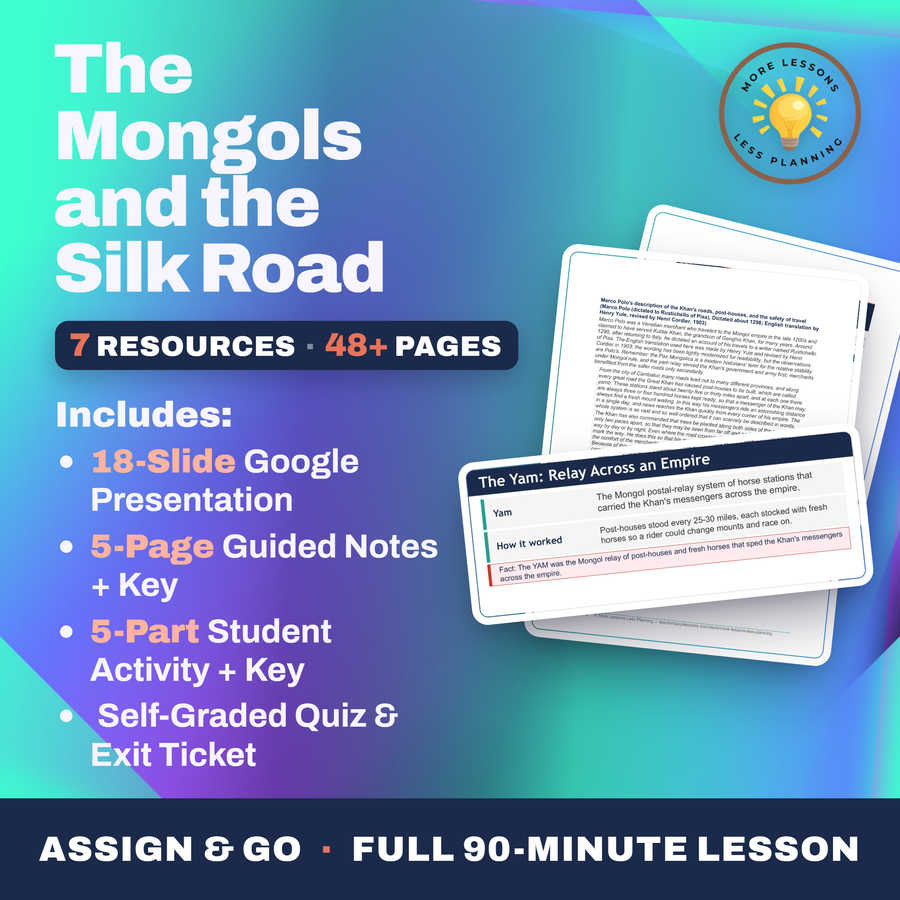
- 11 ready-to-teach files
- Format
- Word (.docx) · PowerPoint (.pptx)
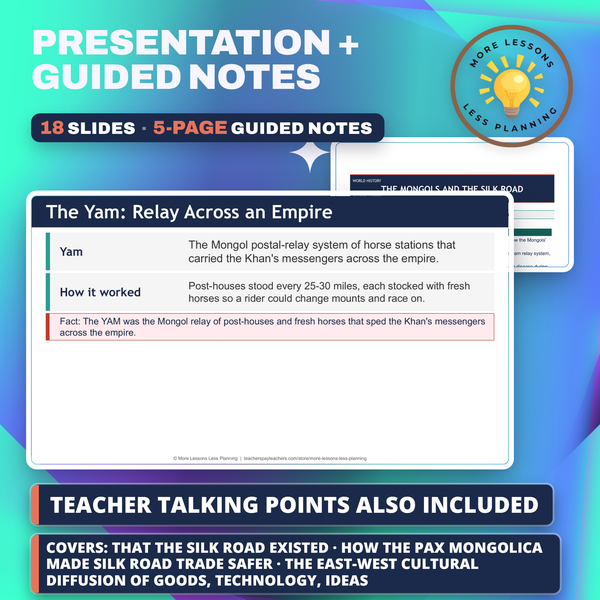
- Slide deck
- Guided notes
- Guided notes teacher key
- Activity + answer key
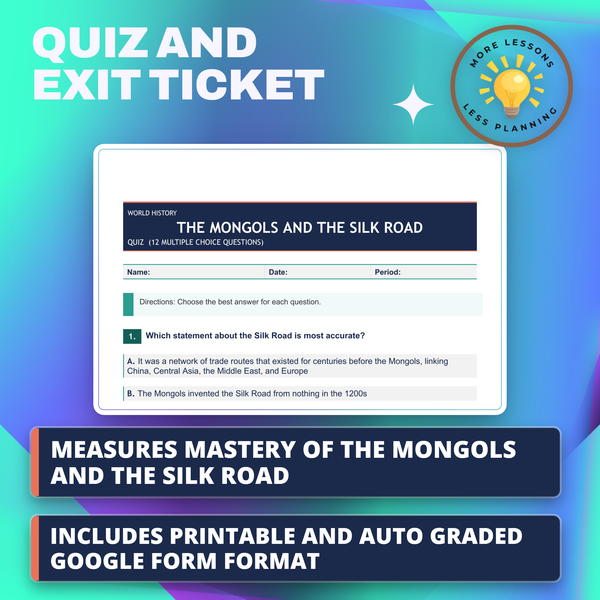
- Quiz + answer key
- Exit ticket + answer key
- Teacher guide
- Teacher presentation notes
What students do
- Explain that the Silk Road predates the Mongols, and how their contiguous empire put long stretches under one authority
- Describe the yam relay, the paiza passport, and marked roads, naming honestly who the yam served first
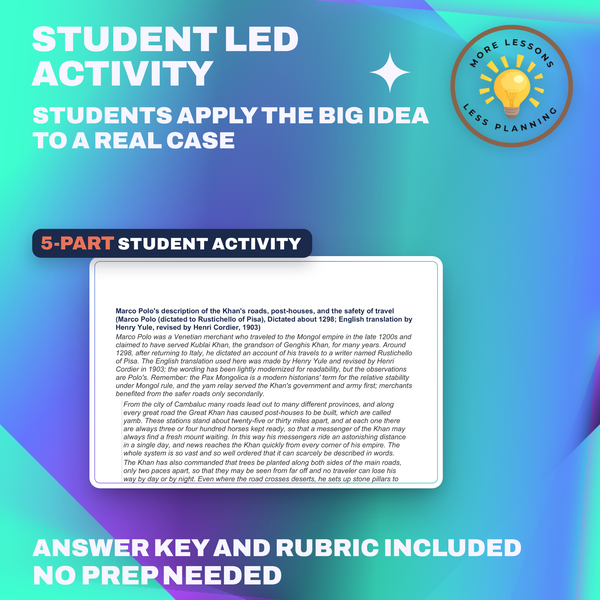
- Read Marco Polo's own description of the Khan's post-houses and evaluate him as an outside, secondhand-dictated source
- Write a research report weighing safer Silk Road trade against the conquest and disease the Pax Mongolica also carried
What it covers
- Why the Silk Road already existed for centuries before the Mongols, and what a contiguous empire actually changed
- The Pax Mongolica's real safety tools - the yam horse-relay, the paiza tablet of authority, and tree-lined marked roads
- Marco Polo's dictated 1298 account of the post-houses, read as a useful but debated outsider's source
- The honest double edge of the period - faster trade and cultural diffusion alongside conquest and the spread of the Black Death
Learning targets
- Explain that the Silk Road existed for centuries before the Mongols, and how the Mongols' contiguous empire placed long stretches of it under a single authority.
- Describe how the Pax Mongolica made Silk Road trade safer through the yam relay system, marked and patrolled roads, and the paiza passport.
- Trace the east-west cultural diffusion of goods, technology, ideas, and even disease during the Pax Mongolica, and weigh its benefits against the violence the empire was built on.
- Analyze a primary source, Marco Polo's description of travel and trade under Mongol rule, and explain what it can and cannot reliably tell us about the Silk Road.
Peek inside
The SILK ROAD was a network of overland trade routes across Asia and Europe.
It carried silk, spices, paper, and many other goods for centuries.
It existed long BEFORE the Mongols - traders used it under earlier empires.
Not one road but a web of routes across deserts, mountains, and oases.
Travel was slow and dangerous, crossing many rival kingdoms.
A Web of Routes, Not One Road
The SILK ROAD was a network of overland trade linking China, Central Asia, the Middle East, and Europe.
The Silk Road existed for centuries the Mongols; traders used it under many earlier empires.
1. Q1. What is the modern historians' term for the 'Mongol Peace' - the period when Mongol control made Silk Road trade across Eurasia safer?
Why this matters
Carrying a paiza tablet across the empire meant guaranteed food, shelter, and a fresh horse at the next station, no matter whose territory a traveler was crossing. That kind of infrastructure, not the road itself, is what the Pax Mongolica actually added to a trade network that already had centuries behind it.
Marco Polo's dictated account gives students a genuine primary source to test against that infrastructure, and I have them flag every claim that sounds like it came from a scribe filling in gaps rather than the traveler's own memory. Sourcing skills stick better on a text students already suspect than on one they are told to trust.
From one teacher to another
The first thing I correct in this lesson is the myth that the Mongols built the Silk Road, because they didn't, they made an already-ancient network safer by putting long stretches of it under one authority for the first time. From there students get specific about how that safety actually worked: the yam relay of horse stations every twenty-five to thirty miles, the paiza tablet that functioned as a passport, and roads lined with trees so no traveler could lose the way. I make them say out loud who the yam relay served first, because it's a natural student error to assume it was built for merchants when it was really built for the Khan's own messengers, with traders benefiting only as a side effect. Marco Polo's own dictated account carries the primary-source work, and I want students weighing him honestly, an outside Venetian observer who told his story to a scribe named Rustichello years after the fact, useful for the general picture but not for exact numbers. The lesson refuses to land on a clean verdict either way: the same roads that carried gunpowder and paper west also carried the Black Death, and the same empire that made trade safer was built on conquest that killed millions, so the closing report has to hold both of those truths at once.
Every file in this toolkit
Download
Where should I send the next one?
Everything here is free and it stays that way. Leave your email and I'll send you the new lessons as they go up. You can unsubscribe from any one of them.
Related resources
Feudalism and the Manor System
Genghis Khan and the Mongol Rise
Knights and Samurai
Knights and the Code of Chivalry
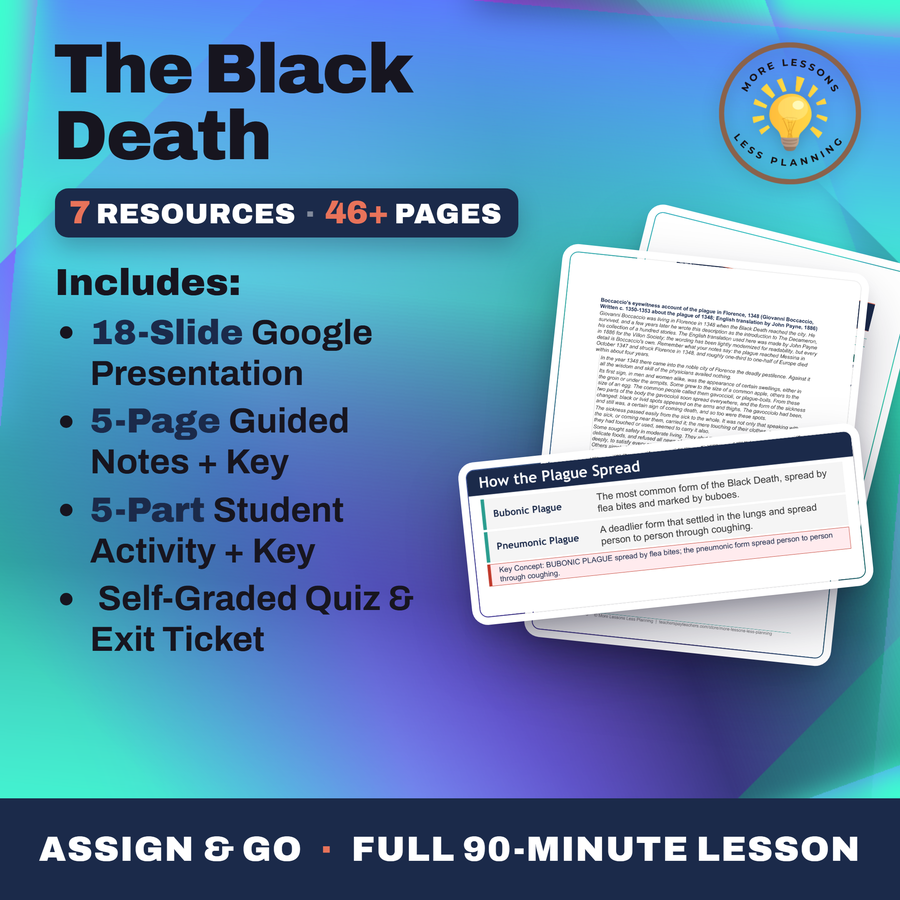
The Black Death
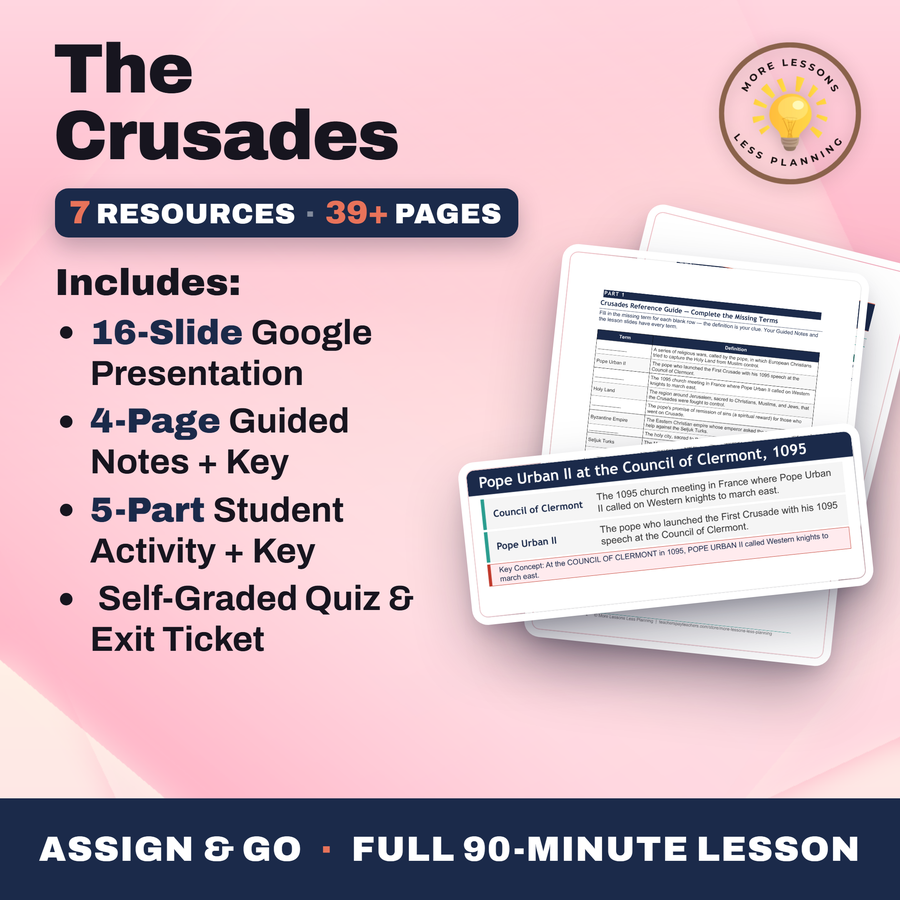
The Crusades
Every lesson on this site is free to download and use. If one of them saved you a prep period, you can chip in a few bucks toward my three kids' daycare fund. That's genuinely where tips go.