The Crusades
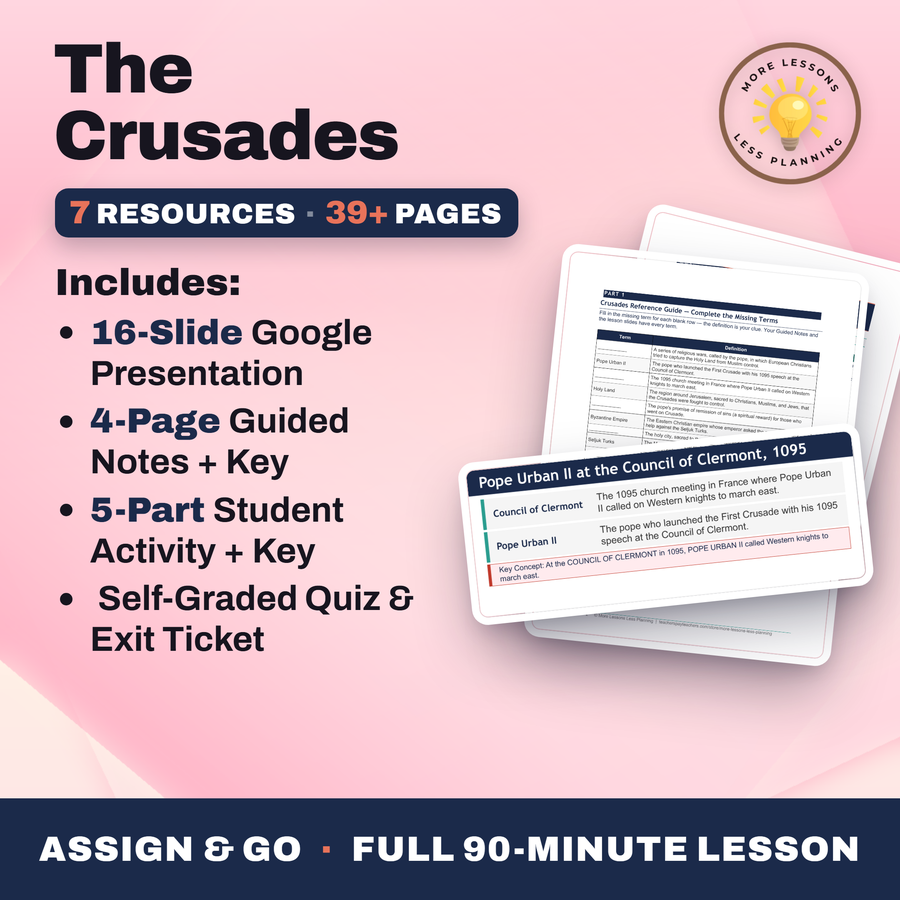
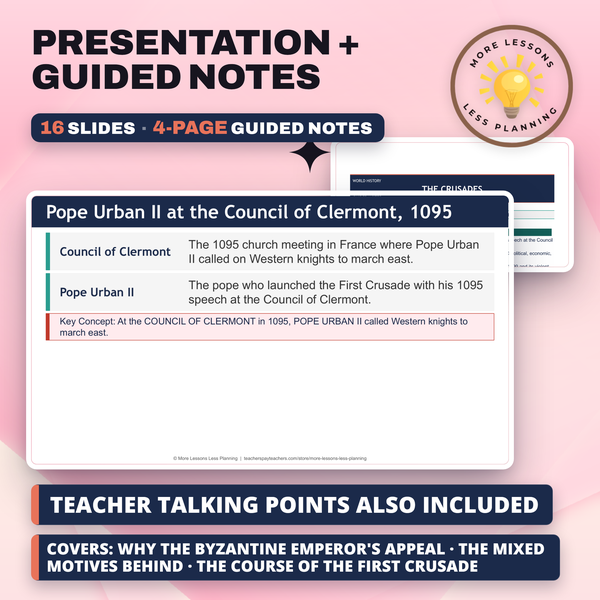
- Slide deck
- Guided notes
- Guided notes teacher key
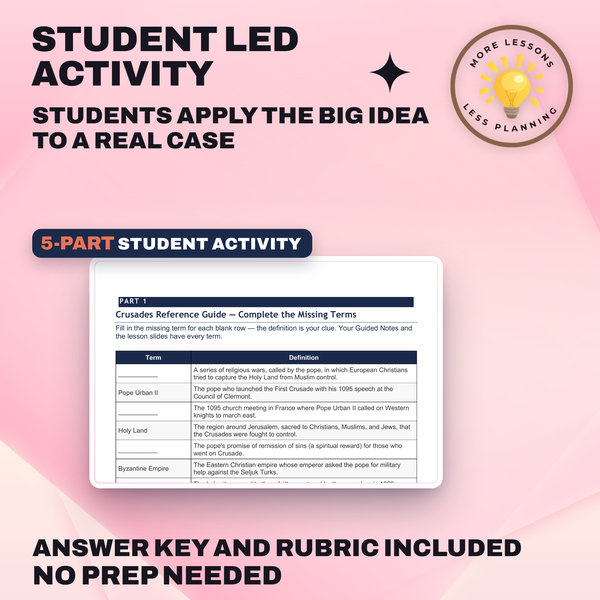
- Activity + answer key
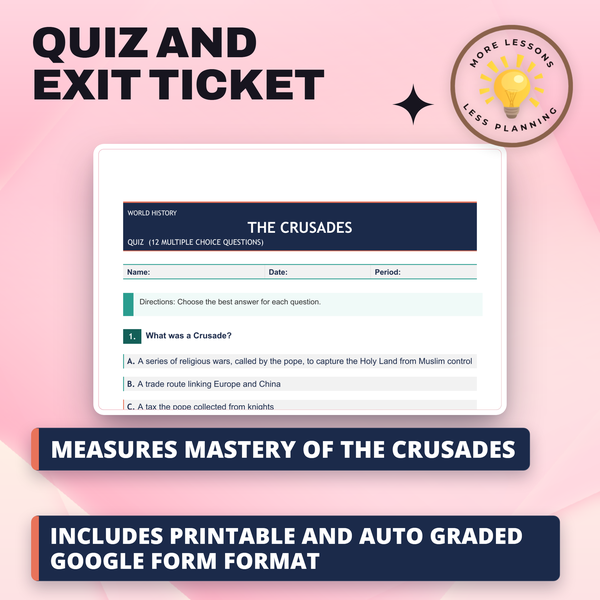
- Quiz + answer key
- Exit ticket + answer key
- Teacher guide
- Teacher presentation notes
Where should I send the next one?
Everything here is free and it stays that way. Leave your email and I'll send you the new lessons as they go up. You can unsubscribe from any one of them.
Every file in this toolkit
Related resources
Feudalism and the Manor System
Knights and Samurai
The Kamakura Shogunate
The Samurai Warrior Code
Aggression and Appeasement
Alliances and the Causes of WWI
What students do
- Explain how the Byzantine appeal for help and Urban II's 1095 Clermont speech launched the First Crusade
- Argue for the mixed motives behind the Crusades, weighing religious devotion against land, wealth, and political gain
- Trace the march to Jerusalem and its capture in 1099, including the massacre that followed
- Analyze Fulcher of Chartres's record of Urban's speech as a later reconstruction, not a word-for-word transcript
What it covers
- The indulgence Urban promised and the First Crusade framed as an armed pilgrimage
- The Seljuk Turks' rise and the Byzantine emperor's request that set the whole chain of events moving
- The 1096 Rhineland massacres alongside the 1099 Jerusalem massacre, as real costs of the Crusade
- Why no exact transcript of Urban's Clermont speech survives, and what that means for reading it as evidence
Learning targets
- Explain why the Byzantine emperor's appeal and Pope Urban II's 1095 speech at the Council of Clermont launched the First Crusade.
- Identify the mixed motives behind the Crusades - religious devotion AND political, economic, and social gain.
- Describe the course of the First Crusade to the capture of Jerusalem in 1099 and its violent consequences, including the 1099 Jerusalem massacre and the 1096 Rhineland massacres.
- Analyze a primary source - Fulcher of Chartres's record of Urban's speech - as a later reconstruction, not a word-for-word transcript, and use it as evidence of Crusade motives.
From one teacher to another
Before students get a clean narrative, I make them sit with an uncomfortable fact: nobody actually wrote down Urban II's speech at Clermont as he gave it, so every version we analyze, including this one, is a later reconstruction. That forces a real conversation about mixed motives, since the same students who accept religious devotion as a reason are often surprised by how much land and political power were also on the table. I don't soften the violence either, the Rhineland massacres and the fall of Jerusalem both get named directly, because a crusade lesson that skips the cost isn't teaching the whole event.
Every lesson on this site is free to download and use. If one of them saved you a prep period, you can chip in a few bucks toward my three kids' daycare fund. That's genuinely where tips go.