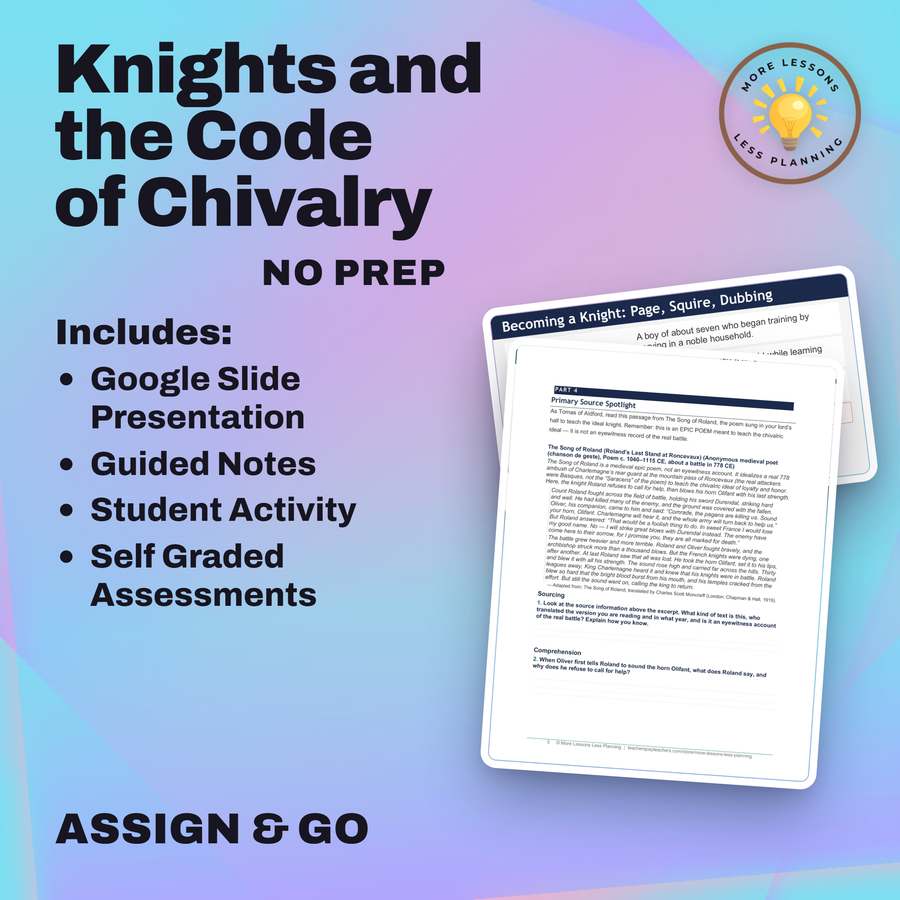

Knights and the Code of Chivalry
Quality reviewed September 2026
- Subject
- World History
- Grades
- Grades 9-12
- Time
- About two 50-minute class periods
- Includes
- 11 ready-to-teach files
- Format
- Word (.docx) · PowerPoint (.pptx)
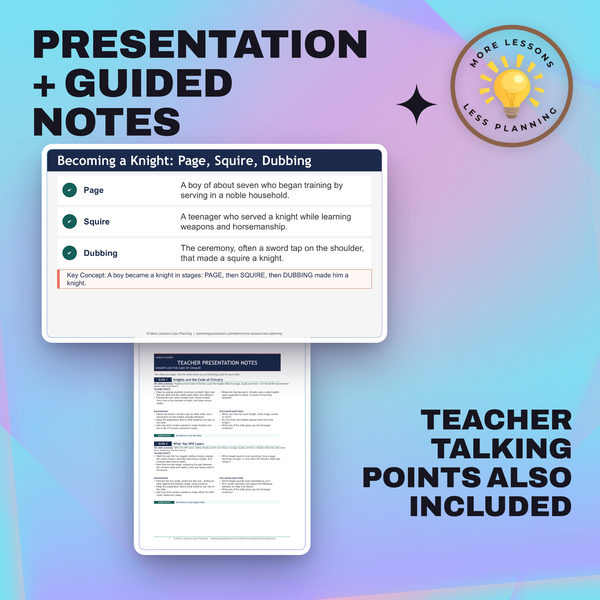
- Slide deck
- Guided notes
- Guided notes teacher key
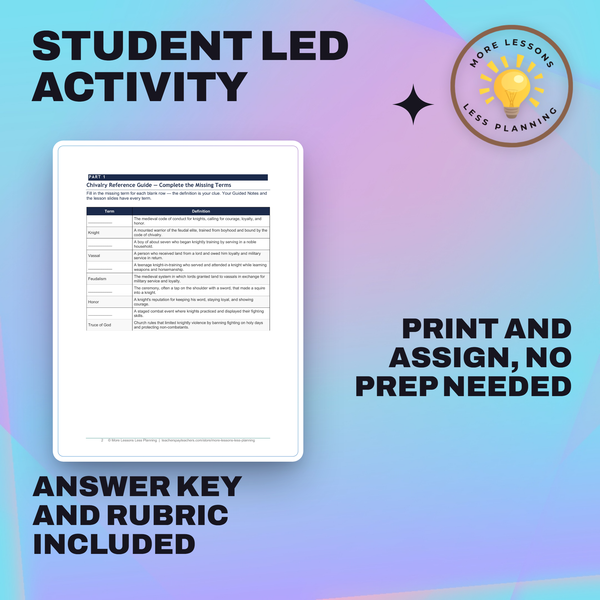
- Activity + answer key
- Quiz + answer key
- Exit ticket + answer key
- Teacher guide
- Teacher presentation notes
What students do
- Define chivalry and identify its core virtues of courage, loyalty, and honor
- Trace the path from page to squire to dubbing that turned a boy into a knight
- Read an excerpt from The Song of Roland and identify the chivalric ideal it teaches
- Compare that ideal to the messier reality of medieval warrior life, including knights who broke the code
What it covers
- Chivalry's core virtues and where the code came from, including feudal duty and the Church's Peace and Truce of God
- The stages of becoming a knight, from page to squire to dubbing
- The Song of Roland as a primary source for the chivalric ideal
- The gap between the chivalric ideal and the reality of medieval warrior life
Learning targets
- Define chivalry and identify its core virtues of courage, loyalty, and honor.
- Explain where the chivalric code came from, including feudal duty and the influence of the Church (the Peace and Truce of God).
- Describe how a boy became a knight through the stages of page, squire, and dubbing.
- Analyze the gap between the chivalric ideal and the messier reality of medieval warrior life, using a primary source.
Peek inside
The Knightly Code
CHIVALRY was the medieval code of conduct for knights, calling for courage, loyalty, and .
A KNIGHT was a mounted warrior of the feudal elite, trained from and bound by the code of chivalry.
1. What word names the medieval code of courage, loyalty, and honor that knights were supposed to follow?
Why this matters
Training men specifically for combat, then asking them to also be gentle, loyal, and honorable, is an odd combination that didn't hold on its own. The Church's Peace and Truce of God stepped in because feudal duty alone wasn't restraining armed men enough.
Singing The Song of Roland in a medieval hall wasn't entertainment the way a modern audience assumes, it was reinforcement, virtues repeated until future knights absorbed them. That only explains so much once students learn some knights broke the code anyway and pillaged the villages they were meant to protect.
From one teacher to another
I built this one around a persona instead of a lecture: students work through it as a squire training to earn his knighthood, moving from page at about age seven to squire to the day of dubbing. Along the way they define chivalry and its core virtues, courage, loyalty, and honor, and trace where the code actually came from, including feudal duty and the Church's Peace and Truce of God, which tried to limit the very fighting knights were trained for. The primary source is an excerpt from The Song of Roland, sung in medieval halls to teach the chivalric ideal, and students use it alongside what they've learned about real knights, some of whom broke the code and pillaged villages, to weigh the ideal against the reality. Guided notes track the slides, the activity comes with a full answer key, and the quiz and exit ticket both include keys.
Every file in this toolkit
Download
Where should I send the next one?
Everything here is free and it stays that way. Leave your email and I'll send you the new lessons as they go up. You can unsubscribe from any one of them.
Related resources

Feudalism and the Manor System

Genghis Khan and the Mongol Rise
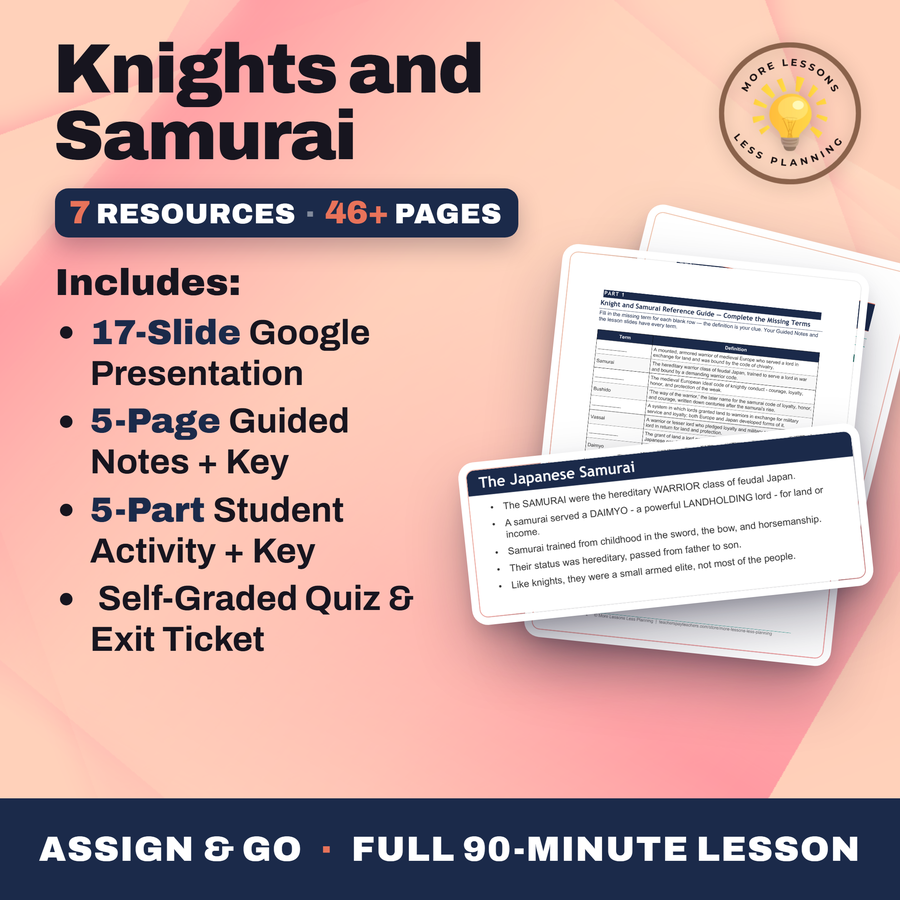
Knights and Samurai
The Black Death
The Crusades

The Kamakura Shogunate
Every lesson on this site is free to download and use. If one of them saved you a prep period, you can chip in a few bucks toward my three kids' daycare fund. That's genuinely where tips go.