The Middle Passage
Quality reviewed September 2026
- Grades
- Grades 9-12
- Time
- About two 50-minute class periods
- Includes
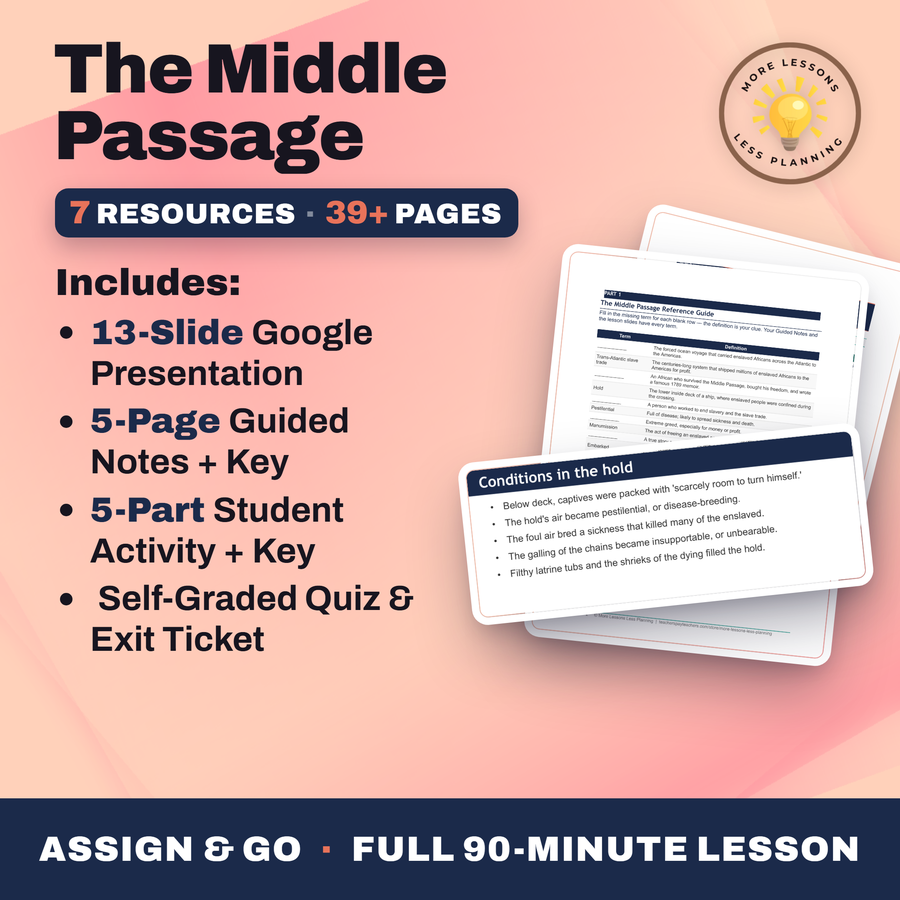
- 11 ready-to-teach files
- Format
- Word (.docx) · PowerPoint (.pptx)
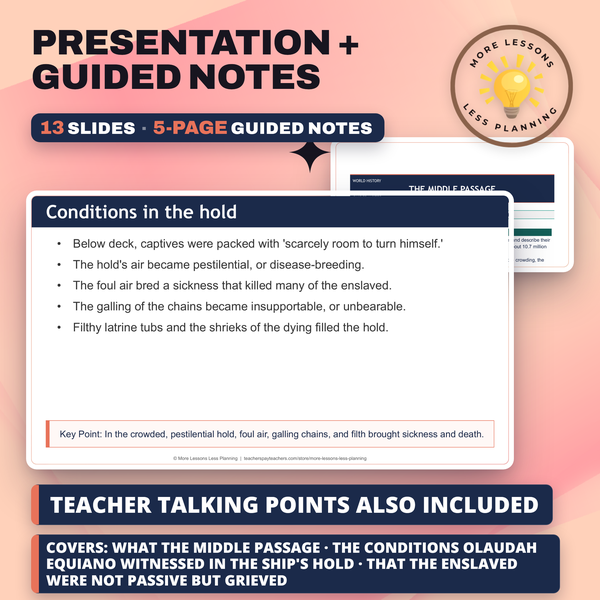
- Slide deck
- Guided notes
- Guided notes teacher key
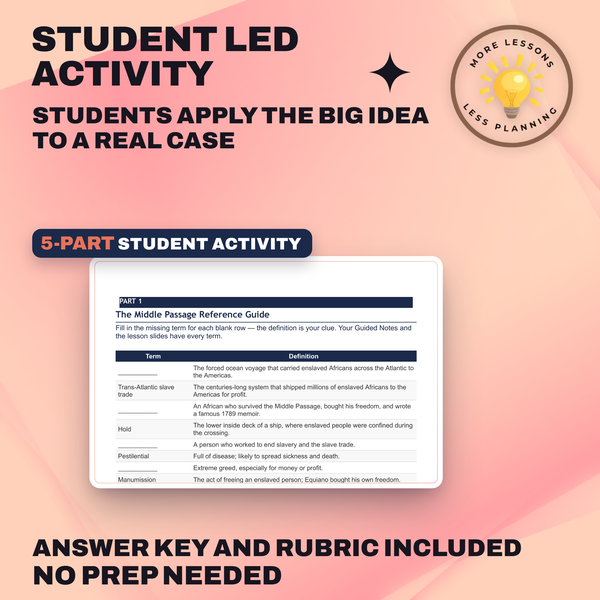
- Activity + answer key
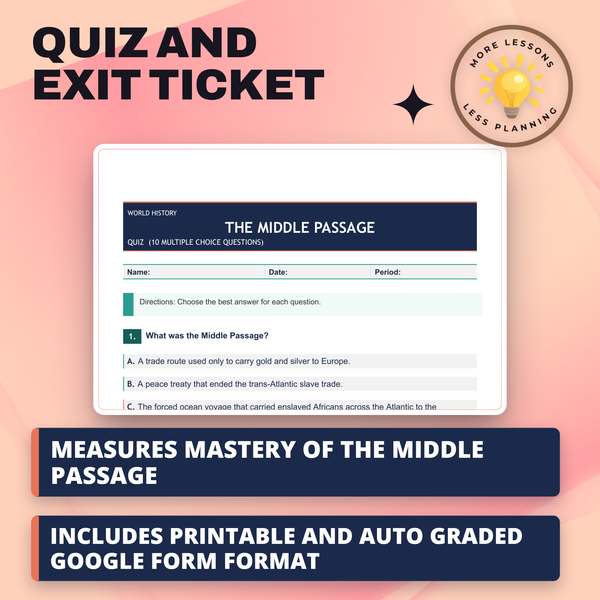
- Quiz + answer key
- Exit ticket + answer key
- Teacher guide
- Teacher presentation notes
What students do
- State the trade's scale using the estimate that about 12.5 million Africans were shipped and about 10.7 million survived
- Read Equiano's own 1789 account of the ship's hold and answer sourcing, comprehension, and analysis questions on it
- Test four claims about the trade against the lesson's evidence, marking each supported or unsupported
- Write a historical account defining the Middle Passage, citing Equiano's testimony, and showing the enslaved were not passive
What it covers
- The trade's scale, using the estimate that about 12.5 million Africans were shipped and about 10.7 million survived
- Olaudah Equiano's own 1789 account of conditions in the ship's hold
- Testing four claims about the trade against the lesson's evidence, marked supported or unsupported
- Equiano's account of resistance, chained men leaping overboard, as evidence against the idea of passivity
Learning targets
- Explain what the Middle Passage and the trans-Atlantic slave trade were, and describe their scale using the estimate that about 12.5 million Africans were shipped and about 10.7 million survived the crossing.
- Describe the conditions Olaudah Equiano witnessed in the ship's hold - the crowding, the pestilential air, the galling chains, and the sickness that killed many.
- Explain that the enslaved were not passive but grieved and resisted, and that Equiano wrote as a first-person survivor and abolitionist.
Peek inside
The Middle Passage was the forced ocean voyage from Africa to the Americas.
It was part of the trans-Atlantic slave trade, a system run for profit.
About 12.5 million Africans were forced aboard slave ships.
About 10.7 million survived the Middle Passage; the rest died.
This was one of the largest forced migrations in all of history.
1. The forced ocean voyage that carried enslaved Africans across the Atlantic to the Americas was the .
Why this matters
Equiano describes chained men leaping overboard rather than stay enslaved, a detail that argues against passivity more forcefully than any summary could. His hold was so crowded, in his own words, that each person had scarcely room to turn himself, and that single sentence carries more weight than the estimate of twelve and a half million people shipped.
Numbers alone can make the trade sound abstract, so this lesson anchors itself in Equiano's own language instead of a secondhand paraphrase. Letting a survivor's account carry both the resistance and the suffering means students meet the Middle Passage as something that happened to specific people, not a statistic to memorize.
From one teacher to another
This lesson is built around a single decision: let Olaudah Equiano's own words carry the history, not a secondhand summary of them. Students read his 1789 memoir directly, the hold so crowded each person had "scarcely room to turn himself," and work out from the text itself why he calls the deaths a result of the purchasers' "improvident avarice" rather than bad luck. I keep the scale in front of them the whole time too, about 12.5 million Africans forced aboard slave ships and about 10.7 million surviving the crossing, because a claim-testing activity in Part 3 asks them to weigh whether calling the trade a marginal event holds up against that number. The other correction I care about is resistance: Equiano's account records chained men leaping overboard rather than stay enslaved, and students have to use that detail directly to counter the idea that the enslaved were passive. Everything here stays in Equiano's documentary voice and sourced to his own memoir, since the point is to let a survivor's testimony do the teaching.
Every file in this toolkit
Download
Where should I send the next one?
Everything here is free and it stays that way. Leave your email and I'll send you the new lessons as they go up. You can unsubscribe from any one of them.
Related resources
Columbus's Voyage to the Americas
Las Casas - A Voice Against Conquest
Magellan and the First Voyage Around the World
Prince Henry the Navigator
The Capture of Atahualpa
The Columbian Exchange
Every lesson on this site is free to download and use. If one of them saved you a prep period, you can chip in a few bucks toward my three kids' daycare fund. That's genuinely where tips go.