The Columbian Exchange
Quality reviewed September 2026
- Grades
- Grades 9-12
- Time
- About two 50-minute class periods
- Includes
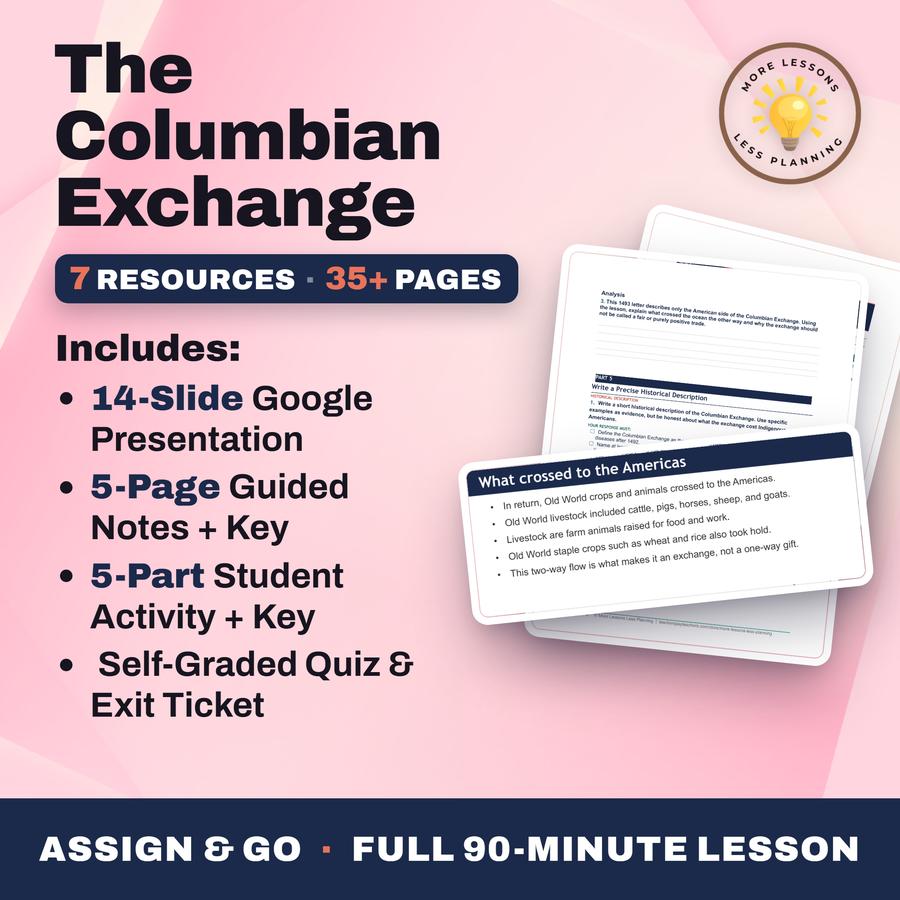
- 11 ready-to-teach files
- Format
- Word (.docx) · PowerPoint (.pptx)
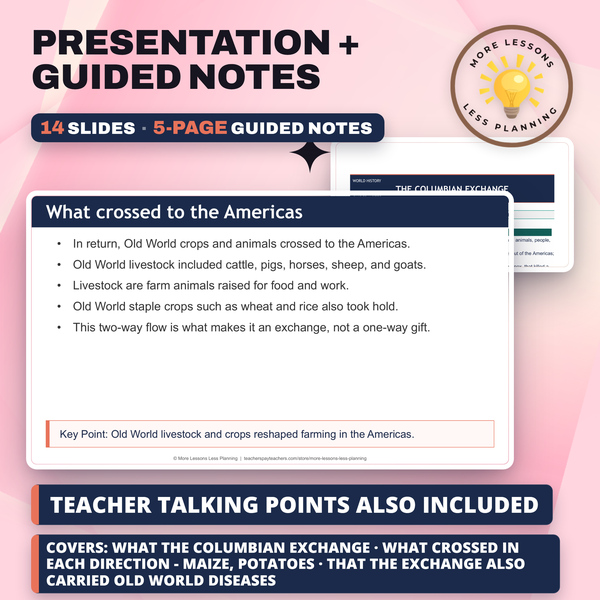
- Slide deck
- Guided notes
- Guided notes teacher key
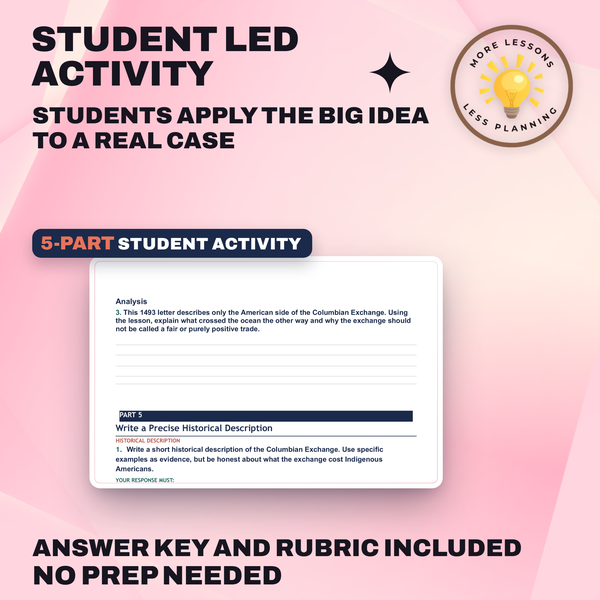
- Activity + answer key
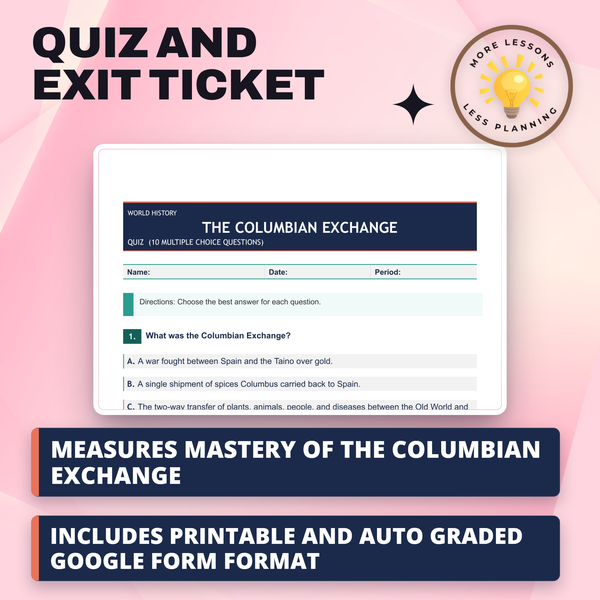
- Quiz + answer key
- Exit ticket + answer key
- Teacher guide
- Teacher presentation notes
What students do
- Define the Columbian Exchange as the two-way movement of plants, animals, people, and diseases after 1492
- Read Columbus's 1493 letter and identify what he described from the American side of the exchange
- Test the claim that the exchange was a "fair swap" against smallpox's toll on Indigenous Americans
- Write a historical description that names items that crossed each direction and states plainly that the exchange was not fair
What it covers
- What moved from the Americas outward (maize, potatoes, tomatoes) versus what came in from the Old World (livestock, wheat)
- Smallpox and other Old World diseases as the deadliest part of the exchange for Indigenous Americans
- Core vocabulary: Columbian Exchange, Taino, staple crop, livestock, epidemic, Old World, New World
- Columbus's 1493 letter to Luis de Santangel describing Hispaniola, read alongside a comparison table testing common claims
Learning targets
- Explain what the Columbian Exchange was: the two-way transfer of plants, animals, people, and diseases between the Old World and the New World after 1492.
- Describe what crossed in each direction - maize, potatoes, and tomatoes out of the Americas; Old World livestock and crops back into the Americas.
- Explain that the exchange also carried Old World diseases, above all smallpox, that killed a huge share of Indigenous Americans, so the exchange was never fair, even, or purely positive.
Peek inside
The two-way idea
After 1492, the Exchange moved foods, animals, people, and diseases between the Old and New Worlds.
The exchange moved in directions across the Atlantic, not just one.
The World was the Americas; the Old World was Europe, Africa, and Asia.
1. The two-way movement of foods, animals, and diseases between the Old World and the New World after 1492 is called the .
Why this matters
Maize and potatoes leaving the Americas sound like a footnote next to smallpox arriving from the opposite direction, and that imbalance is the whole point of this reading. Columbus wrote home about rivers and gold in 1493 without a word about the disease that went on to kill a huge share of the people he had just met.
Fair and unfair are grading words, not historical categories, and forcing a choice anyway is the point of the closing task. Students hold Columbus's own excited letter next to the epidemic he never mentioned and decide which side of the ledger actually weighs more, right after a unit that made discovery sound simple.
From one teacher to another
I built this one specifically to push back on the "fair trade" version of the Columbian Exchange that students sometimes pick up from a quick summary. They read part of Columbus's actual 1493 letter announcing what he'd found - the rivers, the trees, the gold - and then have to test that glowing account against the fuller record, including the part the letter never mentions: smallpox and other Old World diseases killing a huge share of the Indigenous population. Students also work through what moved which direction, since it's genuinely two-way (American crops like maize and potatoes went out, European livestock and wheat came in), and the lesson ends with them writing a short historical description that has to include the disease catastrophe and state plainly that the exchange wasn't even or fair. It's a solid fit right after an Age of Exploration lesson, since it complicates whatever version of "discovery" came before it.
Every file in this toolkit
Download
Where should I send the next one?
Everything here is free and it stays that way. Leave your email and I'll send you the new lessons as they go up. You can unsubscribe from any one of them.
Related resources
Columbus's Voyage to the Americas
Las Casas - A Voice Against Conquest
Magellan and the First Voyage Around the World
Prince Henry the Navigator
The Capture of Atahualpa
The Encomienda System and Spanish Colonial Control
Every lesson on this site is free to download and use. If one of them saved you a prep period, you can chip in a few bucks toward my three kids' daycare fund. That's genuinely where tips go.