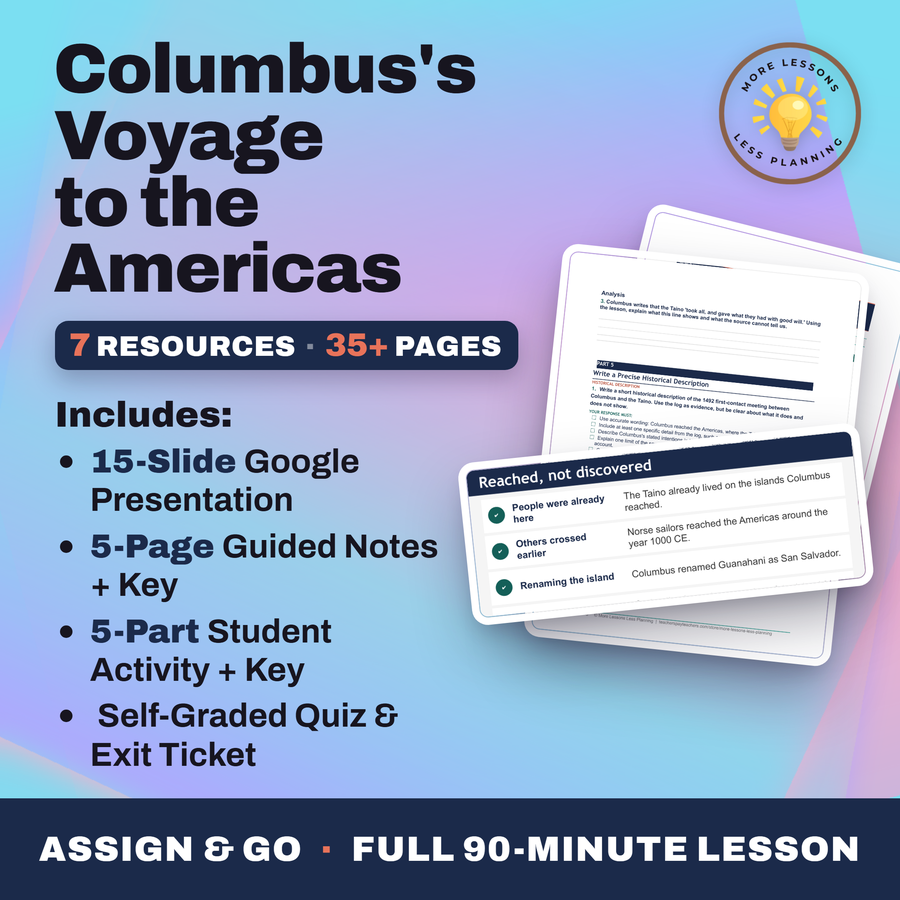
Columbus's Voyage to the Americas
Quality reviewed September 2026
- Grades
- Grades 9-12
- Time
- About two 50-minute class periods
- Includes
- 11 ready-to-teach files
- Format
- Word (.docx) · PowerPoint (.pptx)
- Slide deck
- Guided notes
- Guided notes teacher key
- Activity + answer key
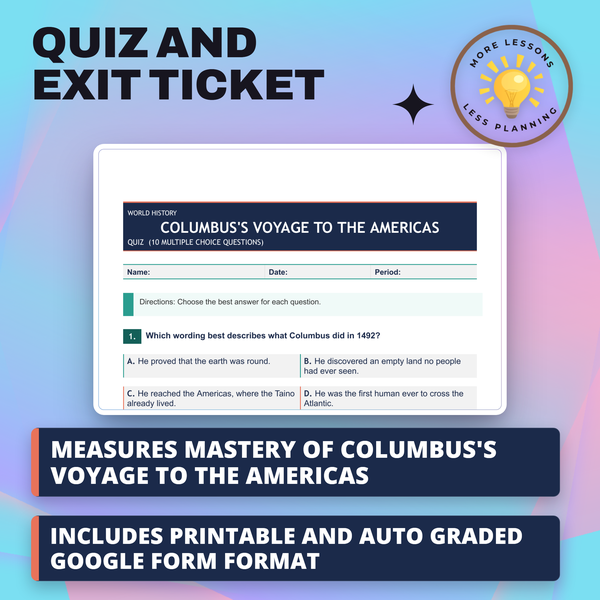
- Quiz + answer key
- Exit ticket + answer key
- Teacher guide
- Teacher presentation notes
What students do
- Learn the vocabulary of the voyage, including ship's log, barter, and royal standard, from Columbus's own record
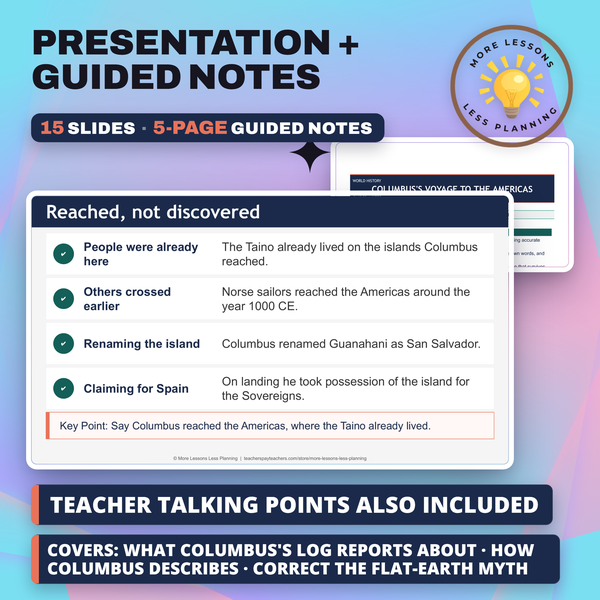
- Test familiar claims about Columbus, including "he discovered America" and "he proved the earth was round," against what the log actually supports
- Read Columbus's 1492 log entry describing first contact with the Taino and identify what goods each side exchanged
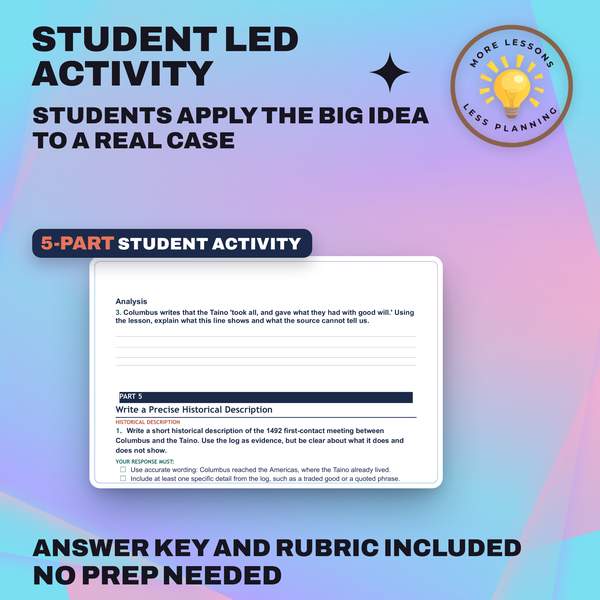
- Write a precise historical description of the encounter that names at least one limit of the source, such as its one-sided view or the lost original
What it covers
- Vocabulary from the voyage itself: ship's log, the Sovereigns, the Taino, barter, and the royal standard
- A side-by-side test of popular claims about Columbus against what the historical record actually supports
- A primary source excerpt from Columbus's own log (the Las Casas abstract, 1893 translation) describing first contact with the Taino, with sourcing, comprehension, and analysis questions
- Writing a source-aware historical description instead of repeating an unexamined claim
Learning targets
- Explain what Columbus's log reports about the voyage and first contact, using accurate wording: he reached the Americas, where the Taino already lived.
- Analyze how Columbus describes the Taino and his own intentions in his own words, and identify what the source leaves out.
- Correct the flat-earth myth and explain the log's limits as a one-sided source that survives only as a later abstract.
Peek inside
The fleet left Spain on Friday, August 3, 1492, from the bar of Saltes.
It sailed west across the Atlantic for weeks.
Land was sighted two hours after midnight on October 12, 1492.
Rodrigo de Triana was the first to see land.
The log records these facts in the admiral's daily entries.
Voyage facts
In 1492, the fleet left Spain on August from the bar of Saltes.
After weeks at sea, land was first sighted on October in 1492.
Rodrigo de was the first to see land.
1. Columbus kept a daily that recorded each day of the voyage.
Why this matters
Two sentences about Columbus get repeated so often that they start to sound like settled fact: that he discovered America and that he proved the earth was round. Neither survives contact with his own log, which is exactly the kind of gap between reputation and record this reading is built to expose.
Checking a famous reputation against the actual record is a skill students keep long after the Columbus details fade. Once students see that a copy of a copy of his log still counts as evidence, with real limits attached, they start reading every other source in the course more carefully.
From one teacher to another
I built this lesson to make students slow down on a story they think they already know. The guided notes teach the actual vocabulary of the voyage - what a ship's log is, what barter looked like, what planting the royal standard meant - and then the activity tests four familiar claims, like "Columbus discovered America" and "Columbus proved the earth was round," against what the record can actually support. The primary source is Columbus's own log entry describing the first meeting with the Taino, and I keep reminding students it survives only as a later copy and records only his side. The closing task has them write a short historical description of that meeting using the log as evidence, while naming at least one real limit of the source. Guided notes, activity, quiz, and exit ticket all come with answer keys, along with a teacher guide.
Every file in this toolkit
Download
Where should I send the next one?
Everything here is free and it stays that way. Leave your email and I'll send you the new lessons as they go up. You can unsubscribe from any one of them.
Related resources
Las Casas - A Voice Against Conquest
Magellan and the First Voyage Around the World
Prince Henry the Navigator
The Capture of Atahualpa
The Columbian Exchange
The Encomienda System and Spanish Colonial Control
Every lesson on this site is free to download and use. If one of them saved you a prep period, you can chip in a few bucks toward my three kids' daycare fund. That's genuinely where tips go.