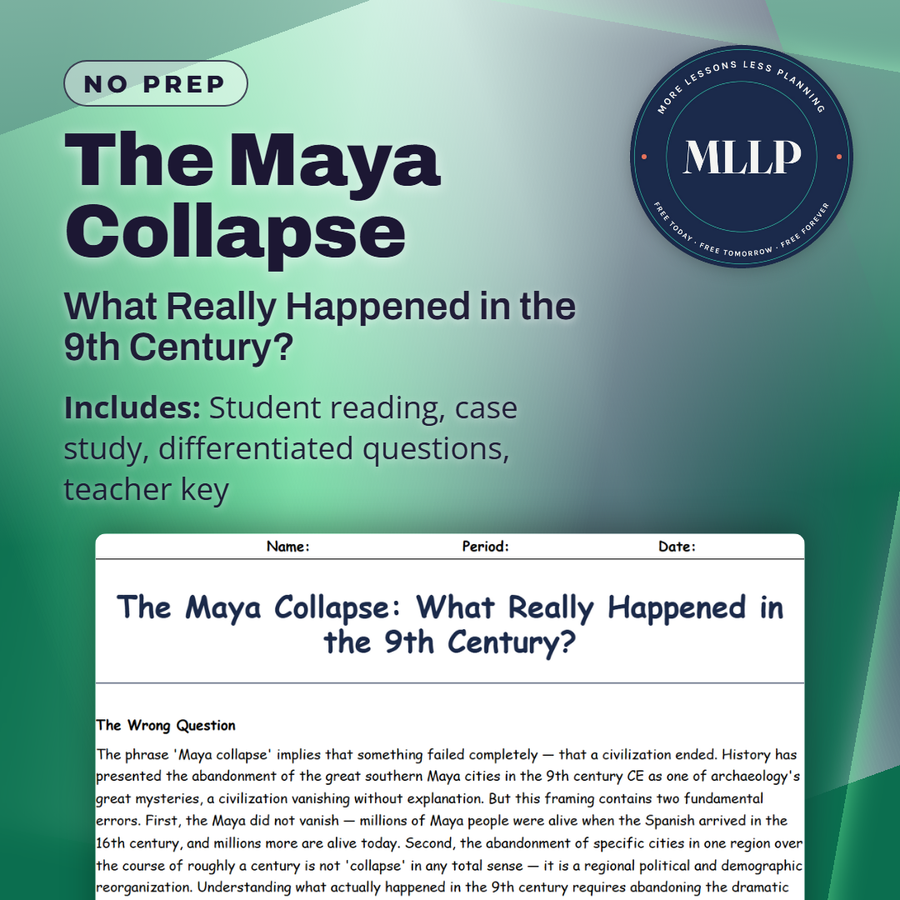
The Maya Collapse: What Really Happened in the 9th Century?
Quality reviewed September 2026
Facts verified September 21, 2026
- Subject
- Social Studies
- Grades
- Grades 9-12
- Length
- 8-page student worksheet
- Time
- About one 50-minute class period
- Great for
- Sub plans and independent work
- Includes
- Reading passage, comprehension questions + full answer key
- Format
- Print-and-go PDF
What students do
- Drought, warfare, and migration evidence for the 9th-century decline get sorted by what each type of evidence actually shows
- Explain why population growth in the northern Yucatan during this period counts as evidence against a true collapse
- The connection between deforestation and worsening drought gets traced through the reading's own explanation
- Answer short-answer questions on Lady Ix Chak's decision to migrate and what it says about her family's choices
What it covers
- Three types of evidence for the 9th-century Maya decline: drought, warfare, and population migration
- Why "collapse" misrepresents what happened when southern cities were abandoned but their people did not disappear
- A case study on a noble family deciding whether to migrate north as their city's drought and tribute crisis deepens
Start reading this worksheet
The Wrong Question
The phrase 'Maya collapse' implies that something failed completely, that a civilization ended. History has presented the abandonment of the great southern Maya cities in the 9th century CE as one of archaeology's great mysteries, a civilization vanishing without explanation. But this framing contains two fundamental errors. First, the Maya did not vanish. Millions of Maya people were alive when the Spanish arrived in the 16th century, and millions more are alive today. Second, the abandonment of specific cities in one region over the course of roughly a century is not 'collapse' in any total sense. That abandonment is a regional political and demographic reorganization. Understanding what actually happened in the 9th century requires abandoning the dramatic mystery and looking at what the archaeological evidence actually shows. Between approximately 800 CE and 950 CE, the major cities of the southern Maya lowlands (Tikal, Palenque, Copan, Quirigua, and dozens of others) saw dramatic reductions in population and the cessation of monument building. The political systems that had sustained these cities for centuries broke down. But population did not simply disappear. People migrated northward to the Yucatan Peninsula, where cities like Chichen Itza and Uxmal were flourishing during this same period, and into highland Guatemala, where Maya populations remained dense.
Evidence One: Climate Change and Drought
The most compelling physical evidence for the timing and cause of the 9th-century regional decline comes from paleoclimatic data. Core samples from lake beds across the Maya lowlands preserve layers of sediment that record rainfall patterns going back thousands of years. These records show a series of severe droughts occurring between approximately 810 and 910 CE, precisely overlapping with the period of city abandonment. The droughts were not uniform or continuous. They came in pulses, separated by periods of normal rainfall, which may have extended the period of stress as populations repeatedly attempted to rebuild only to face another drought cycle. The drought hypothesis is supported by evidence of agricultural failure: eroded soils, reduced pollen from crop plants, and evidence of declining nutrition in human skeletal remains from this period. Deforestation, the accumulated result of centuries of forest clearing for farmland and fuel, worsened the droughts by reducing the moisture that forests return to the atmosphere through transpiration. The Maya had inadvertently made their environment more vulnerable to natural drought cycles through their own agricultural success.
Evidence Two: Warfare and Political Instability
Drought alone does not explain the pattern of city abandonment. If drought were the only factor, we would expect populations to migrate out of the region without political violence, a relatively orderly reorganization. Instead, the archaeological record shows evidence of widespread warfare during this period: burning of elite buildings, destruction of monuments, abandonment of cities after apparent sieges, and a dramatic decline in the production of luxury goods that had sustained the political economy of Maya city-states. As resources became scarce, the competition between city-states intensified. The elaborate alliance systems and tributary relationships that had organized the Classic Maya world began to fracture. Cities that had been subordinate allies revolted against their overlords. Elites competed violently for control of shrinking resources. The evidence from epigraphy, the inscribed record of Maya history, shows the last Long Count dates at most major cities clustering in the early 9th century, followed by silence. No new monuments were erected. The scribes and sculptors who had recorded centuries of dynastic history simply stopped working, or were gone.
Like what you read? The full reading, the case study, and every question set are in the free download below, along with the answer key.
Why this matters
Framing what happened in the 9th century as collapse instead of migration matters because it changes who gets erased from the story: 'collapse' makes it sound like the Maya disappeared, while the actual evidence shows people making hard, rational choices, like Lady Ix Chak weighing whether the drought will break against the risk of staying somewhere the food is running out. Students dealing with their own family stories about moving for work or safety may recognize more of themselves in Lady Ix Chak's decision than in the word 'mystery' that usually gets attached to this period.
From one teacher to another
The word collapse suggests something ended completely, but the reading pushes students past that idea right away: southern Maya cities like Tikal and Palenque were abandoned over roughly a century, while populations moved north to cities like Chichen Itza and Uxmal that were growing at the very same time. Students work through three kinds of evidence for what happened between about 800 and 950 CE: lake-core data showing repeated drought cycles, inscriptions and burned buildings showing rising warfare between competing cities, and settlement surveys showing where the people who left actually went. The reading closes on the present tense on purpose, citing census numbers of millions of Maya people alive today in Guatemala and Mexico who still speak Maya languages. The case study follows a minor noble named Lady Ix Chak, deciding with her husband whether to leave a city whose unfinished temple has sat uncarved for two years because there's no longer anyone to pay the laborers.
What you get
Download
Where should I send the next one?
Everything here is free and it stays that way. Leave your email and I'll send you the new lessons as they go up. You can unsubscribe from any one of them.
Related resources
Chichen Itza: Where Tourists Meet the Ancient World
LiDAR and the Maya: Finding Hidden Cities from the Sky
Maya Agriculture: Feeding Cities in the Jungle
Maya Mathematics and the Calendar: Zero and the End of the World
Maya Writing: Cracking the Hieroglyphic Code
Palenque and King Pakal: A Royal Tomb Inside a Pyramid
Every lesson on this site is free to download and use. If one of them saved you a prep period, you can chip in a few bucks toward my three kids' daycare fund. That's genuinely where tips go.