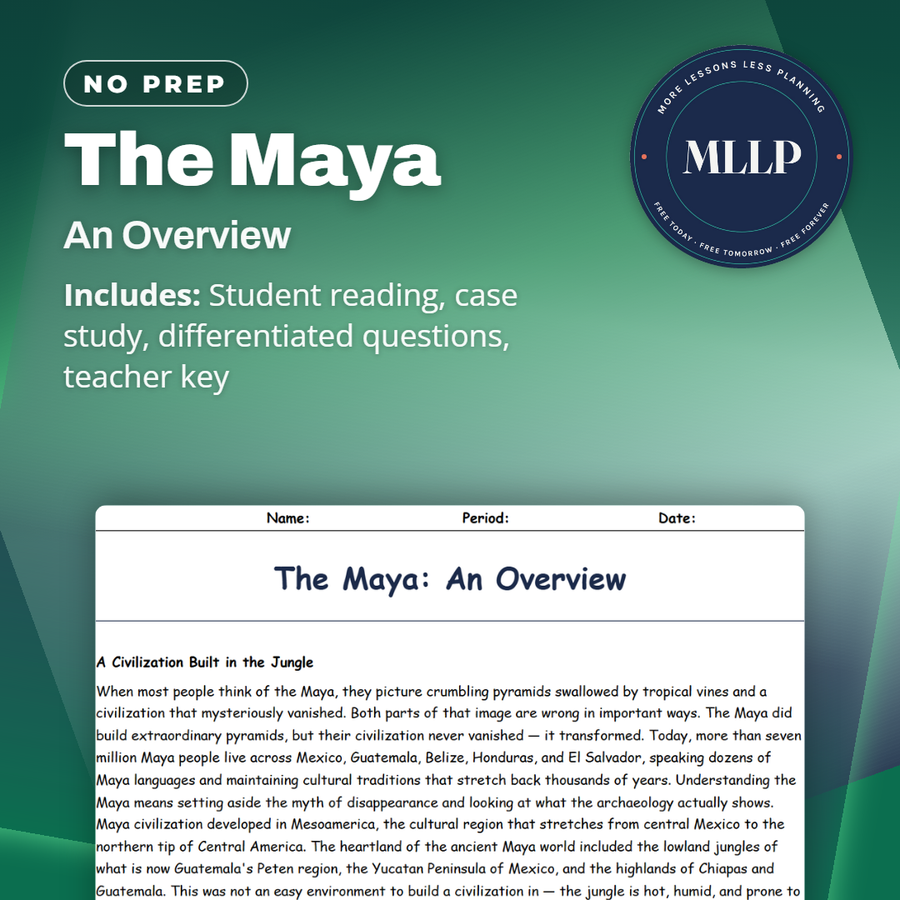
The Maya: An Overview
Quality reviewed September 2026
Facts verified September 21, 2026
- Subject
- Social Studies
- Grades
- Grades 9-12
- Length
- 8-page student worksheet
- Time
- About one 50-minute class period
- Great for
- Sub plans and independent work
- Includes
- Reading passage, comprehension questions + full answer key
- Format
- Print-and-go PDF
What students do
- The three periods of Maya history, Preclassic, Classic, and Postclassic, get placed on a timeline with their major cities
- Explain why calling the Maya political system an empire misreads how their city-states actually operated
- Sort the resources and trade goods that connected the Maya highlands to the lowlands despite political fragmentation
- The farmer's account of living beside 1,500-year-old terraces gets connected to the reading's point about Maya survival
What it covers
- The three periods of Maya history and how power shifted from the southern lowlands to the northern Yucatan over time
- Why Maya political organization was a world of competing city-states rather than a single empire
- A case study on a modern Guatemalan farmer whose family has worked land threaded with ancient Maya terraces for generations
Start reading this worksheet
A Civilization Built in the Jungle
When most people think of the Maya, they picture crumbling pyramids swallowed by tropical vines and a civilization that mysteriously vanished. Both parts of that image are wrong in important ways. The Maya did build extraordinary pyramids, but their civilization never vanished; it transformed. Today, more than seven million Maya people live across Mexico, Guatemala, Belize, Honduras, and El Salvador, speaking dozens of Maya languages and maintaining cultural traditions that stretch back thousands of years. Understanding the Maya means setting aside the myth of disappearance and looking at what the archaeology actually shows. Maya civilization developed in Mesoamerica, the cultural region that stretches from central Mexico to the northern tip of Central America. The heartland of the ancient Maya world included the lowland jungles of what is now Guatemala's Peten region, the Yucatan Peninsula of Mexico, and the highlands of Chiapas and Guatemala. This was not an easy environment to build a civilization in: the jungle is hot, humid, and prone to drought. Yet the Maya not only survived in this environment, they thrived in it for over two thousand years.
Three Great Periods: Rise, Peak, and Transformation
Archaeologists divide Maya history into three major periods: the Preclassic, Classic, and Postclassic. The Preclassic period runs roughly from 2000 BCE to 250 CE. This is when the foundations of Maya civilization were laid: early farming villages grew into towns, writing systems began to develop, and the first large ceremonial centers appeared. The site of El Mirador in present-day Guatemala was one of the largest cities in the ancient world during this period, with pyramids that rival those of Egypt in sheer volume. The Classic period (250 CE to 900 CE) is the era that most people associate with the ancient Maya. This was the time of great city-states like Tikal, Palenque, Calakmul, Copan, and Quirigua. Population estimates for the Maya lowlands during this period once ranged from five to ten million people, and LiDAR surveys since 2018 have revised them upward, to 10 to 15 million or more. Monumental architecture, elaborate tomb burials, carved stone monuments called stelae, and the flowering of Maya writing all characterize this era. The city-states of the Classic period were not unified under a single ruler: they competed, traded, allied, and warred with one another in a constant political dance. The Postclassic period (900 CE to 1521 CE) began after most of the southern lowland cities were abandoned. Power shifted north to cities on the Yucatan Peninsula, including Chichen Itza, Uxmal, and later Mayapan. The Postclassic Maya continued to trade across long distances, build impressive architecture, and maintain complex religious and political systems. When Spanish conquistadors arrived in the early 1500s, they encountered living, thriving Maya city-states, not ruins.
A World of City-States, Not an Empire
One key to understanding the Maya is recognizing that they never formed a single empire. Instead, Maya political organization resembled ancient Greece more than ancient Rome. Individual city-states, each ruled by a divine king called an ajaw, controlled surrounding territory and competed with their neighbors for dominance. Cities formed alliances and engaged in warfare, but no single Maya city ever conquered and unified the entire Maya world. This political fragmentation has important archaeological implications. It means that Maya culture showed significant regional variation. The glyphs used at Palenque in Chiapas differ in style from those at Copan in Honduras. Architectural styles varied by region. Trade goods moved across the entire Maya world, but local traditions remained strong. Archaeologists studying the Maya must always keep in mind which city-state, which region, and which time period they are looking at.
Like what you read? The full reading, the case study, and every question set are in the free download below, along with the answer key.
Why this matters
Diego Coc's story is the clearest way I've found to push back on the disappearance myth without lecturing about it: his family has been farming around Maya earthworks for generations, which means the line between 'ancient Maya' and 'living Maya' that a lot of students draw in their heads doesn't actually exist for the people who live there. It's also worth pointing out to students that archaeologists showing up to survey Diego's land raises a real question about whose knowledge counts, since he had already noticed the terraces held moisture better than the surrounding fields long before anyone brought a LiDAR unit into the area.
From one teacher to another
Seven million Maya people are alive today, speaking dozens of languages across five countries, which is the fact this reading leads with because most students start out picturing a civilization that vanished into the jungle. From there it lays out the three periods archaeologists use to organize Maya history, the Preclassic, Classic, and Postclassic, and makes the point that the Maya were never a single empire but a world of competing city-states, closer to ancient Greece than ancient Rome. Students read about how limestone geography and a lack of rivers made cenotes and water management central to political power, and how trade in jade, obsidian, and cacao connected highlands to lowlands despite the political fragmentation. The case study follows a modern corn farmer named Diego Coc, whose family has farmed land threaded with 1,500-year-old Maya terraces his whole life, without ever having a reason to call an archaeologist about it.
What you get
Download
Where should I send the next one?
Everything here is free and it stays that way. Leave your email and I'll send you the new lessons as they go up. You can unsubscribe from any one of them.
Related resources
Chichen Itza: Where Tourists Meet the Ancient World
LiDAR and the Maya: Finding Hidden Cities from the Sky
Maya Agriculture: Feeding Cities in the Jungle
Maya Mathematics and the Calendar: Zero and the End of the World
Maya Writing: Cracking the Hieroglyphic Code
Palenque and King Pakal: A Royal Tomb Inside a Pyramid
Every lesson on this site is free to download and use. If one of them saved you a prep period, you can chip in a few bucks toward my three kids' daycare fund. That's genuinely where tips go.