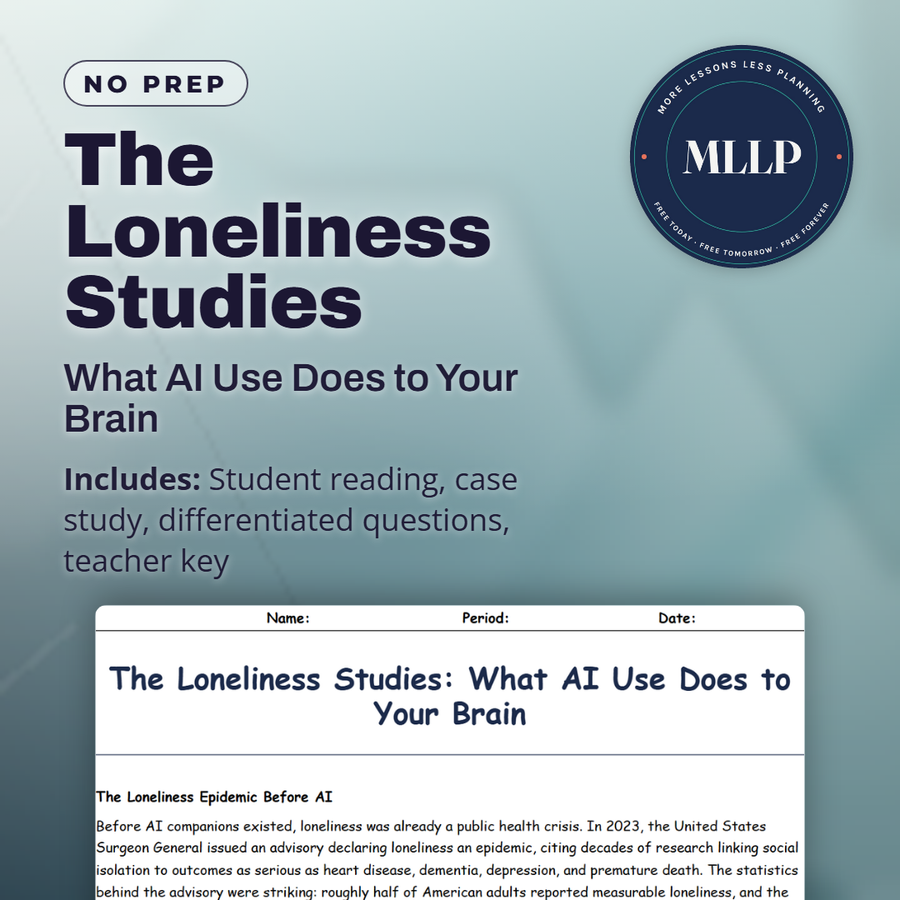
The Loneliness Studies: What AI Use Does to Your Brain
Quality reviewed September 2026
Facts verified September 20, 2026
- Subject
- Career & Life Skills
- Grades
- Grades 9-12
- Length
- 10-page student worksheet
- Time
- About one 50-minute class period
- Great for
- Sub plans and independent work
- Includes
- Reading passage, comprehension questions + full answer key
- Format
- Print-and-go PDF
What students do
- Devon's five months of nightly AI companion use gets checked against the substitution effect research for matching evidence
- Match the substitution effect, compensation effect, and third place to their definitions
- Fill in blanks on the Surgeon General's 2023 loneliness advisory and the oxytocin response to real connection
- The difference between social loneliness and emotional loneliness gets explained through short answer questions built on the reading
What it covers
- Why the loneliness epidemic existed before AI companions arrived, and what the 2023 Surgeon General advisory found
- The substitution effect versus the compensation effect, and why baseline social connection predicts which one shows up
- The substitution trap as a reinforcing loop, and why a third place is something an AI companion cannot be
Start reading this worksheet
The Loneliness Epidemic Before AI
Before AI companions existed, loneliness was already a public health crisis. In 2023, the United States Surgeon General issued an advisory declaring loneliness an epidemic, citing decades of research linking social isolation to outcomes as serious as heart disease, dementia, depression, and premature death. The statistics behind the advisory were striking: roughly half of American adults reported measurable loneliness, and the trend was worsening, particularly among young people. Adolescents and young adults, the very population that had grown up with more digital connectivity than any previous generation, showed the steepest increases in self-reported loneliness and the sharpest declines in close friendship quality. The devices that were supposed to bring people together had, for many, coincided with a growing sense of disconnection. Understanding this context is essential to evaluating AI companions' role honestly. AI companion apps did not arrive into a healthy social ecosystem and disrupt it. They arrived into an already-fractured one, marketed to people who were often already struggling with exactly the problem the apps claimed to address. This matters for two reasons. First, it creates a sympathetic context for use: people turn to AI companions because they are genuinely lonely, and dismissing that need does not help anyone. Second, it raises a harder question: if the loneliness epidemic is driven partly by insufficient real social connection, and AI companions address the feeling of loneliness without producing the real social connection that causes it, they may be treating a symptom in ways that allow the underlying condition to worsen. The difference between addressing loneliness and managing its symptoms is not semantic: it has real consequences for people's lives. Researchers who study loneliness make a distinction that is worth understanding clearly. Social loneliness refers to the absence of a social network: the feeling of not having enough people in your life. Emotional loneliness refers to the absence of close, intimate connection: the feeling of not being deeply known by anyone, even if you are surrounded by people. These are different experiences and they respond to different interventions. Much of the preliminary research suggests that AI companions may reduce feelings of social loneliness (the sense of having someone to talk to) while doing little to address emotional loneliness, and possibly deepening it by occupying the time and emotional energy that might otherwise go toward developing the deep human connections that emotional loneliness actually requires.
What Early Research Shows
The body of research specifically examining the effects of AI companion use on loneliness and social connection is new, but its early findings are consistent enough to warrant careful attention. A series of studies conducted between 2022 and 2024 examined users of major AI companion platforms and found a pattern that researchers called the substitution effect: frequent users reported feeling less acutely lonely on a day-to-day basis, but also showed declining investment in human relationships over time. They initiated contact with friends less often, participated in fewer social activities, and reported lower satisfaction with their human relationships, even as they reported feeling less alone in an immediate sense. The AI was addressing the symptom of loneliness without producing the conditions that would actually resolve it. Neuroimaging studies offer a complementary perspective. When human beings experience genuine social connection (face-to-face interaction, physical touch, real conversation with someone who knows and cares about them), specific brain systems activate in ways that regulate stress, reinforce bonding, and produce the neurochemical signatures of felt safety. Oxytocin release, the activation of the anterior cingulate cortex, and the synchronization of neural activity between two people in real conversation are measurable biological events. Early studies comparing brain responses to human interaction and AI companion interaction show that AI produces some activation of social processing regions, accounting for the felt experience of connection, but does not activate the same depth of response, particularly in systems associated with genuine bonding and stress regulation. The brain is not simply being fooled; it is partially engaging with something that partially resembles what it is built for, but not fully. The compensation effect describes a different pattern found in a subset of users: those who used AI companions as a supplement to, rather than substitute for, real relationships. These users tended to show different outcomes: they were less likely to reduce investment in human relationships, and some showed evidence of using AI-assisted practice (discussing social situations, working through anxiety) to improve their real-world interactions. The distinction between users who substituted and users who compensated was not primarily a function of self-discipline or character; it appeared to be a function of the baseline social connection they had before they started using the apps, and of the specific ways they used them. Users who already had meaningful human relationships tended to add AI as a supplement; users who lacked them tended toward substitution.
The Substitution Trap
The substitution trap is the name researchers give to a specific dynamic that appears in heavy AI companion users: the cycle in which AI use reduces real-world social investment, which increases loneliness, which increases AI use as a response to that loneliness, which further reduces real-world social investment. It is a reinforcing loop, not a stable equilibrium. A person who turns to an AI companion because they are lonely gets short-term relief from the feeling of loneliness. That relief reduces the urgency they feel to seek real social connection. The real social connection they do not seek does not develop. The loneliness (not the symptom, the underlying condition) remains or worsens. The AI companion continues to be the most available relief. The cycle continues. What makes the substitution trap particularly difficult to escape is that the AI is genuinely good at managing the symptom. The felt experience of loneliness, the acute discomfort of having no one to talk to, can be meaningfully reduced by an AI companion interaction. The user is not being irrational when they turn to the AI; the AI does provide something. The problem is that what it provides is the sensation of connection rather than the conditions of connection. Real social connection requires vulnerability, reciprocity, the navigation of imperfection, and the presence of someone who has a real stake in the outcome. AI provides none of these. It provides the comfort of felt connection without the relational infrastructure that would actually address loneliness's root cause. Researchers have noted that the substitution trap mirrors the dynamics of other substitution behaviors studied in psychology (specifically, the difference between behaviors that address a need and behaviors that manage the discomfort of having the need unmet). Eating high-calorie food addresses the sensation of hunger without providing all of the nutrients hunger signals a need for; heavily used AI companions may address the sensation of loneliness without providing the genuine social nourishment that loneliness signals a need for. The parallel is imperfect, but the structural logic, treating a symptom in ways that mask the signal while the underlying need continues, is recognizable and well-studied.
Like what you read? The full reading, the case study, and every question set are in the free download below, along with the answer key.
Why this matters
A teenager who spends five months talking to an AI every night is not lazy or foolish; the research in this reading shows the AI genuinely relieves the felt discomfort of loneliness. What it does not do is rebuild the friendships, activities, and family calls that quietly fall away while that relief is happening. Devon's case study makes that tradeoff visible in specific numbers: canceled plans, an unjoined activity, a grandmother who stopped getting calls. I want students to leave this reading able to name the difference between managing a feeling and meeting the need behind it, in their own lives and not only on a worksheet.
From one teacher to another
What happens when a lonely teenager starts talking to an AI every night is the question this reading follows. It opens with the loneliness epidemic the Surgeon General declared in 2023, then walks through the substitution effect: users feel less lonely day to day while their real relationships quietly shrink. Devon's case study, five months of nightly conversations with an AI companion, gives students a concrete person to test the research against. Some questions ask what social loneliness and emotional loneliness actually mean, and why an AI can ease one while leaving the other untouched. Students finish by tracing the substitution trap as a loop, not a single choice.
What you get
Download
Where should I send the next one?
Everything here is free and it stays that way. Leave your email and I'll send you the new lessons as they go up. You can unsubscribe from any one of them.
Related resources
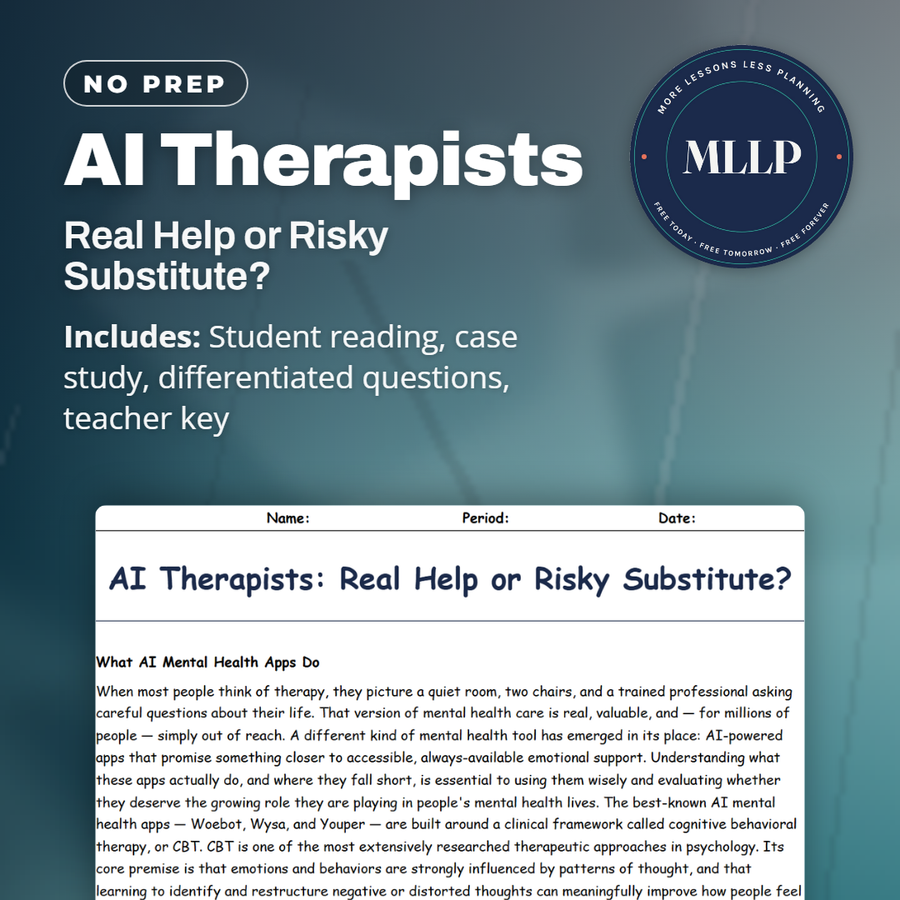
AI Therapists: Real Help or Risky Substitute?
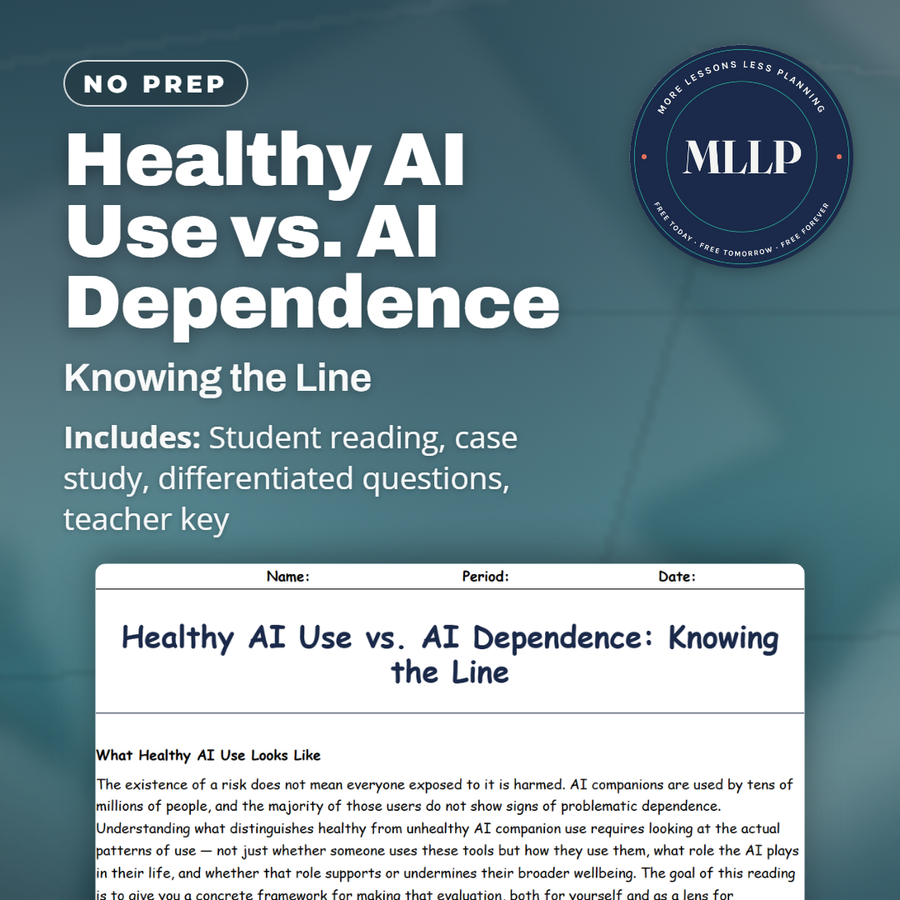
Healthy AI Use vs. AI Dependence: Knowing the Line
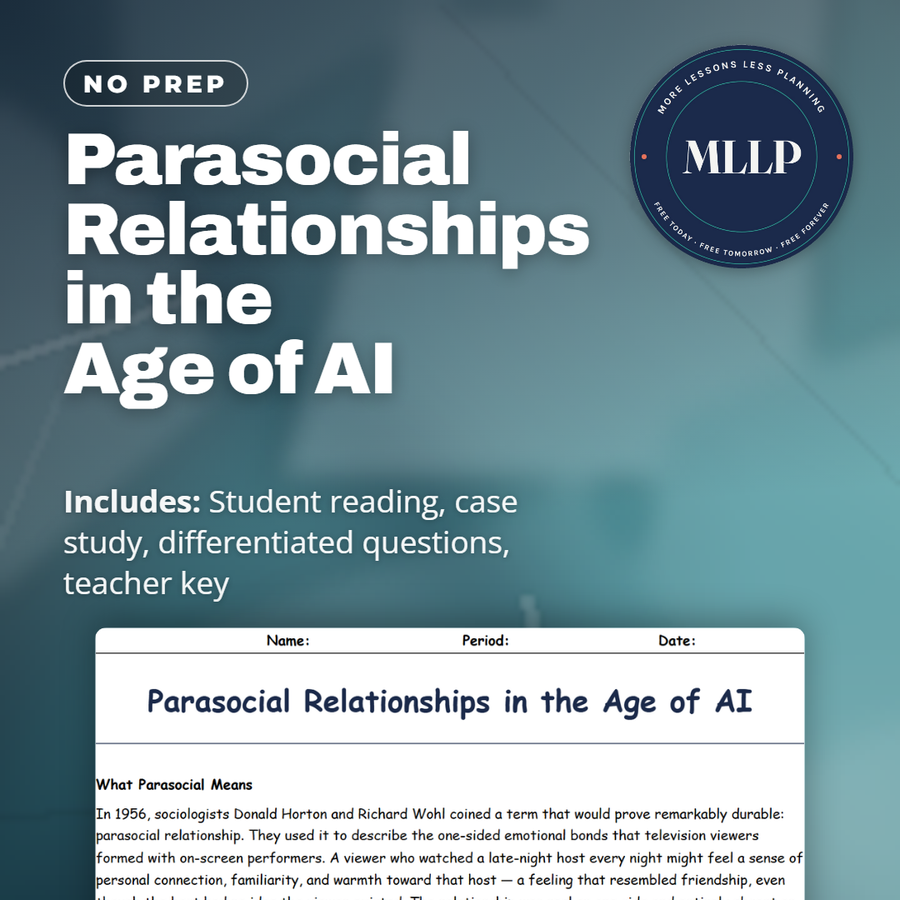
Parasocial Relationships in the Age of AI
Real Connection vs. Simulated Connection: Why It Matters
Should an AI Tell You It Loves You? The Design Question
Talking to Parents and Adults About Your AI Use
Every lesson on this site is free to download and use. If one of them saved you a prep period, you can chip in a few bucks toward my three kids' daycare fund. That's genuinely where tips go.