The Korean War
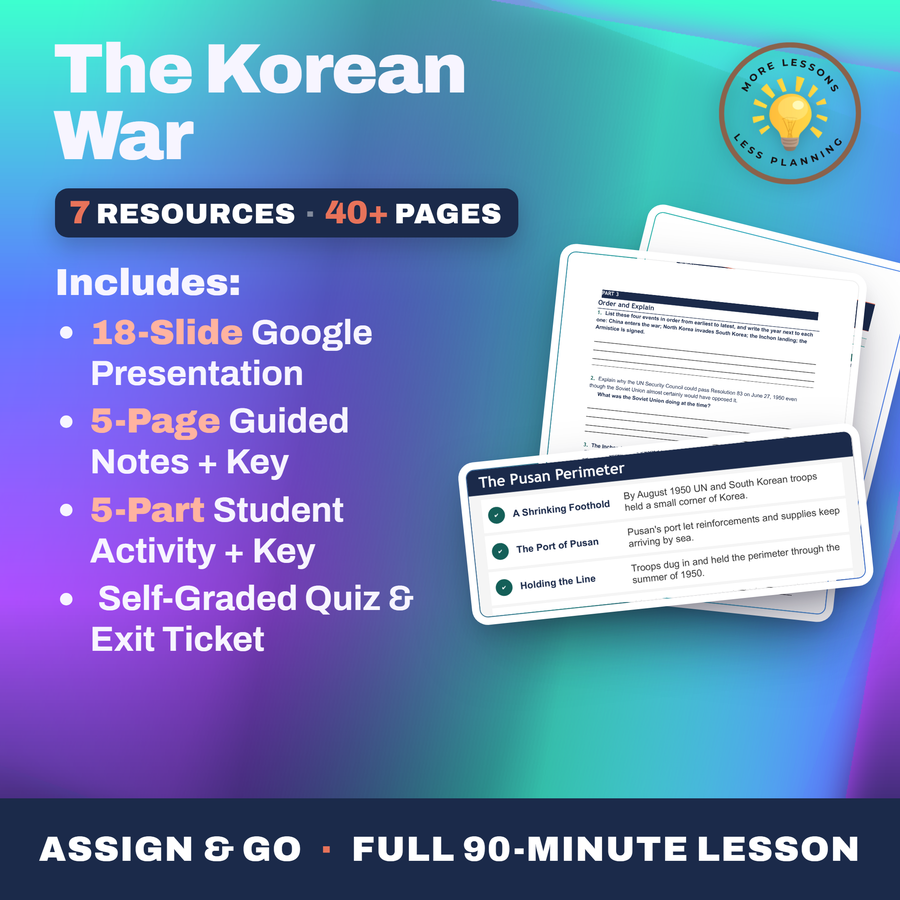
- Slide deck
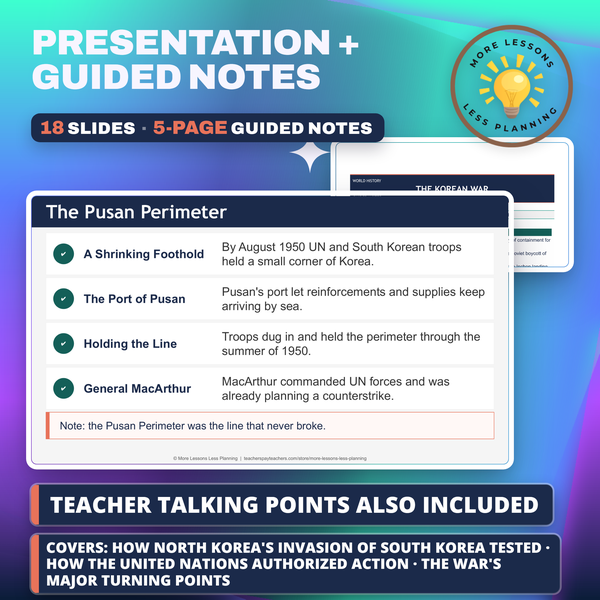
- Guided notes
- Guided notes teacher key
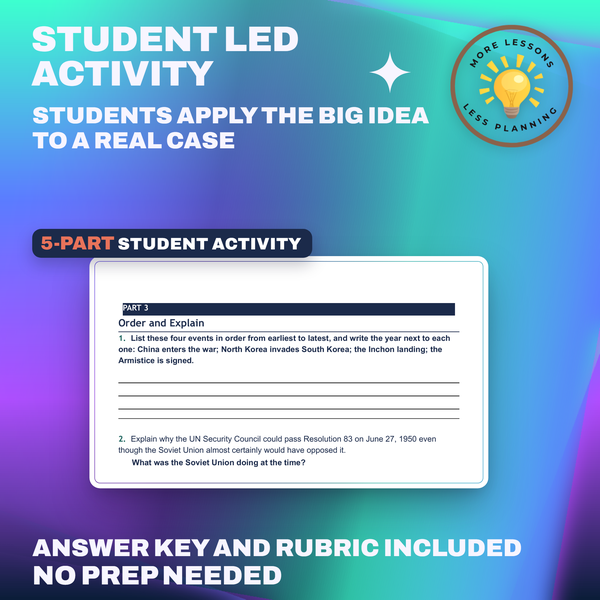
- Activity + answer key
- Quiz + answer key
- Exit ticket + answer key
- Teacher guide
- Teacher presentation notes
Where should I send the next one?
Everything here is free and it stays that way. Leave your email and I'll send you the new lessons as they go up. You can unsubscribe from any one of them.
Every file in this toolkit
Related resources
Decolonization in Africa
Decolonization in Asia
Globalization and the Modern World
Origins of the Cold War
The Berlin Wall
The Cuban Missile Crisis
What students do
- Analyze Truman's June 27, 1950 statement justifying U.S. intervention in Korea
- Explain why the Soviet boycott of the UN Security Council let Resolution 83 pass without a veto
- Trace the war's turning points from the Pusan Perimeter through the Inchon landing to Chinese intervention at the Yalu River
- Evaluate why Truman relieved MacArthur in April 1951 to keep the war limited
What it covers
- How a temporary occupation line at the 38th parallel became a permanent Cold War border
- Why the Inchon landing is remembered as one of the boldest gambles of the war
- What the 1953 Armistice actually settled, and why North and South Korea are still technically at war
Learning targets
- Explain how North Korea's invasion of South Korea tested the U.S. policy of containment for the first time with an army.
- Describe how the United Nations authorized action in Korea and why the Soviet boycott of the Security Council mattered.
- Trace the war's major turning points: the invasion, the Pusan Perimeter, the Inchon landing, and Chinese intervention.
- Analyze President Truman's justification for committing U.S. forces, using his June 27, 1950 statement.
- Explain why the 1953 Armistice halted the fighting but never ended the war, and what it left behind.
From one teacher to another
Korea is where the promise of containment first ran into an actual invading army, and that's the collision this lesson is built around. Students follow the war from the Pusan Perimeter's shrinking foothold through MacArthur's gamble at Inchon to the moment rollback across the 38th parallel pulled China into the fighting, then land on why an armistice in 1953 stopped the war without ever officially ending it. The real argument I want them to have by the end is whether containment worked here, or whether it only revealed what military force couldn't accomplish.
Every lesson on this site is free to download and use. If one of them saved you a prep period, you can chip in a few bucks toward my three kids' daycare fund. That's genuinely where tips go.