
The Fall of the Aztecs
Quality reviewed September 2026
- Grades
- Grades 9-12
- Time
- About two 50-minute class periods
- Includes
- 11 ready-to-teach files
- Format
- Word (.docx) · PowerPoint (.pptx)
- Slide deck
- Guided notes
- Guided notes teacher key
- Activity + answer key
- Quiz + answer key
- Exit ticket + answer key
- Teacher guide
- Teacher presentation notes
What students do
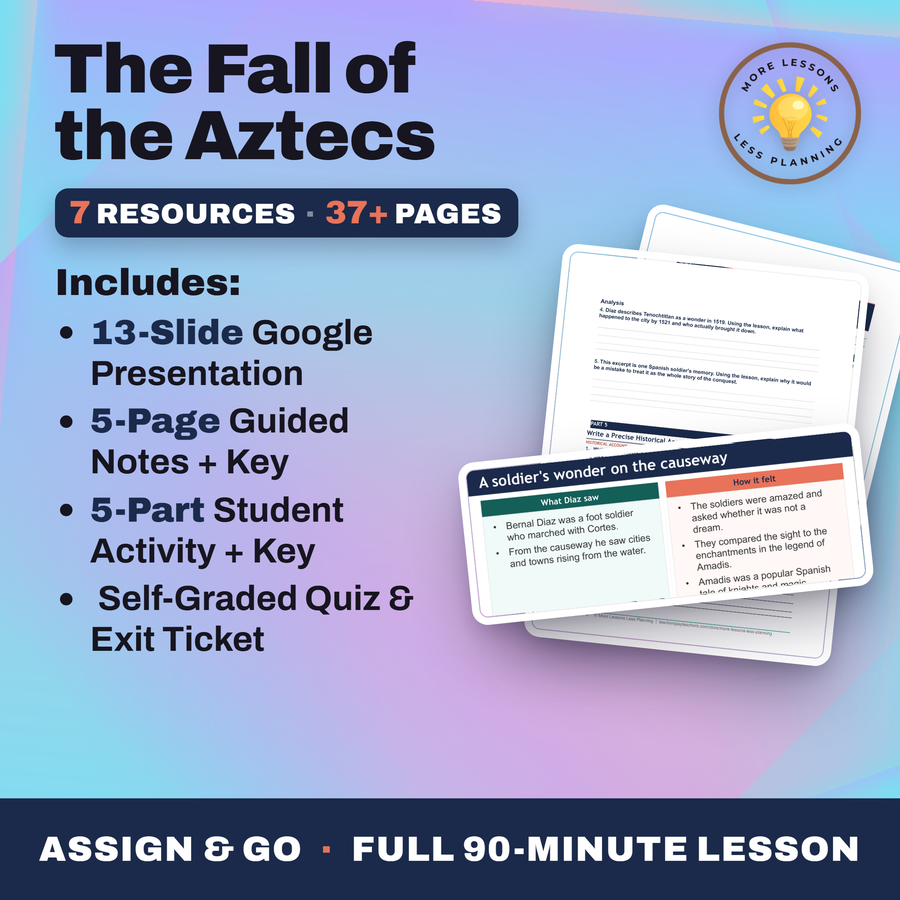
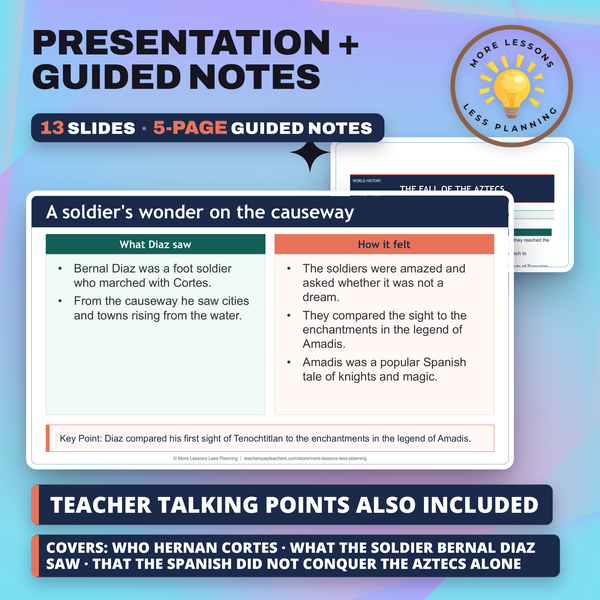
- Read Bernal Diaz's 1519 eyewitness account of first seeing Tenochtitlan from the causeway
- Map the Spanish approach to Tenochtitlan alongside the role of Tlaxcalan allies
- Argue against the classroom claim that Spain conquered the Aztec Empire alone
- Explain how smallpox and tens of thousands of Tlaxcalan warriors decided the siege of 1521
What it covers
- Bernal Diaz's firsthand description of the causeway approach to the Aztec capital
- Why the fall of Tenochtitlan depended on Tlaxcalan allies and a smallpox epidemic, not Spanish arms alone
- Key vocabulary including conquistador, causeway, and siege
Learning targets
- Explain who Hernan Cortes and the Spanish conquistadors were and how they reached the Aztec island capital of Tenochtitlan in 1519.
- Describe what the soldier Bernal Diaz saw and felt on the causeway approach to Tenochtitlan, using his eyewitness account.
- Explain that the Spanish did not conquer the Aztecs alone - tens of thousands of Tlaxcalan allies and a devastating smallpox epidemic were decisive in the fall of Tenochtitlan in 1521.
Peek inside
Tenochtitlan was the capital of the Aztec (Mexica) empire in central Mexico.
It was an island city built on a lake, connected to shore by raised roads.
The Aztec (Mexica) were the people who ruled a large empire from this city.
Montezuma (Moctezuma II) was the Aztec ruler when the Spanish arrived in 1519.
Today the site of Tenochtitlan is Mexico City.
A great city on a lake
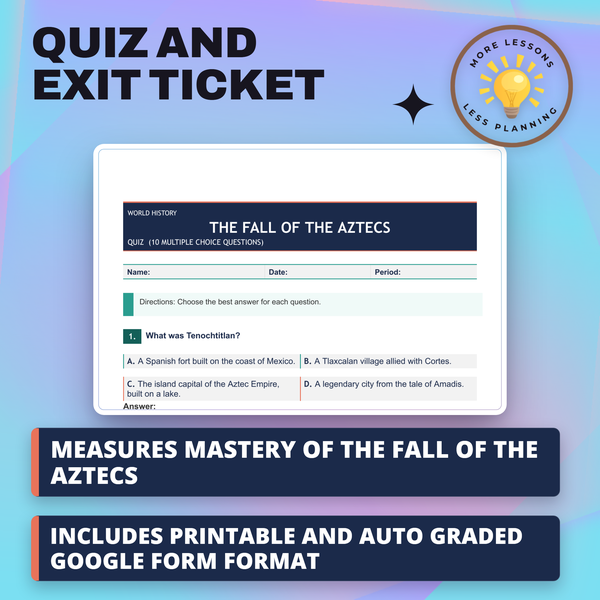
was the island capital of the Aztec (Mexica) empire, built on a lake.
It was an city on a lake, connected to shore by raised roads.
The Aztec ruler (Moctezuma II) led the empire when the Spanish arrived in 1519.
1. The island capital of the Aztec Empire, built on a lake, was called .
Why this matters
Cortes gets top billing in most retellings of 1521, but the numbers tell a different story: tens of thousands of Tlaxcalan warriors fought alongside a few hundred Spaniards, and smallpox weakened Tenochtitlan before the final siege even began. Bernal Diaz's own account of the causeway approach is only one thread in a much larger event.
A one-man narrative is harder to correct than it sounds, since the simple version is already the one most students carry in from movies and old textbooks. I weigh the eyewitness account against allies and disease so students get a concrete case for why crediting a single conqueror flattens what actually happened at Tenochtitlan.
From one teacher to another
The causeway into Tenochtitlan is where I start this one, with water on both sides and a city rising out of the lake that stopped Bernal Diaz's soldiers cold in 1519. I use his actual account of that walk so students don't take his word alone, they weigh it against Tlaxcalan allies numbering in the tens of thousands, plus a smallpox epidemic that did more to end the 1521 siege than any Spanish weapon. Most retellings hand Cortes all the credit for bringing down the Aztec Empire, and I made this one specifically to put that credit where it actually belongs.
Every file in this toolkit
Download
Where should I send the next one?
Everything here is free and it stays that way. Leave your email and I'll send you the new lessons as they go up. You can unsubscribe from any one of them.
Related resources
Columbus's Voyage to the Americas
Las Casas - A Voice Against Conquest
Magellan and the First Voyage Around the World
Prince Henry the Navigator
The Capture of Atahualpa
The Columbian Exchange
Every lesson on this site is free to download and use. If one of them saved you a prep period, you can chip in a few bucks toward my three kids' daycare fund. That's genuinely where tips go.