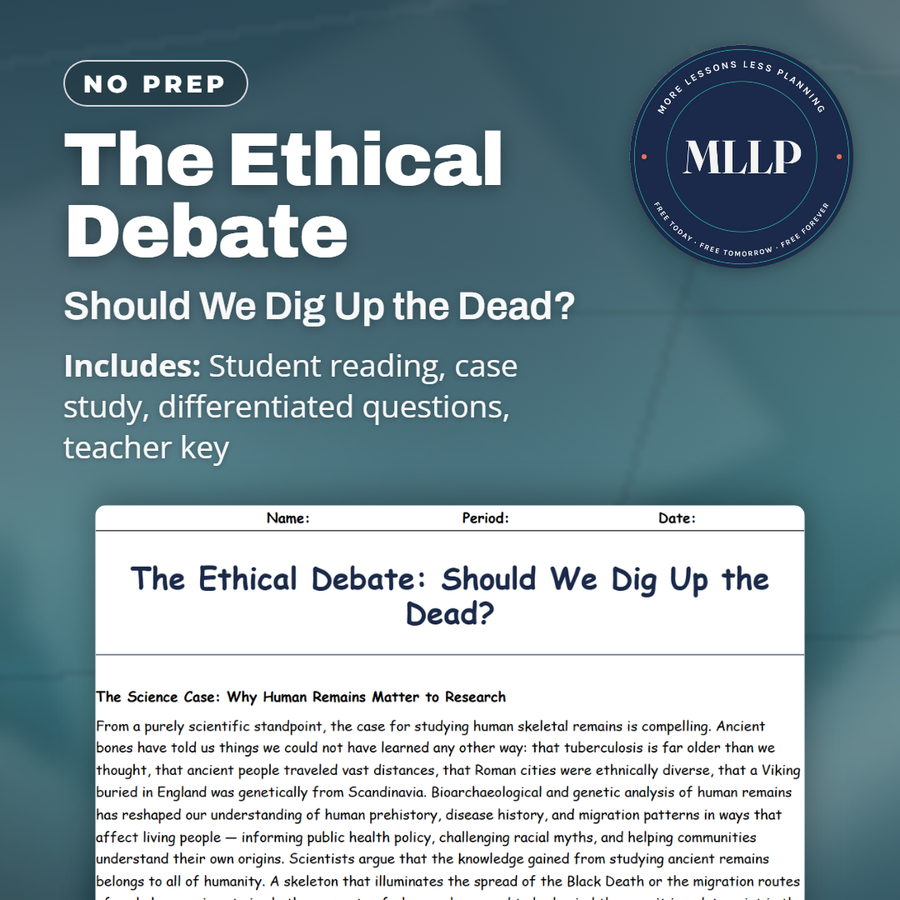
The Ethical Debate: Should We Dig Up the Dead?
Quality reviewed September 2026
Facts verified September 21, 2026
- Subject
- Social Studies
- Grades
- Grades 9-12
- Length
- 9-page student worksheet
- Time
- About one 50-minute class period
- Great for
- Sub plans and independent work
- Includes
- Reading passage, comprehension questions + full answer key
- Format
- Print-and-go PDF
What students do
- Match five terms, including NAGPRA, repatriation, and consent, to their definitions
- Kennewick Man's twenty-year legal battle only ended after a 2015 DNA study tied him to modern Native Americans
- Write a short-answer argument for or against displaying human remains in museums, using evidence from the reading
- Dani, who is Lakota, stops in front of a museum display case and decides she has to say something to her teacher
What it covers
- How the 20-year Kennewick Man legal battle ended with a 2015 DNA study and a 2017 reburial
- What NAGPRA requires federally funded museums and universities to do with Native American remains
- Why many Indigenous communities frame the repatriation debate around consent and voice rather than science alone
Start reading this worksheet
The Science Case: Why Human Remains Matter to Research
From a purely scientific standpoint, the case for studying human skeletal remains is compelling. Ancient bones have told us things we could not have learned any other way: that tuberculosis is far older than we thought, that ancient people traveled vast distances, that Roman cities were ethnically diverse, that a Viking buried in England was genetically from Scandinavia. Bioarchaeological and genetic analysis of human remains has reshaped our understanding of human prehistory, disease history, and migration patterns in ways that affect living people: it informs public health policy, challenges racial myths, and helps communities understand their own origins. Scientists argue that the knowledge gained from studying ancient remains belongs to all of humanity. A skeleton that illuminates the spread of the Black Death or the migration routes of early humans is not simply the property of whoever happened to be buried there. It is a data point in the shared human story. Moreover, most individuals whose remains end up in museum collections lived so long ago that there are no living communities with a clear genealogical relationship to them. In these cases, researchers argue, the scientific value of study outweighs the speculative harm of disturbing remains that have no living descendants to object.
The NAGPRA Law: How the U.S. Tried to Find Balance
In the United States, the ethical debate around Native American human remains came to a head in the late 1980s. For over a century, the remains of thousands of Native Americans had been collected, sometimes from fresh graves, sometimes from battlefield sites, sometimes simply dug up from tribal lands, and placed in museum collections and university laboratories, often without any consent from the communities whose ancestors they represented. The scale of this collection was staggering: the Smithsonian Institution alone held the remains of approximately 18,500 Native Americans when NAGPRA was passed. The Native American Graves Protection and Repatriation Act (NAGPRA), signed into law in 1990, requires federal agencies and institutions that receive federal funding to inventory their holdings of Native American human remains and sacred objects, determine cultural affiliation, and return (repatriate) those remains and objects to affiliated tribes upon request. Implementation has been slow and uneven. Many institutions delayed compliance. Determining cultural affiliation for remains thousands of years old is genuinely difficult. And some institutions have challenged the law's application to their collections. Nevertheless, NAGPRA represented a significant acknowledgment that the previous system had been wrong: collecting the dead without consent was not simply a historical curiosity but an ongoing injustice requiring active correction.
Kennewick Man: A Case That Went to Court
Perhaps no case illustrates the tension between scientific interests and Indigenous rights more vividly than the controversy over Kennewick Man, the remains of an ancient individual found along the Columbia River in Washington State in 1996. The skeleton was approximately 8,500 years old, making it one of the oldest and most complete ancient human skeletons ever found in North America. Scientists immediately recognized its extraordinary research potential. A coalition of Native American tribes, including the Umatilla, Colville, Yakama, Nez Perce, and Wanapum, claimed cultural affiliation under NAGPRA and requested repatriation. A group of scientists sued to prevent repatriation, arguing that the skeleton was too old to have a demonstrable cultural affiliation with any modern tribe and that scientific study should take precedence. The case wound through the federal courts for more than seven years. In 2004, the Ninth Circuit Court of Appeals ruled in favor of the scientists, finding that the federal government had not demonstrated sufficient evidence of cultural affiliation. Scientists studied the remains extensively. Then, in 2015, a new aDNA study found that Kennewick Man was genetically more closely related to modern Native Americans than to any other living population. Congress passed legislation in 2016 ordering his repatriation, and he was reburied by the tribes in a private ceremony in February 2017 — thirteen years after the Ninth Circuit ruling and over twenty years after his initial discovery.
Like what you read? The full reading, the case study, and every question set are in the free download below, along with the answer key.
Why this matters
This is one of the few readings in the unit where there is no single right answer, and that is deliberate. Kennewick Man shows students that science and law can disagree with each other for decades, and Dani's case study puts a present-day teenager, not a historical abstraction, in front of the exact dilemma the reading describes. Repatriation debates are still active right now in museums around the world, so students are learning a live issue, not a settled one, and the reading asks them to weigh scientific value against a community's right to decide what happens to their own ancestors.
From one teacher to another
A skeleton in a glass case looks like simple education until you consider whose ancestor it might be, and this reading lays out both sides of that argument in detail. It opens with the strongest scientific case for studying human remains, then covers NAGPRA, the 1990 law that requires federally funded institutions to inventory and return Native American remains to affiliated tribes. Kennewick Man is the reading's hardest example: an 8,500-year-old skeleton that scientists fought for seven years to keep studying, until a 2015 DNA study proved a genetic link to modern Native Americans and Congress ordered his repatriation in 2016. The final passage brings in the perspective of Indigenous communities, who frame the issue less as science versus culture and more as a question of who gets a voice in decisions about their own ancestors. The case study follows seventeen-year-old Dani Runningwater, who is Lakota, as she stands in front of a museum display case and decides she has to say something to her teacher.
What you get
Download
Where should I send the next one?
Everything here is free and it stays that way. Leave your email and I'll send you the new lessons as they go up. You can unsubscribe from any one of them.
Related resources
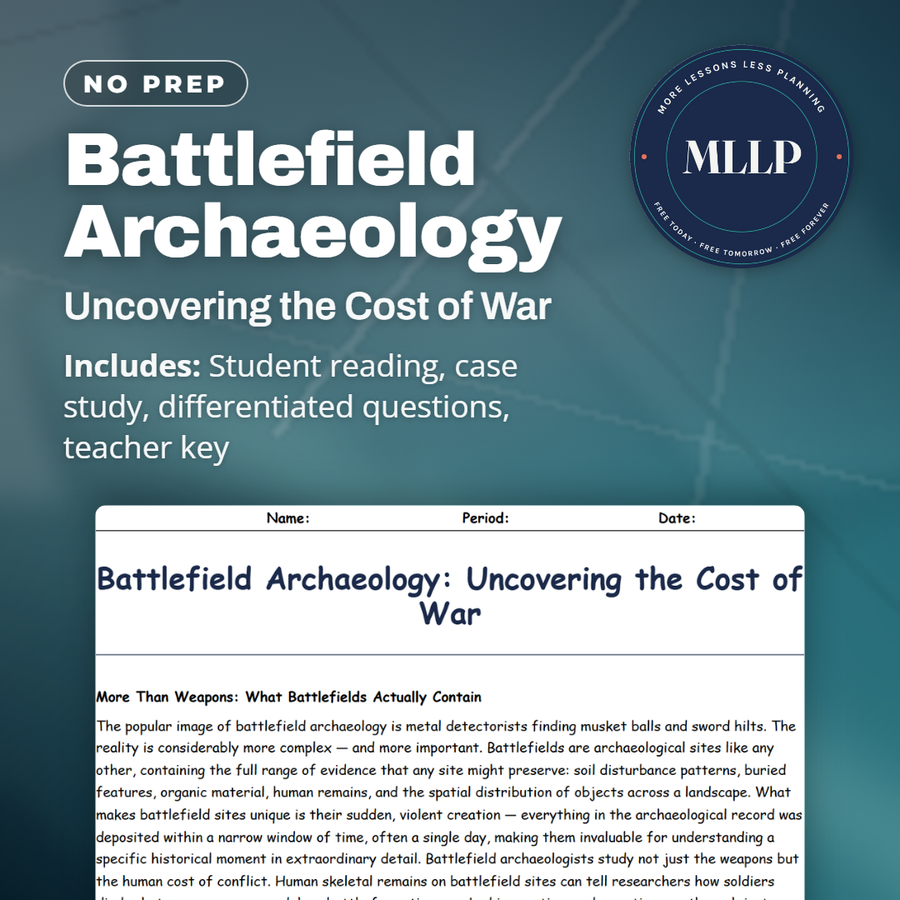
Battlefield Archaeology: Uncovering the Cost of War
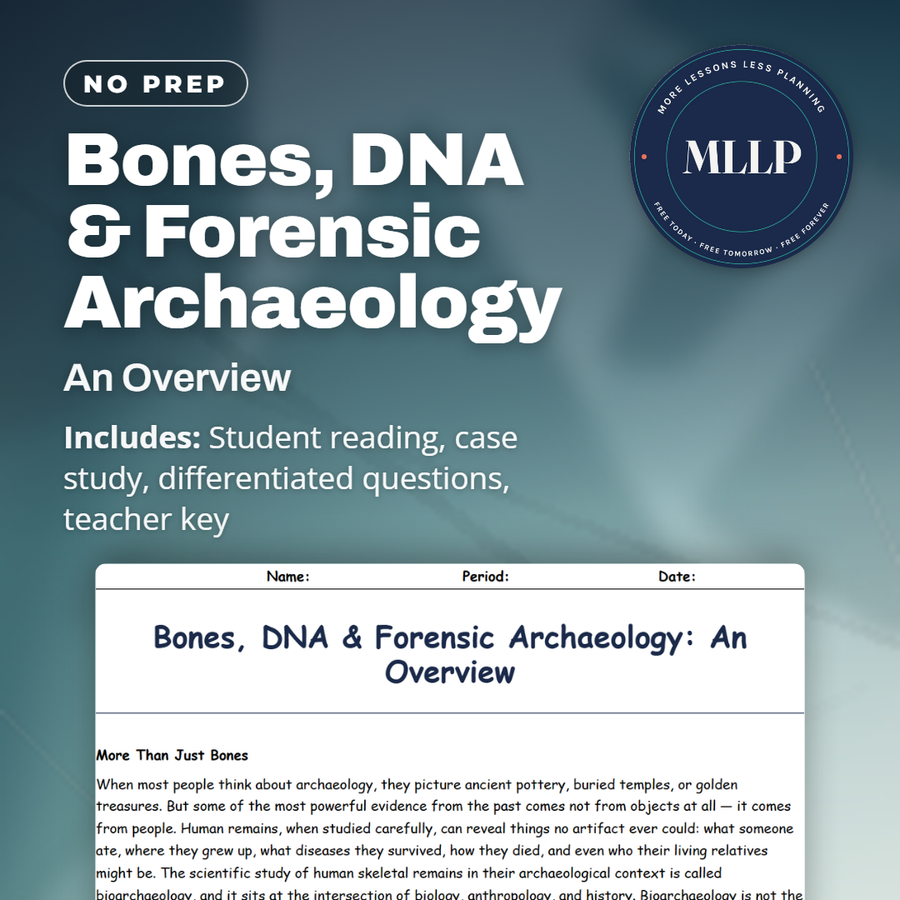
Bones, DNA & Forensic Archaeology: An Overview
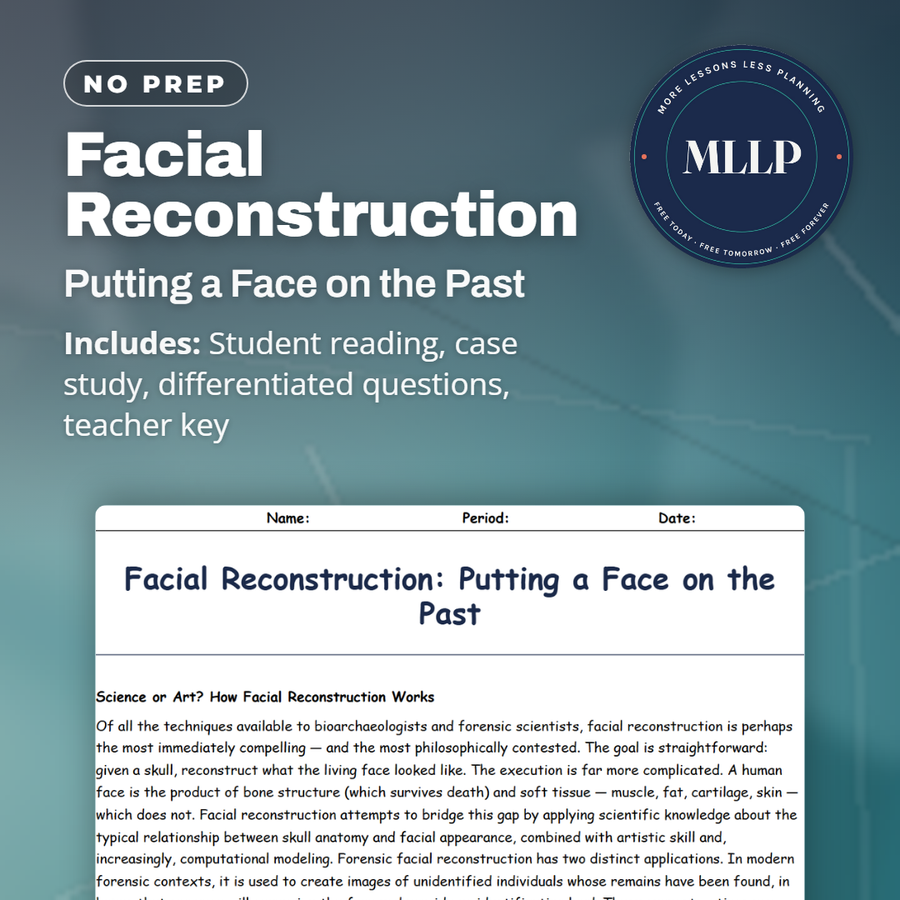
Facial Reconstruction: Putting a Face on the Past
Forensic Archaeology: Solving Modern Crimes with Ancient Methods
_COVER.png)
Isotope Analysis: You Are What You Eat (and Where You Lived)
Mummies: Preserved Bodies and What They Teach Us
Every lesson on this site is free to download and use. If one of them saved you a prep period, you can chip in a few bucks toward my three kids' daycare fund. That's genuinely where tips go.