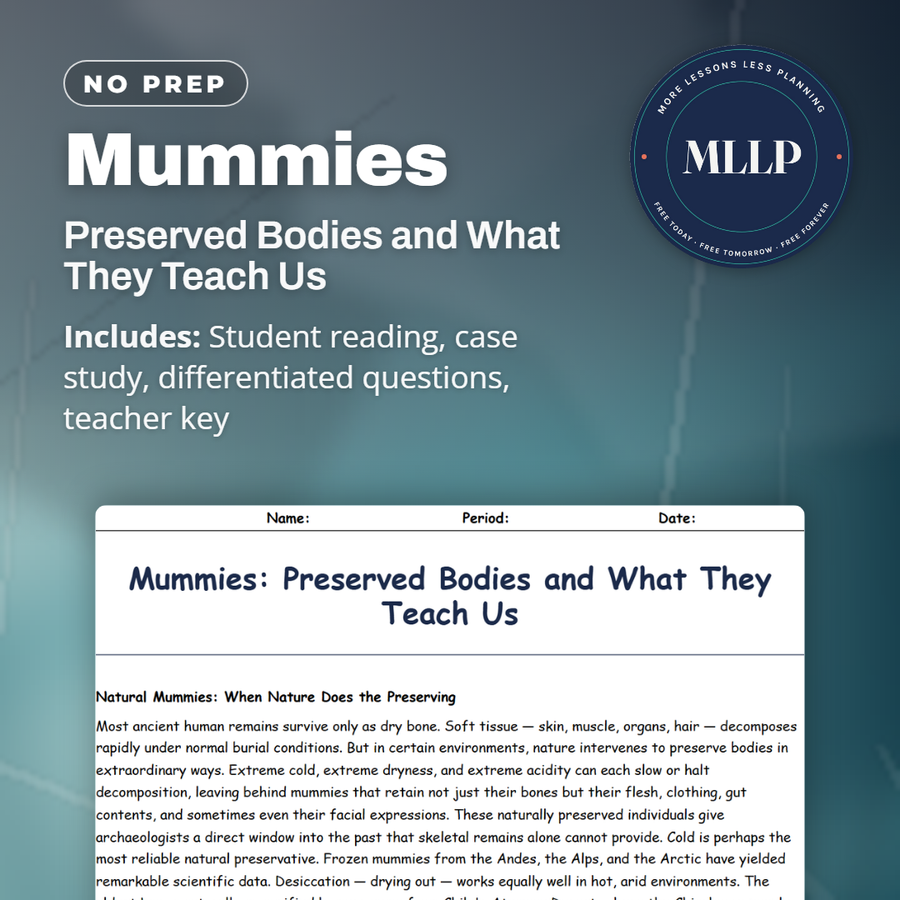
Mummies: Preserved Bodies and What They Teach Us
Quality reviewed September 2026
Facts verified September 21, 2026
- Subject
- Social Studies
- Grades
- Grades 9-12
- Length
- 8-page student worksheet
- Time
- About one 50-minute class period
- Great for
- Sub plans and independent work
- Includes
- Reading passage, comprehension questions + full answer key
- Format
- Print-and-go PDF
What students do
- Sort the preservation methods behind Otzi, Tollund Man, and Egyptian mummies by what each one actually relies on
- A 2001 CT scan found the arrowhead still lodged in Otzi's shoulder, proving he was murdered rather than lost in a storm
- Explain how CT scanning let Dr. Okonkwo find a hidden wound without unwrapping a 3,300-year-old mummy
- A routine mummy scan at the Cairo Museum turns up a metal object exactly where a fatal wound would sit
What it covers
- How Egyptian embalmers used natron, organ removal, and linen wrapping across a 70-day mummification process
- Why peat bogs preserve skin and hair while often dissolving the bones underneath
- What a CT scan of Otzi the Iceman revealed about an arrowhead lodged in his shoulder
Start reading this worksheet
Natural Mummies: When Nature Does the Preserving
Most ancient human remains survive only as dry bone. Soft tissue, including skin, muscle, organs, and hair, decomposes rapidly under normal burial conditions. But in certain environments, nature intervenes to preserve bodies in extraordinary ways. Extreme cold, extreme dryness, and extreme acidity can each slow or halt decomposition, leaving behind mummies that retain not just their bones but their flesh, clothing, gut contents, and sometimes even their facial expressions. These naturally preserved individuals give archaeologists a direct window into the past that skeletal remains alone cannot provide. Cold is perhaps the most reliable natural preservative. Frozen mummies from the Andes, the Alps, and the Arctic have yielded remarkable scientific data. Desiccation (drying out) works equally well in hot, arid environments. The oldest known naturally mummified humans come from Chile's Atacama Desert, where the Chinchorro people deliberately mummified their dead over 7,000 years ago, predating Egyptian mummification by thousands of years. High altitude conditions in the Andes have preserved the bodies of Inca children sacrificed in religious ceremonies (called capacocha) with such fidelity that their last meals can be analyzed and their blood type determined.
The Egyptian Way: Intentional Mummification
When most people think of mummies, they think of Egypt, and for good reason. The ancient Egyptians developed intentional mummification into a sophisticated, ritually elaborate process that they practiced for over 3,000 years. The goal was to preserve the body for the afterlife: Egyptian religious belief held that the soul needed a recognizable physical form to return to after death. Without a preserved body, the soul could not achieve eternal life. Mummification was therefore not just a preservation technique but a religious necessity, at least for those who could afford it. The full mummification process took approximately 70 days. After death, the body was taken to an embalming workshop. The brain was typically removed through the nose using a metal hook and discarded. The ancient Egyptians considered the heart, not the brain, to be the seat of thought and emotion. Internal organs were removed from the abdomen, dried with natron (a naturally occurring salt), and placed in canopic jars with lids shaped like the heads of protective deities. The body cavity was packed with natron-soaked linen and left to dry for 40 days. After drying, the body was washed, anointed with oils and resins, wrapped in hundreds of meters of linen bandages with protective amulets placed between the layers, and placed in a series of nested coffins.
Bog Bodies: Europe's Eerie Preserved Dead
In the peat bogs of northern Europe, particularly in Denmark, the Netherlands, Germany, Ireland, and the United Kingdom, hundreds of well-preserved human bodies have been discovered over the past several centuries. Peat bogs preserve flesh through a combination of cold temperatures, acidic water (from decomposing sphagnum moss), and oxygen-poor conditions. The acid tans the skin like leather and often dissolves the bones while leaving the soft tissue remarkably intact, a reversal of normal burial conditions. Many bog bodies still have their hair, skin, fingernails, and stomach contents. Most bog bodies date to the Iron Age, between roughly 500 BCE and 100 CE, and many show evidence of violent death: strangulation, throat-cutting, blunt force trauma, or multiple simultaneous injuries. Tollund Man, found in Denmark in 1950, had a braided leather noose still around his neck when he was discovered; his face is so well-preserved that he looks as though he might have died recently. Lindow Man, found in a Cheshire peat bog in 1984, had been struck on the head, garroted, and had his throat cut before being placed in the bog, a pattern of overkill that many archaeologists interpret as ritualized killing, possibly a sacrificial offering to Iron Age gods.
Like what you read? The full reading, the case study, and every question set are in the free download below, along with the answer key.
Why this matters
Mummies show up everywhere in pop culture, usually wrapped in myth, and this reading replaces that with the actual science: how natron dries a body, how peat bogs tan skin like leather, and how a CT scan can find a murder weapon inside remains that are more than three thousand years old. Dr. Okonkwo's case study makes the point concrete: a routine research scan turns into evidence of a killing no one has thought about in over three millennia. Students interested in radiology, museum work, or archaeology get a clear look at how modern imaging technology answers questions that used to require physically cutting a specimen apart.
From one teacher to another
Nature and ritual can both stop a body from decaying, and this reading walks through both routes: the natural cold and desiccation that preserved Otzi the Iceman in an Alpine glacier for 5,300 years, and the deliberate 70-day Egyptian process of removing organs, drying the body in natron, and wrapping it in linen. It covers Europe's bog bodies, whose acidic peat tans skin like leather while often dissolving the bones underneath, including Tollund Man, found in Denmark with a leather noose still around his neck. Otzi gets the most detailed treatment: a 2001 CT scan found an arrowhead lodged in his shoulder, proving he was murdered rather than lost in a storm. The case study follows radiologist Dr. Sarah Okonkwo as a CT scan of a 3,300-year-old Egyptian mummy turns up something that should not be there: a small metallic object positioned exactly where a fatal wound would be.
What you get
Download
Where should I send the next one?
Everything here is free and it stays that way. Leave your email and I'll send you the new lessons as they go up. You can unsubscribe from any one of them.
Related resources
Battlefield Archaeology: Uncovering the Cost of War
Bones, DNA & Forensic Archaeology: An Overview
Facial Reconstruction: Putting a Face on the Past
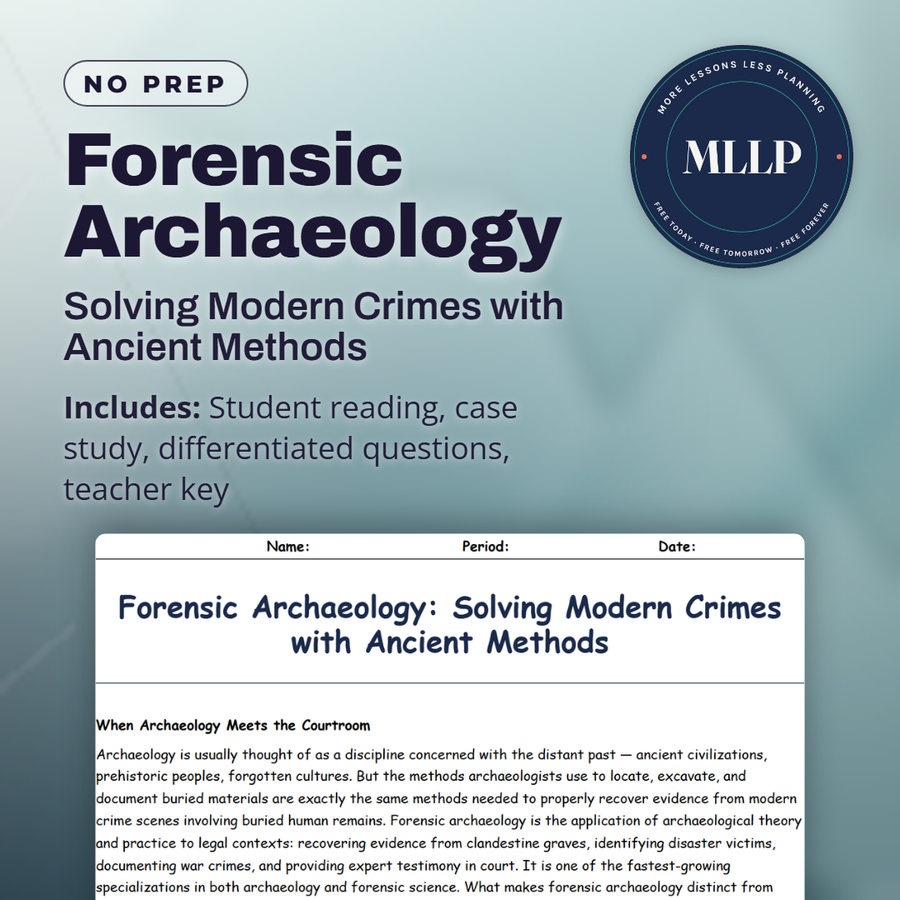
Forensic Archaeology: Solving Modern Crimes with Ancient Methods
_COVER.png)
Isotope Analysis: You Are What You Eat (and Where You Lived)
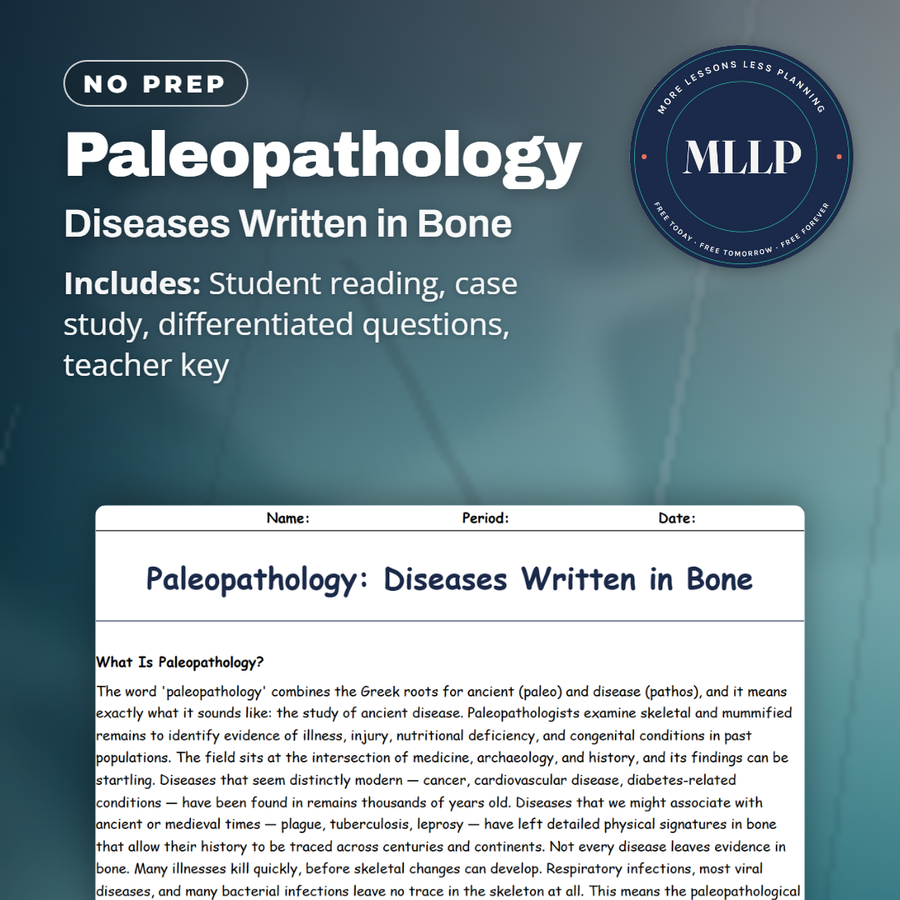
Paleopathology: Diseases Written in Bone
Every lesson on this site is free to download and use. If one of them saved you a prep period, you can chip in a few bucks toward my three kids' daycare fund. That's genuinely where tips go.