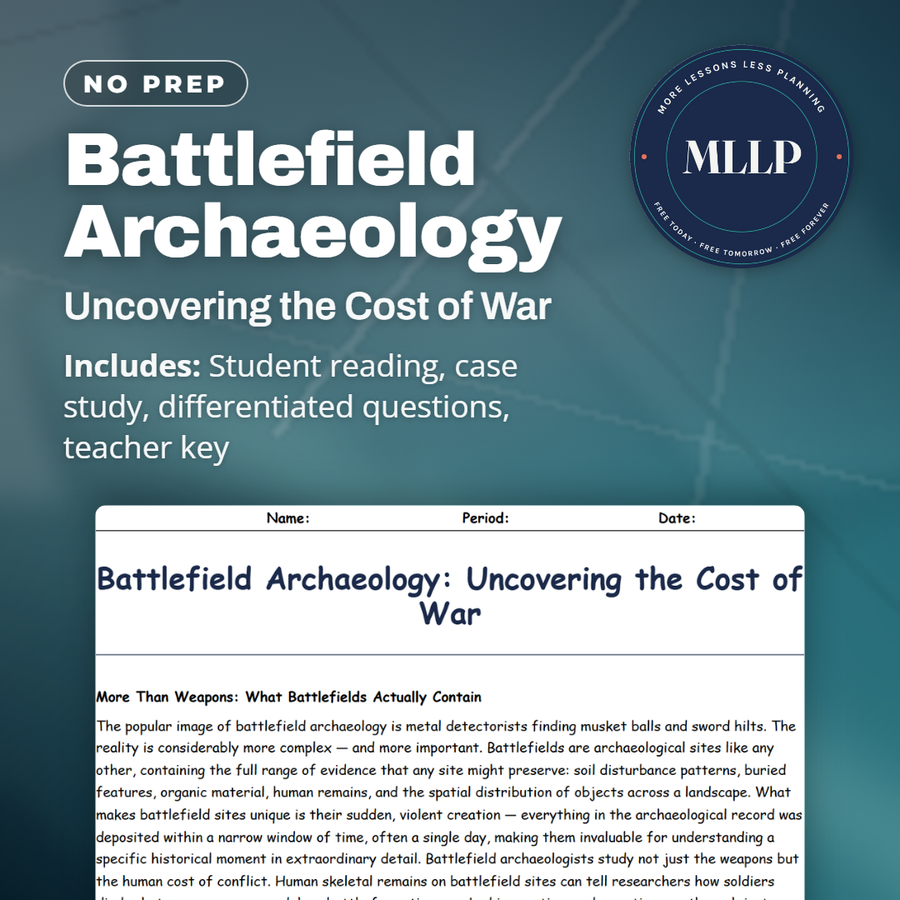
Battlefield Archaeology: Uncovering the Cost of War
Quality reviewed September 2026
Facts verified September 21, 2026
- Subject
- Social Studies
- Grades
- Grades 9-12
- Length
- 9-page student worksheet
- Time
- About one 50-minute class period
- Great for
- Sub plans and independent work
- Includes
- Reading passage, comprehension questions + full answer key
- Format
- Print-and-go PDF
What students do
- Trace how 19th-century bone traders erased the physical evidence of Waterloo's roughly 47,000 casualties
- The Western Front's WWI trenches still surrender human remains during ordinary construction work in Belgium and France
- Explain the ethical balance between excavating a war grave for research and treating it as a resting place
- A dental bridge and a living great-granddaughter's DNA sample bring Private William Holt home a century after Passchendaele
What it covers
- Why Waterloo's battlefield has almost no human remains despite roughly 47,000 casualties in a single day
- How dental records, DNA, and isotope analysis work together to identify WWI soldiers still listed as missing
- The Defense POW/MIA Accounting Agency's ongoing work identifying more than 1,000 previously unknown service members
Start reading this worksheet
More Than Weapons: What Battlefields Actually Contain
The popular image of battlefield archaeology is metal detectorists finding musket balls and sword hilts. The reality is considerably more complex, and more important. Battlefields are archaeological sites like any other, containing the full range of evidence that any site might preserve: soil disturbance patterns, buried features, organic material, human remains, and the spatial distribution of objects across a landscape. What makes battlefield sites unique is their sudden, violent creation: everything in the archaeological record was deposited within a narrow window of time, often a single day, making them invaluable for understanding a specific historical moment in extraordinary detail. Battlefield archaeologists study not just the weapons but the human cost of conflict. Human skeletal remains on battlefield sites can tell researchers how soldiers died, what weapons were used, how battle formations worked in practice, and sometimes (through isotope and DNA analysis) who the soldiers were and where they came from. The archaeology of war is also, ultimately, the archaeology of individual people caught in catastrophic events, and recovering their identities and stories has become an increasingly important part of the field. In recent decades, the identification and return of remains from 20th-century conflicts has given battlefield archaeology a deeply personal and often emotional dimension.
Waterloo: Napoleon's Defeat Mapped in Metal
The Battle of Waterloo, fought on June 18, 1815, in what is now Belgium, ended Napoleon's rule and shaped European history for the next century. It also generated one of the most intensively studied battlefield archaeological landscapes in the world. Archaeological surveys beginning in the 1990s and accelerating in the 2000s used metal detectors, GPS mapping, and soil analysis to build an extraordinarily detailed picture of how the battle unfolded, far more nuanced than the historical accounts of officers who survived it. One of the most striking findings from Waterloo archaeology was the near-total absence of human skeletal remains on the battlefield. Historical accounts suggest that approximately 47,000 soldiers were killed, wounded, or went missing at Waterloo in a single day. The archaeology accounts for almost none of the dead. Excavations and historical research eventually revealed why: the battlefield was systematically stripped of bones in the years following the battle, with remains ground up and sold as fertilizer. This 'bone trade' was not unique to Waterloo. Many 19th-century European battlefields were commercially stripped of human remains within years of the fighting. The archaeology of absence can be as revealing as the archaeology of presence.
WWI Trenches: Archaeology of the Western Front
The Western Front of World War One, the network of trenches stretching from the English Channel to the Swiss border, is one of the most archaeologically rich landscapes in the world. Decades of excavation have revealed the extraordinary complexity of trench systems: not just simple ditches but elaborate underground networks with sleeping quarters, command posts, medical stations, and even recreational spaces. The artifacts recovered from these sites form a vivid material record of daily life under the most extreme conditions: personal photographs, letters, playing cards, modified weapons, food containers, religious objects, and human remains. Human remains are recovered regularly from Western Front excavations, often during construction work in Belgium and France. The In Flanders Fields Museum in Ypres maintains a database of unidentified remains found in the region. Identification of these individuals is a complex, multi-step process: isotope analysis to determine geographic origin, DNA extraction and comparison to living relatives or reference databases, and sometimes dental record matching when military records survive. The British, French, Belgian, German, and Australian governments all maintain programs for identifying and repatriating remains, and successful identifications, even a century after the war ended, still make international news.
Like what you read? The full reading, the case study, and every question set are in the free download below, along with the answer key.
Why this matters
War never fully ends for the families left waiting on an answer, and this reading shows students the science that finally closes that gap. Every year the Defense POW/MIA Accounting Agency adds more names to the list of soldiers brought home, and that work depends on the same isotope and DNA techniques students meet elsewhere in this unit. It also raises a question worth sitting with: a battlefield is a research site, but it is also, still, a grave. Students who are drawn to forensic careers should know that this is one of the fields where the science and the human stakes are impossible to separate.
From one teacher to another
Metal detectors and GPS mapping turned the Waterloo battlefield into one of the most studied conflict sites in the world, and the biggest finding was an absence. Almost none of the roughly 47,000 casualties left skeletal remains, because 19th-century scrap dealers ground up battlefield bones and sold them as fertilizer. The reading moves from that surprise to the trench networks of the Western Front, where construction crews in Belgium and France still turn up WWI remains on a regular basis, and multinational teams use isotope analysis, DNA, and dental records to put names back on soldiers listed only as missing. It ends with the U.S. Defense POW/MIA Accounting Agency, which has identified more than 1,000 previously unknown service members using those same methods. The case study follows Dr. Marta Janssen's team as a dental bridge and a great-granddaughter's DNA sample identify Private William Holt, missing since the third day of Passchendaele in 1917.
What you get
Download
Where should I send the next one?
Everything here is free and it stays that way. Leave your email and I'll send you the new lessons as they go up. You can unsubscribe from any one of them.
Related resources
Bones, DNA & Forensic Archaeology: An Overview
Facial Reconstruction: Putting a Face on the Past
Forensic Archaeology: Solving Modern Crimes with Ancient Methods
_COVER.png)
Isotope Analysis: You Are What You Eat (and Where You Lived)
Mummies: Preserved Bodies and What They Teach Us
Paleopathology: Diseases Written in Bone
Every lesson on this site is free to download and use. If one of them saved you a prep period, you can chip in a few bucks toward my three kids' daycare fund. That's genuinely where tips go.