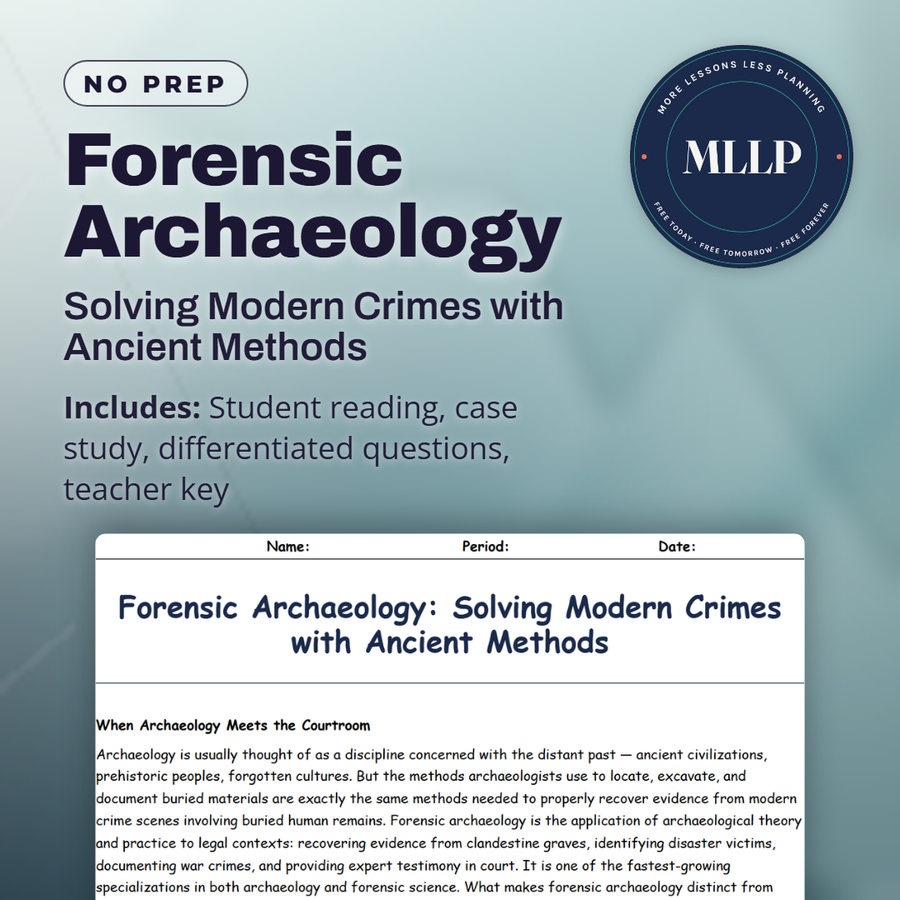
Forensic Archaeology: Solving Modern Crimes with Ancient Methods
Quality reviewed September 2026
Facts verified September 21, 2026
- Subject
- Social Studies
- Grades
- Grades 9-12
- Length
- 8-page student worksheet
- Time
- About one 50-minute class period
- Great for
- Sub plans and independent work
- Includes
- Reading passage, comprehension questions + full answer key
- Format
- Print-and-go PDF
What students do
- Write short answers explaining why a rushed excavation destroys evidence that can never be recovered
- Ground-penetrating radar and cadaver dogs locate a clandestine grave long before anyone picks up a trowel
- Srebrenica's excavated mass graves supplied the documented evidence behind convictions at an international war crimes tribunal
- Sort out what Dr. Osei says a three-hour police excavation destroyed, from soil profile to buried artifacts
What it covers
- Why archaeologists treat a clandestine grave itself as evidence, not only the body inside it
- How Srebrenica mass grave excavations produced evidence used in international war crimes convictions
- What chain of custody documentation is and why a single gap can make evidence inadmissible in court
Start reading this worksheet
When Archaeology Meets the Courtroom
Archaeology is usually thought of as a discipline concerned with the distant past: ancient civilizations, prehistoric peoples, forgotten cultures. But the methods archaeologists use to locate, excavate, and document buried materials are exactly the same methods needed to properly recover evidence from modern crime scenes involving buried human remains. Forensic archaeology is the application of archaeological theory and practice to legal contexts: recovering evidence from clandestine graves, identifying disaster victims, documenting war crimes, and providing expert testimony in court. It is one of the fastest-growing specializations in both archaeology and forensic science. What makes forensic archaeology distinct from ordinary crime scene investigation is its insistence on patience and documentation. Police officers trained in rapid evidence collection sometimes see a burial as something to be excavated as quickly as possible to recover the body. Forensic archaeologists see it differently: the grave itself is evidence. Data points that can answer questions in court include the depth of the burial, the orientation of the body, the presence of soil disturbance, the objects buried with the remains, the pattern of plant growth above the grave, and the insect activity in different layers. Once a grave is disturbed carelessly, that evidence is destroyed permanently.
Excavating Clandestine Graves: Patience Over Speed
A clandestine grave is one that has been deliberately concealed, typically by someone trying to hide evidence of a crime. These graves present unique challenges because the person who dug them was not following any systematic plan. They might be shallow or deep, in open ground or under concrete, containing one individual or many. Forensic archaeologists use a range of survey techniques before they ever put a trowel in the ground: ground-penetrating radar to detect soil disturbances, cadaver dogs trained to locate human decomposition, careful vegetation analysis (plants grow differently over disturbed soil), and aerial photography to identify anomalies invisible at ground level. Once excavation begins, it proceeds with the same systematic care as any archaeological dig. Soil is removed in controlled layers. Every artifact and bone fragment is mapped in three dimensions before it is moved. Photography documents each stage. Soil samples are collected for later analysis. The goal is to establish not just what is in the grave, but what it tells us about how and when the body was placed there: information that can establish time of death, manner of burial, and potentially the identity of whoever did the burying. In court, this level of documentation is not just useful. It is required.
War Crimes and Mass Graves: Archaeology as Justice
Some of the most consequential work in forensic archaeology takes place not in local criminal cases but on an international scale. Mass graves from genocides, civil wars, and atrocities represent some of the most challenging and emotionally demanding sites forensic archaeologists will ever work. In the 1990s and 2000s, forensic archaeology teams worked extensively in Bosnia, Rwanda, and elsewhere, documenting the physical evidence of mass killings to support international criminal tribunals. The Srebrenica massacre in Bosnia, in which approximately 8,000 Bosnian Muslim men and boys were killed in 1995, was documented in part through the excavation of dozens of primary and secondary mass graves, sites where bodies had been moved to conceal them. The forensic evidence from these excavations was central to convictions at the International Criminal Tribunal for the former Yugoslavia. Archaeologists testified about the number of individuals represented in each grave, the manner of death, the evidence of perimortem (around the time of death) trauma, and the stratigraphic evidence showing that graves had been disturbed and bodies moved. In legal terms, this was not just academic scholarship. It was evidence that sent convicted war criminals to prison. The ability to excavate carefully, document systematically, and testify credibly in court is what makes forensic archaeologists uniquely valuable in these contexts.
Like what you read? The full reading, the case study, and every question set are in the free download below, along with the answer key.
Why this matters
Crime shows make excavation look fast, and this reading pushes back on that directly: a grave excavated in three hours can permanently destroy the evidence a real court case depends on, which is exactly what Dr. Osei has to explain to a defense attorney in the case study. Srebrenica shows the same principle scaled up to the level of international justice, where careful documentation of mass graves became evidence that helped convict war criminals decades later. For a student weighing law enforcement, law, or forensic science as a career, this is a clear example of how patience and documentation are not paperwork. They are the evidence itself.
From one teacher to another
The same careful, patient methods that archaeologists use on an ancient burial turn out to be exactly what a modern courtroom needs from a crime scene involving buried remains. This reading walks through how forensic archaeologists survey a suspected clandestine grave with ground-penetrating radar and cadaver dogs before ever picking up a trowel, then document every layer, artifact, and bone in three dimensions because a grave disturbed carelessly can never be re-excavated. It follows that same discipline into international war crimes work, where systematic excavation of Bosnia's Srebrenica mass graves produced evidence used in convictions at an international tribunal, and into disaster response, where chain of custody documentation can decide whether evidence holds up in court. The case study follows expert witness Dr. James Osei as he explains, to a defense attorney, exactly what a three-hour shovel excavation destroyed before anyone realized it mattered.
What you get
Download
Where should I send the next one?
Everything here is free and it stays that way. Leave your email and I'll send you the new lessons as they go up. You can unsubscribe from any one of them.
Related resources
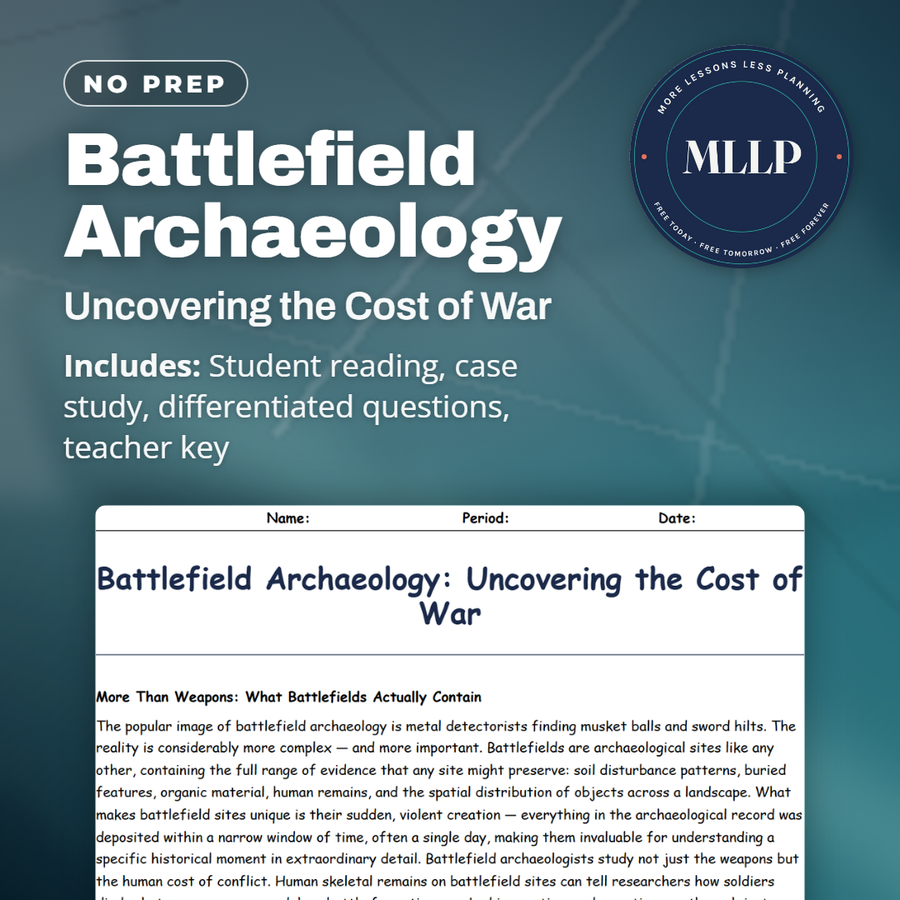
Battlefield Archaeology: Uncovering the Cost of War
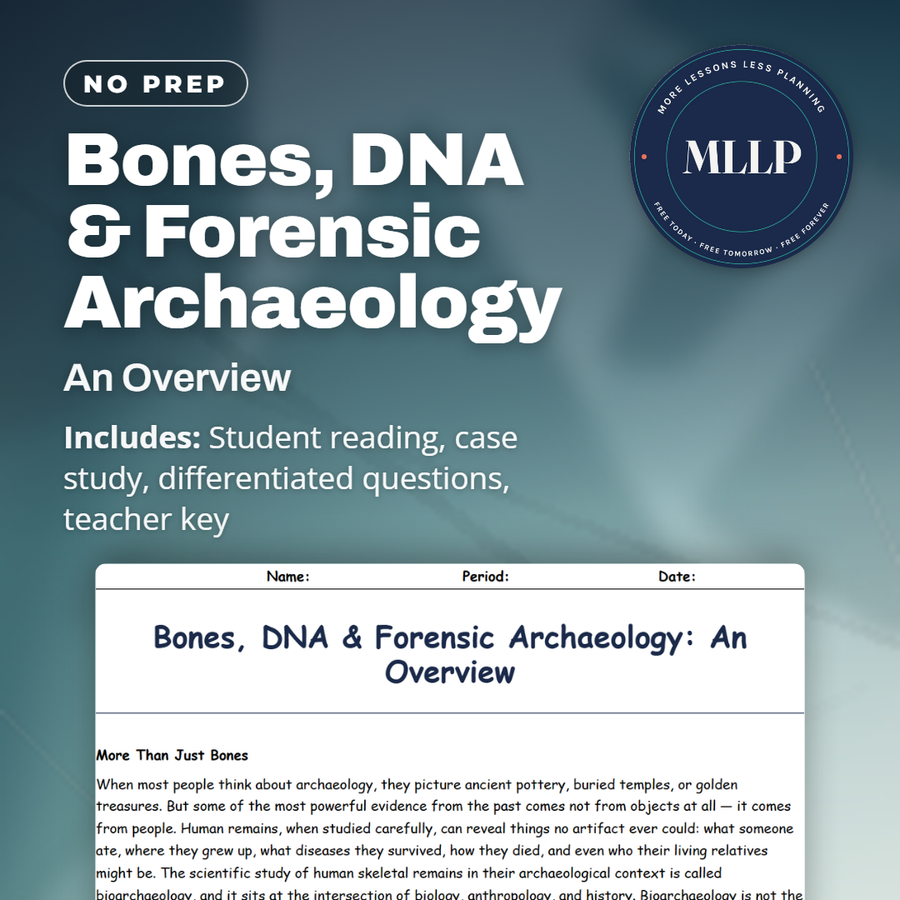
Bones, DNA & Forensic Archaeology: An Overview
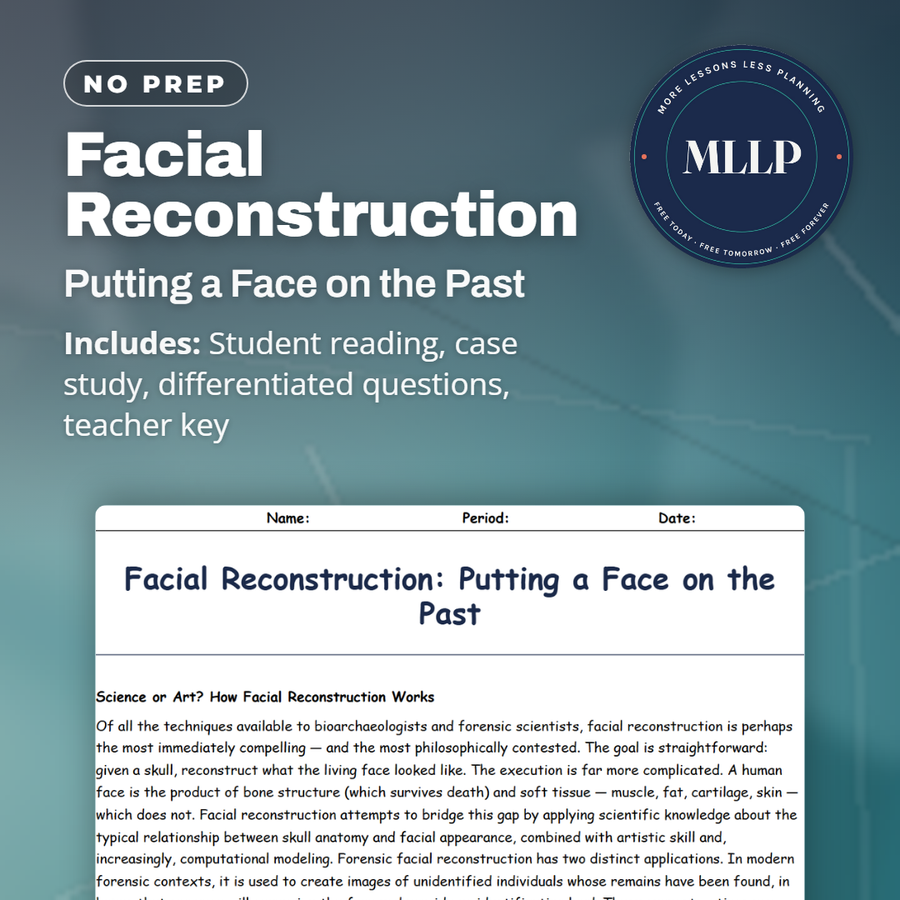
Facial Reconstruction: Putting a Face on the Past
_COVER.png)
Isotope Analysis: You Are What You Eat (and Where You Lived)
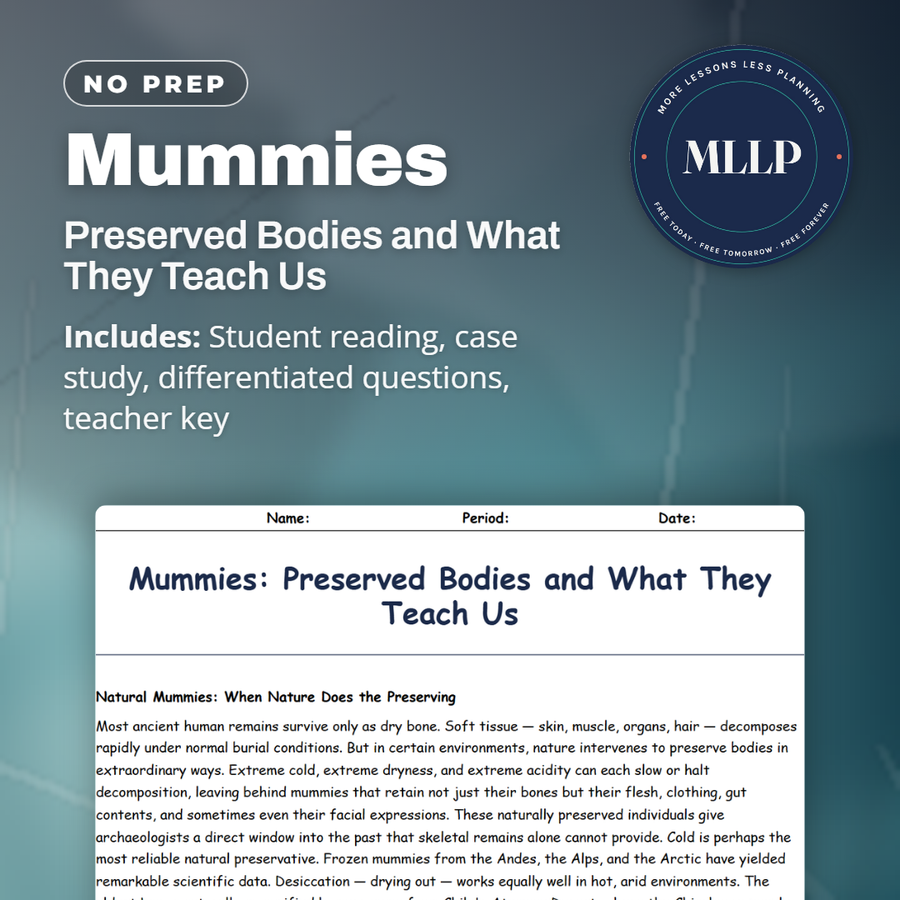
Mummies: Preserved Bodies and What They Teach Us
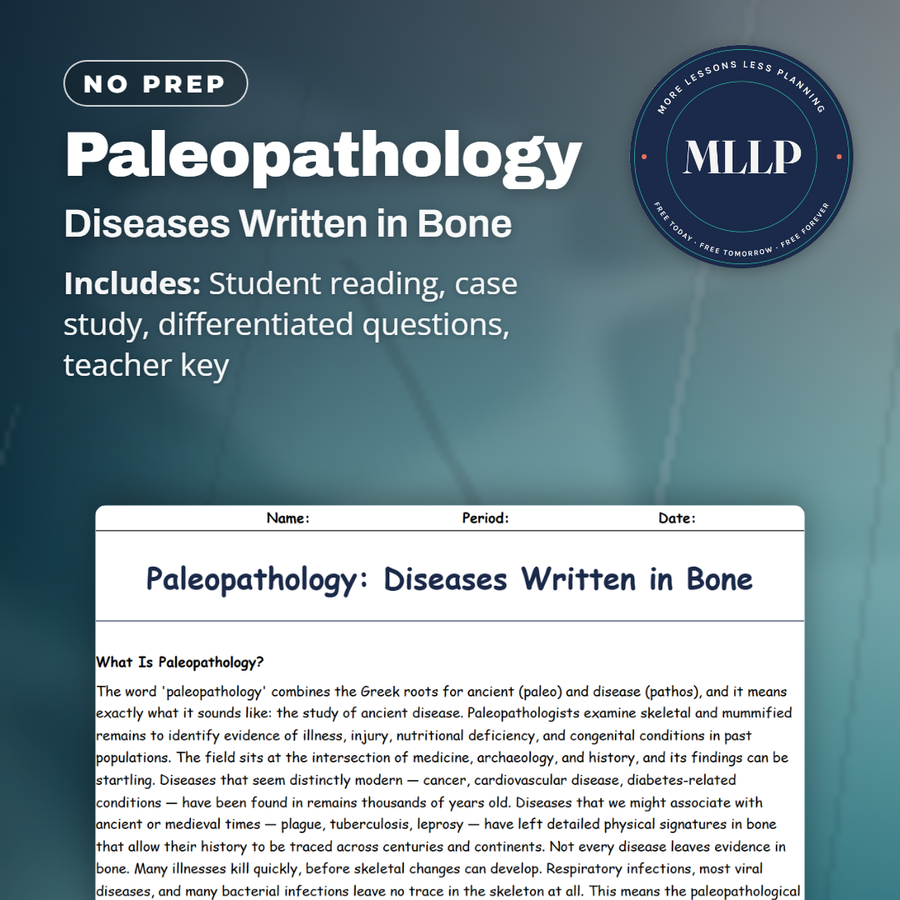
Paleopathology: Diseases Written in Bone
Every lesson on this site is free to download and use. If one of them saved you a prep period, you can chip in a few bucks toward my three kids' daycare fund. That's genuinely where tips go.