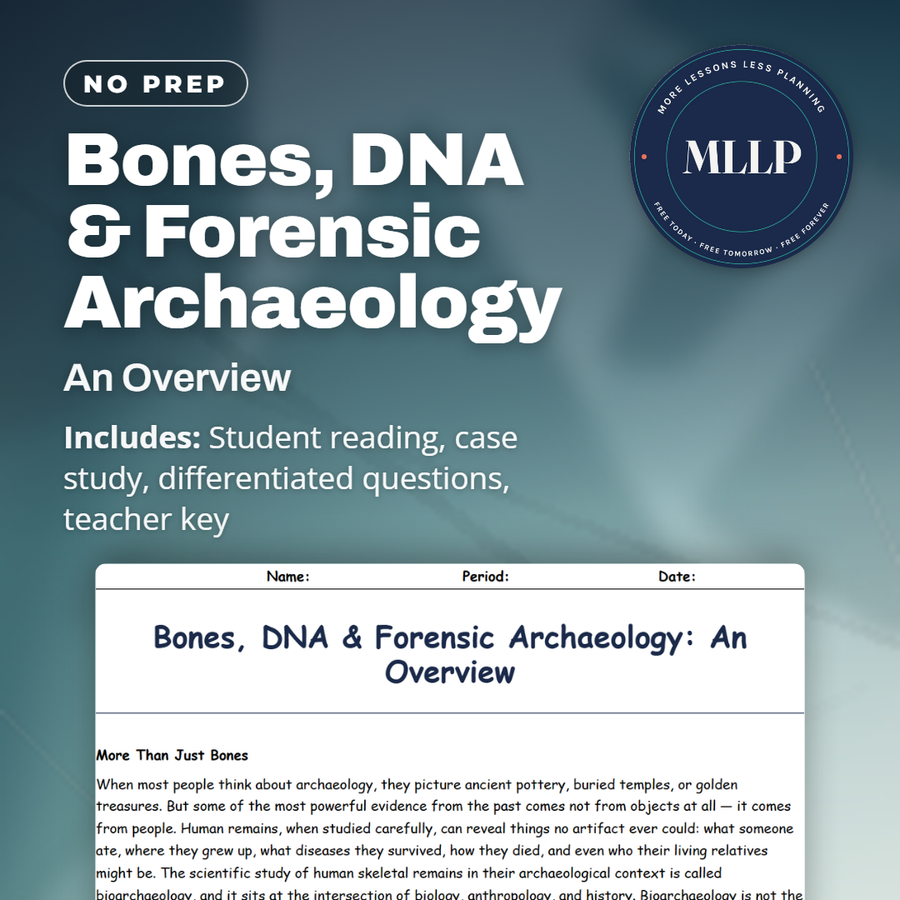
Bones, DNA & Forensic Archaeology: An Overview
Quality reviewed September 2026
Facts verified September 21, 2026
- Subject
- Social Studies
- Grades
- Grades 9-12
- Length
- 8-page student worksheet
- Time
- About one 50-minute class period
- Great for
- Sub plans and independent work
- Includes
- Reading passage, comprehension questions + full answer key
- Format
- Print-and-go PDF
What students do
- Match five terms, including bioarchaeology, osteology, and aDNA, to their definitions
- Bioarchaeology's historical questions and forensic anthropology's legal ones turn out to rest on the exact same bone-reading skills
- Fill in blanks naming bioarchaeology, ancient DNA, and NAGPRA
- Maya's family finds a human femur in their Ohio farmhouse and has to think through what NAGPRA would mean if it is Indigenous
What it covers
- The difference between bioarchaeology's historical questions and forensic anthropology's legal ones
- How NAGPRA changed the legal status of Native American remains held in museums and universities
- What a 150-year-old femur found in a farmhouse cellar can and cannot tell a forensic anthropologist
Start reading this worksheet
More Than Just Bones
When most people think about archaeology, they picture ancient pottery, buried temples, or golden treasures. But some of the most powerful evidence from the past comes not from objects at all: it comes from people. Human remains, when studied carefully, can reveal things no artifact ever could: what someone ate, where they grew up, what diseases they survived, how they died, and even who their living relatives might be. The scientific study of human skeletal remains in their archaeological context is called bioarchaeology, and it sits at the intersection of biology, anthropology, and history. Bioarchaeology is not the same as simply digging up bones. It is a disciplined practice that treats human remains as primary historical documents. A bioarchaeologist looks at a skeleton the way a detective looks at a crime scene: systematically, carefully, and with a specific set of questions in mind. How old was this person? What was their biological sex? Did they show signs of disease or malnutrition? Were there injuries consistent with violence? Every bone in the human body has the potential to answer one of these questions, and together they build a portrait of a life lived centuries or millennia ago.
The Science of Reading the Dead
Forensic anthropology is a closely related field, but it is oriented toward legal and criminal contexts rather than historical ones. Where a bioarchaeologist might study a medieval burial to understand population health, a forensic anthropologist is more likely to be called to a crime scene or disaster site to help identify victims. Both fields use the same fundamental skills (reading bone morphology, estimating age at death, determining biological sex), but their purposes and contexts are different. In some cases, the fields overlap significantly: when archaeologists excavate historic mass graves from wars or genocides, forensic anthropologists are often part of the team. Osteology, the scientific study of bones, underlies both disciplines. The human skeleton contains 206 bones in adults, and each one carries information. The density of bone changes with age. The shape of certain bones differs between biological sexes. The surfaces where muscles attach show wear patterns that reveal lifetime labor habits. Growth plates fuse at predictable ages. A trained osteologist can look at a skeleton and produce a biological profile that includes estimated age, sex, height, ancestry, and a list of health conditions, all without a single written record.
Ancient DNA: A Revolution in Progress
The newest and perhaps most dramatic tool in the study of human remains is ancient DNA, often abbreviated aDNA. Preserved fragments of genetic material can sometimes be extracted from bones and teeth that are thousands of years old, and when they can, the results are often stunning. Ancient DNA has revealed that modern Europeans are descended from at least three distinct ancestral populations. It confirmed that Neanderthals and modern humans interbred. It showed that the first Americans came from Siberia in multiple migration waves. It even identified entirely new human relatives, the Denisovans, from a single finger bone found in a Siberian cave. Ancient DNA analysis has transformed archaeology from a field that reconstructed the past from objects into one that can directly read the genetic code of the people who made them. But it is not magic. DNA degrades rapidly, especially in warm or wet conditions. Contamination from modern DNA is a constant risk. Only a fraction of ancient specimens preserve usable genetic material, and even when DNA is recovered, interpreting what it means requires careful statistical analysis. The field is moving fast, and its findings sometimes overturn long-held assumptions, which makes it exciting, but also means scientists must interpret results with caution.
Like what you read? The full reading, the case study, and every question set are in the free download below, along with the answer key.
Why this matters
A lot of students think archaeology stops at pottery and ruins, but this reading uses NAGPRA to show how the same bone-reading skills raise real legal and ethical stakes today. Thousands of Native American remains sat in museum drawers for decades before this law required their return, and Maya's case study puts a present-day family in the middle of that same question inside a farmhouse cellar. Students headed toward forensic science, law, or anthropology get a concrete look at how a single bone can trigger a legal process that outlasts the original discovery by years.
From one teacher to another
Skeletons carry information no artifact ever could, and this reading treats bioarchaeology as a discipline that reads bone the way a detective reads a scene. It separates bioarchaeology, which reconstructs how past populations lived, from forensic anthropology, which applies the same bone-reading skills to modern crime scenes and disasters, then shows how ancient DNA has confirmed Neanderthal interbreeding, traced the Denisovans to a single Siberian finger bone, and revealed multiple migration waves into the Americas. It closes on NAGPRA, the 1990 law requiring federally funded institutions to return Native American remains to affiliated tribes. The case study follows sixteen-year-old Maya Kowalski, who finds a human femur in her family's Ohio farmhouse and has to think through what a forensic anthropologist can and cannot determine from a single bone.
What you get
Download
Where should I send the next one?
Everything here is free and it stays that way. Leave your email and I'll send you the new lessons as they go up. You can unsubscribe from any one of them.
Related resources
Battlefield Archaeology: Uncovering the Cost of War
Facial Reconstruction: Putting a Face on the Past
Forensic Archaeology: Solving Modern Crimes with Ancient Methods
_COVER.png)
Isotope Analysis: You Are What You Eat (and Where You Lived)
Mummies: Preserved Bodies and What They Teach Us
Paleopathology: Diseases Written in Bone
Every lesson on this site is free to download and use. If one of them saved you a prep period, you can chip in a few bucks toward my three kids' daycare fund. That's genuinely where tips go.