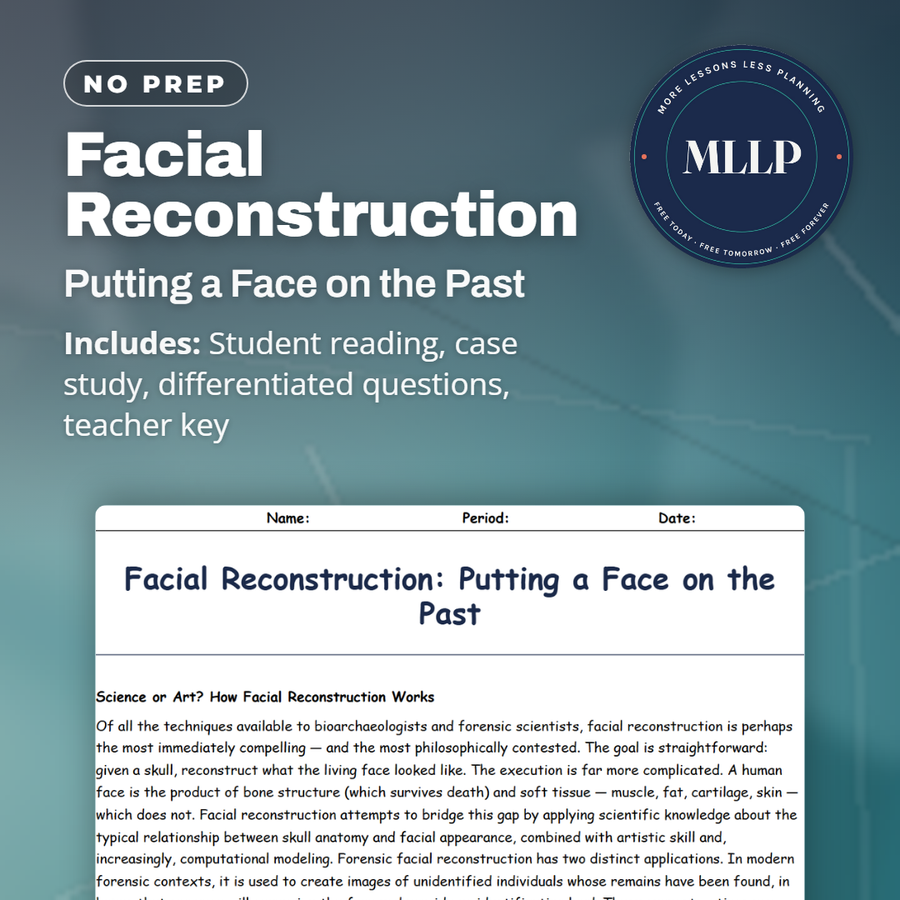
Facial Reconstruction: Putting a Face on the Past
Quality reviewed September 2026
Facts verified September 21, 2026
- Subject
- Social Studies
- Grades
- Grades 9-12
- Length
- 9-page student worksheet
- Time
- About one 50-minute class period
- Great for
- Sub plans and independent work
- Includes
- Reading passage, comprehension questions + full answer key
- Format
- Print-and-go PDF
What students do
- Sort out how tissue depth tables and skull morphology each shape a reconstructed face differently
- Richard III's skull-based reconstruction turned out far younger and more sympathetic than centuries of Tudor-era portraits
- Explain why Camille documents what her reconstruction can and cannot prove instead of presenting it as a finished portrait
- A forensic artist rebuilds a woman's face from a Boston construction site using 21 standard skull landmark points
What it covers
- How tissue depth tables and skull landmarks guide the buildup of a reconstructed face
- Why Richard III's skull-based reconstruction looked so different from his Tudor-era portraits
- What a skull can and cannot reveal about skin color, eye color, and a person's expression
Start reading this worksheet
Science or Art? How Facial Reconstruction Works
Of all the techniques available to bioarchaeologists and forensic scientists, facial reconstruction is perhaps the most immediately compelling, and the most philosophically contested. The goal is straightforward: given a skull, reconstruct what the living face looked like. The execution is far more complicated. A human face is the product of bone structure (which survives death) and soft tissue (muscle, fat, cartilage, skin), which does not. Facial reconstruction attempts to bridge this gap by applying scientific knowledge about the typical relationship between skull anatomy and facial appearance, combined with artistic skill and, increasingly, computational modeling. Forensic facial reconstruction has two distinct applications. In modern forensic contexts, it is used to create images of unidentified individuals whose remains have been found, in hopes that someone will recognize the face and provide an identification lead. These reconstructions are explicitly tools for generating tips, not definitive portraits: the goal is to jog someone's memory, not to produce a photograph-quality likeness. In archaeological contexts, reconstruction is used to put a human face on historical figures (kings, ancient populations, prehistoric individuals), making them accessible to a public that finds it easier to connect with a face than with a bare skull.
Tissue Depth Tables and Skull Morphology
The scientific foundation of facial reconstruction lies in tissue depth data: measurements of how thick the soft tissue is at specific landmark points on a living face, collected from cadavers and medical imaging studies. These measurements vary by age, sex, body mass, and ancestry, and tissue depth tables organized by these variables are the starting point for any reconstruction. A reconstructor places tissue depth markers at specific skull landmarks and uses them to guide the buildup of clay or digital modeling: the markers define the surface the face must reach at each point, and the reconstructor fills in between them using anatomical knowledge and professional judgment. Skull morphology, the shape and structure of the skull, provides additional information. The width of the nasal aperture correlates with the width of the nose. The depth of the eye socket relates to eye protrusion. The shape of the dental arch influences the appearance of the lips and lower face. The angle and prominence of the brow ridges shape the forehead. These relationships are probabilistic, not deterministic: they narrow the range of plausible facial appearances without specifying an exact result. Two skilled reconstructors working from the same skull, using the same tissue depth data, can produce recognizably similar but not identical results. This is why reconstruction is characterized as both a science and an art: the science constrains the possibilities, but the art fills in the gaps.
Famous Reconstructions: Richard III, Tutankhamun, and Beyond
The 2012 discovery of Richard III's skeleton beneath a Leicester car park, and the subsequent facial reconstruction, became one of the most publicized archaeological finds of the century. Richard III, the last English king to die in battle (at Bosworth Field in 1485), had been depicted in portraits painted after his death that showed a man with a somewhat pinched, suspicious face: portraits that may have been influenced by Tudor propaganda intent on portraying the defeated king unfavorably. The reconstruction from his actual skull produced a face that many people found surprisingly sympathetic: a relatively young-looking man (he was 32 when he died), with a dignified, somewhat melancholy expression. The reconstruction shifted public perception of a figure who had been defined for centuries largely by Shakespeare's villain. Tutankhamun has been reconstructed multiple times using different methods, with results that vary somewhat in detail but consistently show a young man with a somewhat elongated skull, consistent with depictions in Egyptian art but with the addition of soft tissue that makes him recognizable as an individual rather than an idealized representation. The expanding canon of facial reconstructions has given human faces to individuals who would otherwise remain purely anonymous, among them ancient Athenians, prehistoric hunter-gatherers, and medieval women found beneath city streets. Each reconstruction carries its own uncertainties, and responsible practitioners are careful to communicate what is scientifically constrained versus what reflects the reconstructor's informed judgment.
Like what you read? The full reading, the case study, and every question set are in the free download below, along with the answer key.
Why this matters
Students see AI-generated faces online constantly, so the digital reconstruction section of this reading lands close to home: the same technology that can move faster than a human artist can also look more certain than the science actually supports. Richard III's case gives students a concrete example of how a face, real or reconstructed, can shape public opinion for centuries, since Tudor propaganda shaped his image long before anyone had his actual skull to work from. Camille's case study shows what responsible practice looks like when a reconstruction has real emotional weight for the people who will read the final report.
From one teacher to another
A skull can outlive a face by thousands of years, and this reading explains how forensic artists rebuild the missing soft tissue using tissue depth tables, measurements of skin thickness collected from cadavers and organized by age, sex, and ancestry. It follows the science through two famous cases: the 2012 reconstruction of Richard III, which produced a younger, more sympathetic face than centuries of Tudor-era portraits had suggested, and the ongoing digital and AI-assisted reconstructions that can now be revised and shared far more easily than a clay model. The reading is direct about the limits: a skull cannot reveal exact skin color, eye color, or a person's habitual expression without DNA evidence. The case study follows forensic artist Camille Dubois as she reconstructs the face of a woman found beneath a Boston construction site and writes, carefully, about what her science can and cannot prove.
What you get
Download
Where should I send the next one?
Everything here is free and it stays that way. Leave your email and I'll send you the new lessons as they go up. You can unsubscribe from any one of them.
Related resources

Battlefield Archaeology: Uncovering the Cost of War

Bones, DNA & Forensic Archaeology: An Overview

Forensic Archaeology: Solving Modern Crimes with Ancient Methods
_COVER.png)
Isotope Analysis: You Are What You Eat (and Where You Lived)

Mummies: Preserved Bodies and What They Teach Us

Paleopathology: Diseases Written in Bone
Every lesson on this site is free to download and use. If one of them saved you a prep period, you can chip in a few bucks toward my three kids' daycare fund. That's genuinely where tips go.