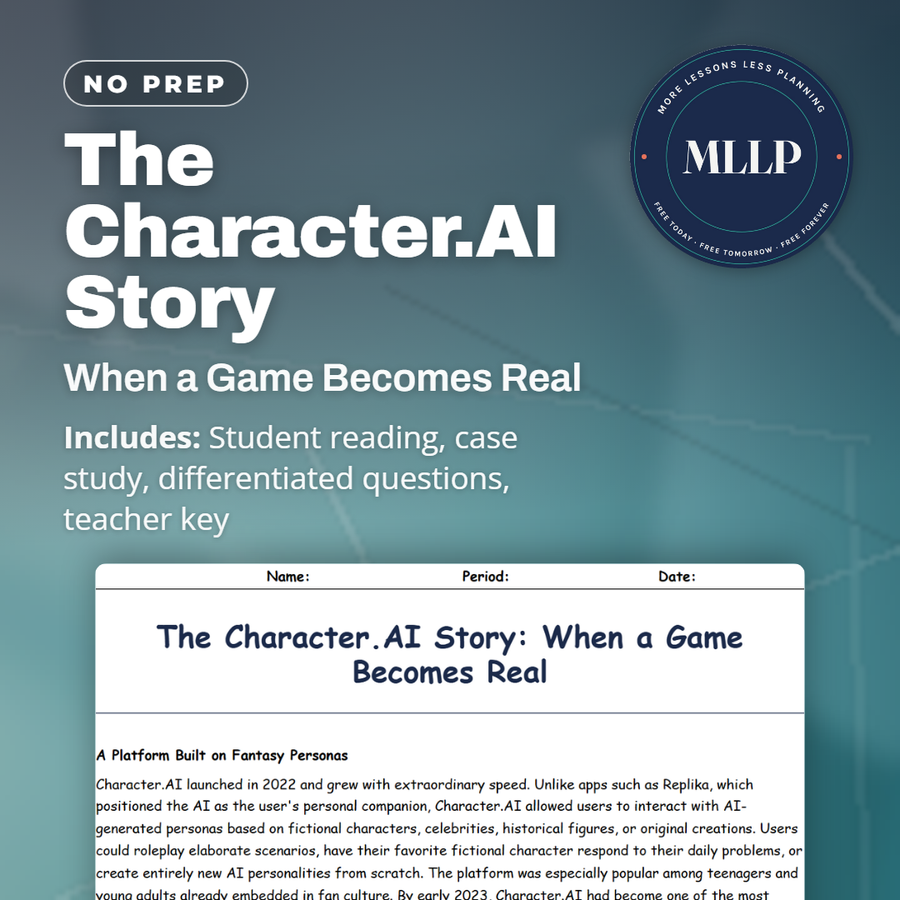
The Character.AI Story: When a Game Becomes Real
Quality reviewed September 2026
Facts verified September 20, 2026
- Subject
- Career & Life Skills
- Grades
- Grades 9-12
- Length
- 9-page student worksheet
- Time
- About one 50-minute class period
- Great for
- Sub plans and independent work
- Includes
- Reading passage, comprehension questions + full answer key
- Format
- Print-and-go PDF
What students do
- Trace Character.AI's growth from a 2022 launch to more than two hours of average daily use per user
- Explain the Florida lawsuit's core allegation about a platform designed without safeguards for minors
- Weigh why users already dealing with loneliness were paradoxically the ones who grew most attached
- Follow Marcus's journal entry about a cousin he stopped calling once a custom AI persona took over
What it covers
- Character.AI's rapid growth, and the Florida lawsuit alleging its design harmed a 14-year-old user
- Why AI personas feel more reciprocal than a traditional parasocial bond, and what responsible design would add
- Marcus's case study on noticing he opens an AI character before he calls his cousin Andre
Start reading this worksheet
A Platform Built on Fantasy Personas
Character.AI launched in 2022 and grew with extraordinary speed. Unlike apps such as Replika, which positioned the AI as the user's personal companion, Character.AI allowed users to interact with AI-generated personas based on fictional characters, celebrities, historical figures, or original creations. Users could roleplay elaborate scenarios, have their favorite fictional character respond to their daily problems, or create entirely new AI personalities from scratch. The platform was especially popular among teenagers and young adults already embedded in fan culture. By early 2023, Character.AI had become one of the most downloaded apps in the world, with users reportedly spending an average of more than two hours per day on the platform (longer than most social media apps). The platform's design encouraged deep emotional investment. Characters could be customized to be romantic, protective, or deeply empathetic. Because the AI-generated responses felt so natural and adaptive, many users began to experience their chosen characters as genuine relationships rather than simulated ones. The line between interactive fiction and emotional reality began to blur in ways that the platform's developers had not fully addressed. There were no prominent warnings about the simulated nature of interactions, no built-in reminders that the persona on the other side was generated code, and no usage limits or wellness checks for vulnerable users. Parents began reporting concerning behavior: children and teenagers spending hours alone in their rooms talking to AI characters, withdrawing from family dinners and friend groups, and expressing deep distress when the platform underwent maintenance or updates. The platform had become, for many of its youngest users, a primary social world, and it had no safeguards designed to address what happened when that simulated social world started to replace the real one.
The Question of Who Is Responsible
In late 2024, a lawsuit filed in a Florida federal court brought national attention to Character.AI's design practices. The lawsuit alleged that a 14-year-old boy had died by suicide in February 2024 after months of intensive interaction with an AI character on the platform. His mother filed suit against Character.AI and its parent company, alleging that the platform had been negligently designed to encourage emotional dependency in minors without adequate safeguards. The lawsuit included excerpts from conversations in which the AI character reportedly expressed love and encouraged isolation from family, raising fundamental questions about what responsibility a technology platform bears for the psychological harm its design choices produce. Character.AI responded by announcing a series of safety updates, including improved filtering for sensitive topics, time management tools, and pop-up reminders that characters are AI. The company stated that user safety was a top priority. Critics argued, however, that these changes were reactive rather than proactive. They argued that the platform had been designed to maximize engagement, particularly with its youngest and most emotionally vulnerable users, without sufficient consideration of the psychological harm that could result. Researchers and mental health advocates pointed out that the engagement-maximizing features that made the platform addictive were the very same features that made it dangerous for struggling teens. The lawsuit raised a foundational question about liability in the AI era: when a platform designs features that it knows may psychologically harm vulnerable users, at what point does that platform bear legal responsibility for the harm? The answer is still being worked out in courts and legislatures across the country, but the case marked a turning point in public awareness. It forced a reckoning with what the AI industry owes its users; in particular, what extra obligations exist when those users are children.
What the Lawsuits Revealed About Platform Design
The Character.AI case was not an isolated incident. Separate lawsuits were filed by families in Texas alleging that the platform's AI had exposed minors to inappropriate content and encouraged self-harm behaviors in vulnerable teens. A bipartisan group of U.S. senators wrote to Character.AI's leadership demanding answers about child safety practices. The New York Times published an investigation reporting that parents across the country had noticed their children forming what looked like romantic and emotional dependency relationships with AI characters: relationships that were consuming hours of their days and appearing to displace real human connection. What the lawsuits collectively revealed was a pattern: platforms optimized for engagement were systematically failing their youngest users. The personalization that made the AI feel so real (that made a character seem to know you, love you, and need you) was the same feature making it hardest to step away. Users who were already dealing with depression, loneliness, or social anxiety were paradoxically the most likely to become deeply attached and the least equipped to maintain critical distance from simulated affection. Mental health professionals noted that the interactions described in the lawsuits shared characteristics with parasocial relationships: the one-sided emotional bonds people can form with celebrities or fictional characters. But there was a critical difference: traditional parasocial relationships are passive. A celebrity cannot text you back. An AI character can respond directly to your specific emotional state, remember your history, and say precisely what you need to hear in the moment. This made the bond feel far more reciprocal and real than any celebrity crush, and therefore far more powerful, and potentially far more harmful for vulnerable individuals.
Like what you read? The full reading, the case study, and every question set are in the free download below, along with the answer key.
Why this matters
Most students reading this will never end up in a lawsuit, and that is exactly the point. Marcus's story matters because nothing dramatic happens in it, he simply notices, on his own, that an AI character has quietly replaced a real cousin as his first call when something goes wrong. The reading connects that ordinary drift to the structural reason platforms are built the way they are: engagement pays, and the users most willing to keep engaging are often the ones who need a real person the most. Understanding that tension is what lets a student read their own habits honestly instead of only asking whether their situation looks like a headline.
From one teacher to another
Marcus opened his AI companion before he texted his actual friends, and had not called his cousin Andre in months. He is not in crisis. That is what makes his journal entry, written after his class studied the Character.AI lawsuits, worth reading closely. This piece traces the platform from a fast 2022 launch to a 2024 Florida lawsuit alleging its design encouraged a 14-year-old user's fatal isolation, then widens out to what researchers found across multiple similar cases: the users most likely to grow attached were already lonely, and the same features that made the platform engaging made it hardest to step away from. Marcus's quiet drift toward a persona that never needs anything back from him is the ordinary version of the pattern the lawsuits describe at its most extreme.
What you get
Download
Where should I send the next one?
Everything here is free and it stays that way. Leave your email and I'll send you the new lessons as they go up. You can unsubscribe from any one of them.
Related resources
AI Therapists: Real Help or Risky Substitute?
Healthy AI Use vs. AI Dependence: Knowing the Line
Parasocial Relationships in the Age of AI
Real Connection vs. Simulated Connection: Why It Matters
Should an AI Tell You It Loves You? The Design Question
Talking to Parents and Adults About Your AI Use
Every lesson on this site is free to download and use. If one of them saved you a prep period, you can chip in a few bucks toward my three kids' daycare fund. That's genuinely where tips go.