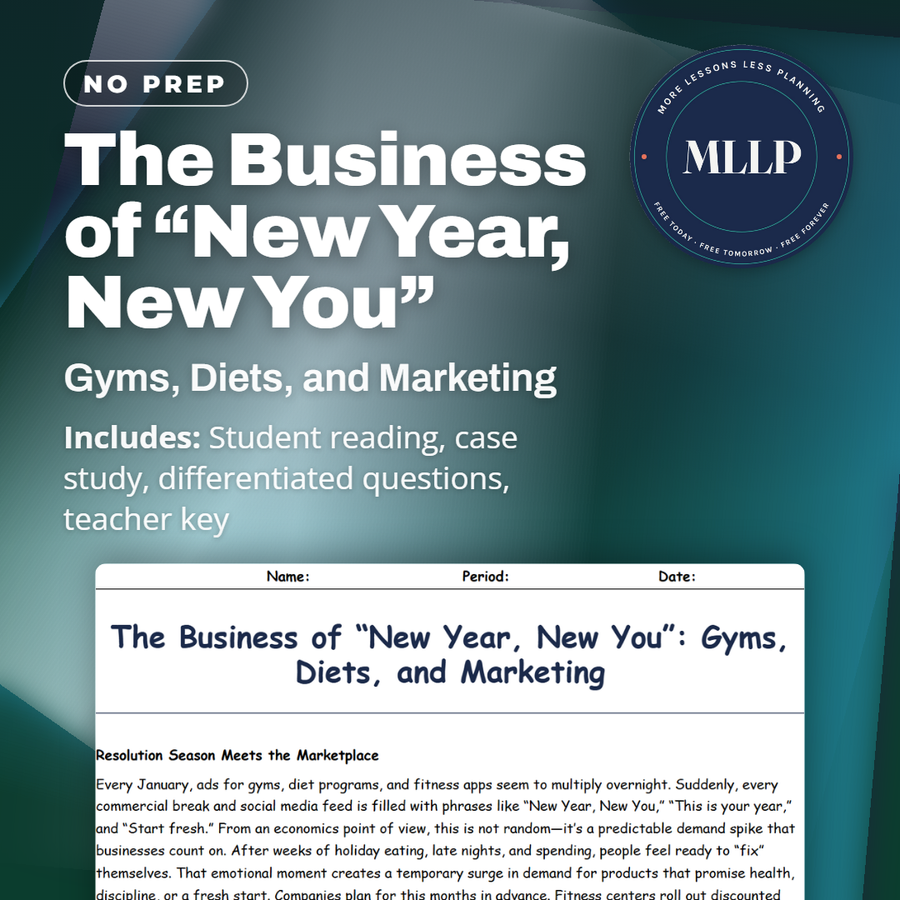
The Business of “New Year, New You”: Gyms, Diets, and Marketing
Quality reviewed September 2026
Facts verified September 9, 2026
- Subject
- Social Studies
- Grades
- Grades 9-12
- Length
- 7-page student worksheet
- Time
- About one 50-minute class period
- Great for
- Sub plans and independent work
- Includes
- Reading passage, comprehension questions + full answer key
- Format
- Print-and-go PDF
What students do
- Analyze how gyms use subscription models and loss aversion to retain paying members
- Evaluate scarcity marketing tactics and social proof in New Year fitness promotions
- Calculate the actual cost per visit using Jordan's gym contract case study
- Apply sunk cost fallacy concepts to explain why consumers keep paying for unused services
What it covers
- Subscription business models and recurring revenue
- Behavioral economics and consumer decision-making
- Marketing psychology and persuasion tactics
Start reading this worksheet
Resolution Season Meets the Marketplace
Every January, ads for gyms, diet programs, and fitness apps seem to multiply overnight. Suddenly, every commercial break and social media feed is filled with phrases like “New Year, New You,” “This is your year,” and “Start fresh.” From an economics point of view, this is not random—it’s a predictable demand spike that businesses count on. After weeks of holiday eating, late nights, and spending, people feel ready to “fix” themselves. That emotional moment creates a temporary surge in demand for products that promise health, discipline, or a fresh start. Companies plan for this months in advance. Fitness centers roll out discounted sign-up fees and “no money down” deals that expire in early January. Diet programs offer limited-time trial prices. Fitness influencers release new “challenge” programs starting on January 1. These offers are carefully timed to match the psychology of resolutions: people feel motivated, optimistic, and willing to commit to something big—often bigger than they can realistically maintain in February or March. Economists and psychologists call this a temporal mismatch between how we feel now and how we will feel later. In early January, it is easy to imagine a future version of yourself who goes to the gym five days a week and never orders fries. Businesses quietly build their business model around that optimism. They know that sign-ups are highest when motivation is highest, even if actual usage drops sharply once school, work, and life get busy again.
Memberships, Subscriptions, and “Breakage” in Behavior
Many “New Year, New You” products rely on subscription models rather than one-time purchases. A gym membership, for example, charges a monthly fee for access, whether you show up or not. A diet app might bill your credit card every month or offer a cheaper price for a full year paid up front. Economically, this structure creates a steady stream of recurring revenue for the business. The ideal customer is not necessarily the one who uses the service every day, but the one who keeps paying for months. A key concept here is loss aversion—the idea that people dislike losses more than they enjoy equal-sized gains. Once you’ve signed a contract or paid for a year of access, canceling can feel like admitting defeat or “wasting” the money you spent. That feeling is related to the sunk cost fallacy: treating past expenses (which cannot be recovered) as a reason to keep investing, even when it no longer makes sense. Gyms and programs benefit when customers stay subscribed out of habit or guilt, instead of based on current marginal benefit (what you actually get out of it now). Here is a simplified look at how a typical gym might earn money from “New Year, New You” customers: From the business’s perspective, January is like planting seeds. The sign-ups are the easy part; the real profit often comes from month after month of automatic payments, especially from those who stop using the service regularly but delay canceling “just in case” they start again.
Like what you read? The full reading, the case study, and every question set are in the free download below, along with the answer key.
Why this matters
Jordan signs a gym contract on January 2, certain the workouts will happen every week, and is still paying for it in March after they stopped. That gap has nothing to do with gym equipment; it is the subscription model and the sunk cost fallacy that keep Jordan paying anyway.
The concept lands fast when it is somebody else's contract, and it lands for real once students calculate Jordan's actual cost per visit. Teaching it in early January, while their own families weigh the same ads, turns a behavioral economics term into something they recognize at home.
From one teacher to another
I teach this worksheet in early January when every student has seen the gym ads and at least half their families are considering a membership. We walk through Jordan's actual experience. Signing up on January 2 full of optimism, then paying through March for workouts that never happen. The subscription model and sunk cost fallacy suddenly make sense when it's their own money. Students crunch numbers to find the real cost per visit, then we talk about why people keep renewing something they've stopped using. It's a sharp lesson in the gap between January motivation and February reality.
What you get
Download
Where should I send the next one?
Everything here is free and it stays that way. Leave your email and I'll send you the new lessons as they go up. You can unsubscribe from any one of them.
Related resources

Biology of Evergreen Plants: The Science Behind Christmas Trees
Body Clocks and Midnight Countdowns: Circadian Rhythms at New Year’s

Calendars, Orbits, and the Science of New Year’s Day

Christmas on the Home Front: WWII Rationing and Resilience

Colorful Chemistry: Holiday Lights, Fireworks, and the Science of Glow
Crowded Skies: Holiday Air Travel and the Environment
Every lesson on this site is free to download and use. If one of them saved you a prep period, you can chip in a few bucks toward my three kids' daycare fund. That's genuinely where tips go.