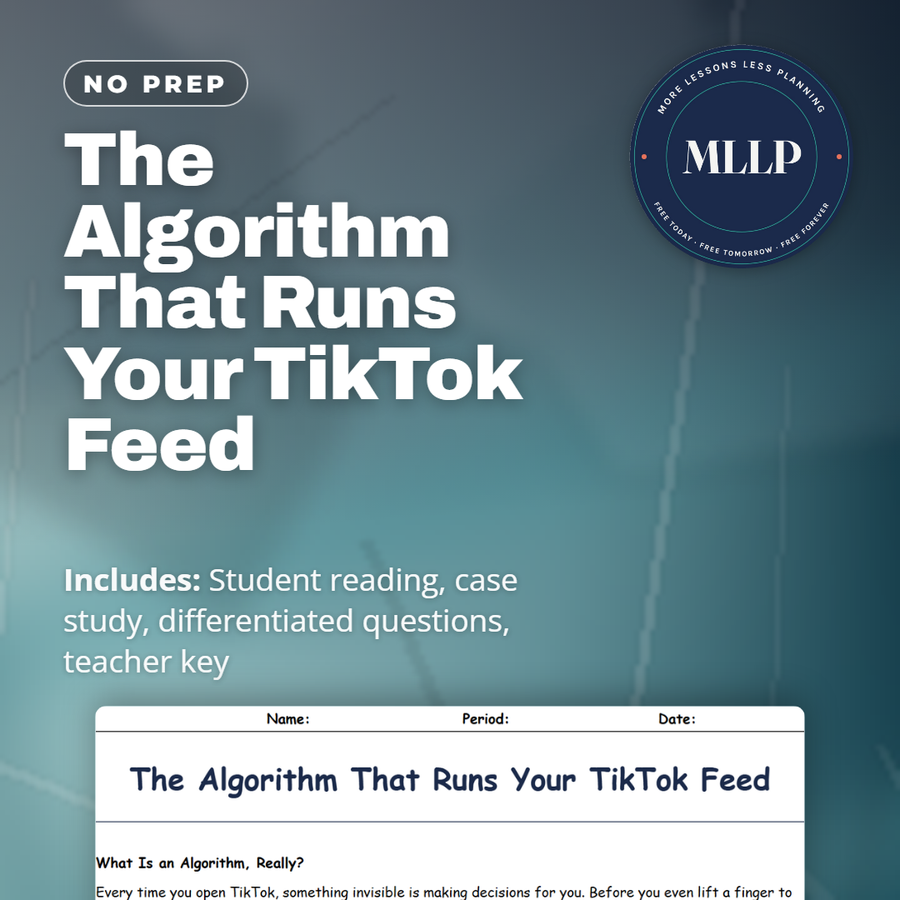
The Algorithm That Runs Your TikTok Feed
Quality reviewed September 2026
Facts verified September 20, 2026
- Subject
- Career & Life Skills
- Grades
- Grades 9-12
- Length
- 9-page student worksheet
- Time
- About one 50-minute class period
- Great for
- Sub plans and independent work
- Includes
- Reading passage, comprehension questions + full answer key
- Format
- Print-and-go PDF
What students do
- Fill in the blank on the signals, from watch time to replay rate, that train TikTok's recommendation algorithm
- A single rewatched video can shift an entire For You Page within days, no search required
- Answer whether TikTok's algorithm violated Destiny's trust or simply did what it was built to do
- Destiny's feed shifted from dance videos to diet content after she rewatched one video twice
What it covers
- How watch time, replays, and collaborative filtering decide what lands on the For You Page
- The rabbit hole effect and why emotionally intense content keeps climbing the feed
- Destiny's case study on how one rewatched video reshaped her entire recommendations
Start reading this worksheet
What Is an Algorithm, Really?
Every time you open TikTok, something invisible is making decisions for you. Before you even lift a finger to scroll, a complex system has already calculated (with startling accuracy) what videos are most likely to keep you watching. That system is called a recommendation algorithm, and understanding how it works is one of the most important pieces of AI literacy a young person can have today. An algorithm is simply a set of instructions. In everyday life, a recipe is an algorithm: do step one, then step two, then step three, and you get a result. Computer algorithms work the same way, except they can execute millions of steps in a fraction of a second. TikTok's recommendation algorithm, sometimes called the For You Page (FYP) algorithm, is one of the most sophisticated and carefully guarded algorithms in the world.
The Signals That Feed the Machine
TikTok's algorithm is powered by behavioral data: the digital traces you leave every time you interact with the app. The signals it tracks include: how long you watch each video (even a one-second pause counts), whether you rewatch a clip, whether you like, comment, share, or follow the creator, what you search for, what content you skip, and even how you hold your phone while watching. Every one of those actions is a data point. According to documents TikTok filed with regulators and internal reporting, watch time and replay behavior are the two strongest signals in the algorithm. A video you watch three times in a row tells the system something powerful: this user cannot look away. That signal gets amplified immediately. The content you skip, on the other hand, trains the algorithm away from topics you find boring or annoying. Within 30 minutes of a new user signing up, TikTok's system has already built a rough profile of that person's preferences. It keeps getting more accurate with every scroll.
How the For You Page Is Built
When a new video is uploaded to TikTok, it is first shown to a small test audience: maybe a few hundred users with similar profiles to the uploader's existing followers. The algorithm measures how that test group responds. High completion rate? Strong engagement? The video gets pushed to a larger pool. This cascading process repeats: each wave tests the video on a bigger audience, and only videos that continue to perform well get pushed to millions of people. This is why TikTok can launch unknown creators into overnight fame. It has nothing to do with follower counts and everything to do with performance data. A 14-year-old in a small town with zero followers can go viral if their video hits a 95% completion rate in its first test group. The algorithm is democratic in one sense (it gives everyone a shot) but it is also brutally efficient: videos that underperform are buried instantly, often seen by fewer than 500 people total. The system also uses collaborative filtering, which means it looks at what similar users have watched and enjoyed. If 10,000 people who watched the same cooking video you loved also spent hours watching cat content, the algorithm will start testing cat videos on you too, even if you never explicitly searched for cats. It connects dots you didn't even know existed.
Like what you read? The full reading, the case study, and every question set are in the free download below, along with the answer key.
Why this matters
Most students in this room open TikTok multiple times a day without ever seeing the machinery deciding what shows up next. The reading names the exact signals, watch time and replays above all, that quietly train a feed toward whatever keeps a person scrolling, whether or not it is healthy for them. That knowledge changes how a student uses the Not Interested button, notices a rabbit hole forming, or decides to put the phone down mid session. Media literacy now includes understanding that an app is optimizing for attention, not for a person's wellbeing.
From one teacher to another
Before a viewer scrolls past the first video, TikTok has already run a small test audience, measured completion rate, and decided whether to push a clip to millions of people or bury it. The reading breaks down the signals behind that decision: watch time and replays outweigh likes or comments, and collaborative filtering connects viewers who share almost nothing except similar viewing habits. It also traces the rabbit hole effect, where a single rewatched video about dieting or politics can narrow an entire feed within days, because the algorithm rewards whatever keeps someone watching regardless of whether it is good for them. Destiny's case study makes that concrete: one video she watched twice reshaped her whole For You Page before she noticed what was happening. Students finish by weighing whether that counts as a violation of trust or the algorithm simply doing its job.
What you get
Download
Where should I send the next one?
Everything here is free and it stays that way. Leave your email and I'll send you the new lessons as they go up. You can unsubscribe from any one of them.
Related resources
AI Customer Service Chatbots: When to Push for a Human
AI in Banking: Fraud Detection and Auto-Approvals
AI in Self-Driving Cars: Tesla, Waymo, and the Rest
AI in Sports: From Cameras to Coaching
AI in Video Games: NPCs and Procedural Worlds
Smart Home AI: Thermostats, Doorbells, Security
Every lesson on this site is free to download and use. If one of them saved you a prep period, you can chip in a few bucks toward my three kids' daycare fund. That's genuinely where tips go.