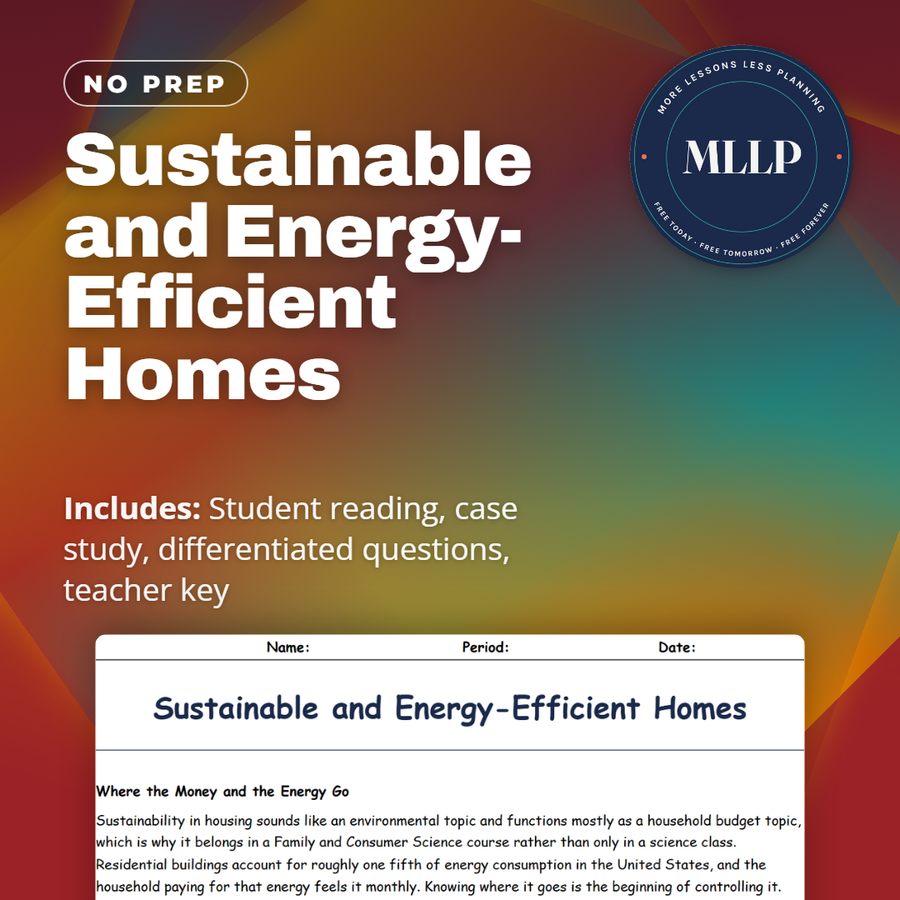
Sustainable and Energy-Efficient Homes
Quality reviewed September 2026
Facts verified September 23, 2026
- Subject
- Career & Life Skills
- Grades
- Grades 9-12
- Length
- 9-page student worksheet
- Time
- About one 50-minute class period
- Great for
- Sub plans and independent work
- Includes
- Reading passage, comprehension questions + full answer key
- Format
- Print-and-go PDF
What students do
- The Nguyens chase a solar panel idea before finding the real leak with a stick of incense
- Explain why the reading orders sealing and insulating before any system upgrade or solar panel
- Answer questions on R-value, air sealing, and the ENERGY STAR and EnergyGuide labels
- Renter-only fixes like LED bulbs, cold water washing, and removable weatherstripping get pulled out as their own list
What it covers
- The correct sequence for improving a home's energy use, seal first, then upgrade, then generate
- R-value, air sealing, and reading the ENERGY STAR and EnergyGuide labels
- What a renter can still do, from the Nguyens' incense test to LED bulbs
Start reading this worksheet
Where the Money and the Energy Go
Sustainability in housing sounds like an environmental topic and functions mostly as a household budget topic, which is why it belongs in a Family and Consumer Science course rather than only in a science class. Residential buildings account for roughly one fifth of energy consumption in the United States, and the household paying for that energy feels it monthly. Knowing where it goes is the beginning of controlling it. Space heating and cooling together typically consume the largest share of home energy, commonly around half in many climates. Water heating usually ranks second at roughly fifteen to twenty percent. Appliances, electronics, and lighting divide most of the rest, with refrigerators running continuously and clothes dryers drawing heavily in short bursts. That distribution explains why the highest-value improvements are almost never the visible ones. People tend to imagine sustainability as solar panels, which are genuine but expensive and usually the last step rather than the first. The established professional sequence is to reduce demand before generating supply, meaning seal and insulate the building first so it needs less energy, then upgrade the systems that deliver it, and only then consider producing energy on site. Following that order matters financially, since installing solar panels on a leaky, poorly insulated house means paying to generate energy that immediately escapes through the attic. The cheapest unit of energy is always the one a household never needs to use. Utility companies frequently offer free or discounted home energy audits, which identify the largest losses in a specific house rather than relying on national averages, and many states fund rebates for the improvements an audit recommends.
The Building Envelope
The building envelope is the physical barrier separating conditioned indoor air from outdoor air, consisting of walls, roof, foundation, windows, and doors. Nearly every efficiency conversation starts here because the envelope determines how hard the heating and cooling systems must work. Two properties govern it. Insulation resists heat flow and is rated by R-value, where a higher R-value means greater resistance, and recommended levels vary by climate zone, with attics often calling for R-38 to R-60 in colder regions. Air sealing addresses leaks, which is a separate problem from insulation and frequently a larger one, since insulation slows heat moving through materials while air sealing stops it from simply blowing through gaps. Typical leakage points are attic hatches, recessed lights, plumbing and wiring penetrations, rim joists, and the frames around windows and doors. Caulk and weatherstripping are among the cheapest improvements available, often costing under fifty dollars for a whole house and returning that within a single season. Windows deserve realistic treatment. They are the weakest thermal point in most walls, and double or triple glazing with low-emissivity coatings and inert gas fills performs far better than single panes, but full window replacement is expensive and pays back slowly. Weatherstripping existing windows, adding cellular shades, and using exterior shading on the sun-exposed sides deliver much of the benefit at a small fraction of the cost. Insulation also loses much of its value when it is compressed or installed with gaps, so the quality of the installation matters nearly as much as the R-value printed on the package.
Systems, Water, and Labels Worth Reading
Once the envelope is tight, the systems inside it matter. Heating and cooling equipment carries efficiency ratings that allow direct comparison: furnaces use AFUE as a percentage of fuel converted to heat, air conditioners use SEER, and heat pumps use both SEER and HSPF. Heat pumps have become significant because they move heat rather than generating it and can deliver substantially more heat energy than the electrical energy they consume, which is why they are now used well beyond mild climates. A programmable or smart thermostat is among the cheapest meaningful upgrades, since setting temperatures back while a household sleeps or is away reduces consumption without any equipment change. Water heating responds to insulating the tank and the first several feet of pipe, lowering the setting to about one hundred twenty degrees Fahrenheit, and installing low-flow fixtures. Water conservation overlaps directly, since heating water is where much of its cost lives. WaterSense-labeled fixtures meet federal efficiency criteria, and a running toilet, the single most common household water waste, can lose hundreds of gallons a day from a part costing a few dollars. Two labels are worth genuine trust. ENERGY STAR identifies appliances meeting federal efficiency standards, and the yellow EnergyGuide label on new appliances states estimated annual energy use and operating cost, which allows shoppers to compare lifetime cost rather than sticker price alone. A cheaper appliance that costs more to run every day for a decade is not actually the cheaper appliance.
Like what you read? The full reading, the case study, and every question set are in the free download below, along with the answer key.
Why this matters
The reading's last section is aimed at a renter rather than a homeowner, since a rented room or a first apartment is what almost every student here will actually live in first. A cold water wash cycle, a power strip switched off at night, and a question about past utility bills that almost no applicant thinks to ask a landlord all transfer directly, and the Nguyens' ninety-one dollar fix, sealing before buying panels, is arithmetic that works at any income level.
From one teacher to another
A February heating bill of three hundred forty dollars sends the Nguyen family shopping for solar panels before their daughter, working through a FACS housing unit, asks them to try the reading's walkthrough first. Students learn the professional sequence: seal and insulate the building envelope, then upgrade the heating and cooling systems, and only then consider generating energy on site. The reading covers R-value, air sealing versus insulation, and how to read the ENERGY STAR and EnergyGuide labels instead of trusting a price tag. It ends with what a renter can do without owning anything, from LED bulbs to a power strip that eliminates phantom load.
What you get
Download
Where should I send the next one?
Everything here is free and it stays that way. Leave your email and I'll send you the new lessons as they go up. You can unsubscribe from any one of them.
Related resources

Color Theory in the Home
Floor Plans and Space Planning
Furniture, Function, and Traffic Flow
Housing Needs vs. Housing Wants
Lighting and Window Treatments
Reading a Lease and Knowing Your Renter's Rights
Every lesson on this site is free to download and use. If one of them saved you a prep period, you can chip in a few bucks toward my three kids' daycare fund. That's genuinely where tips go.