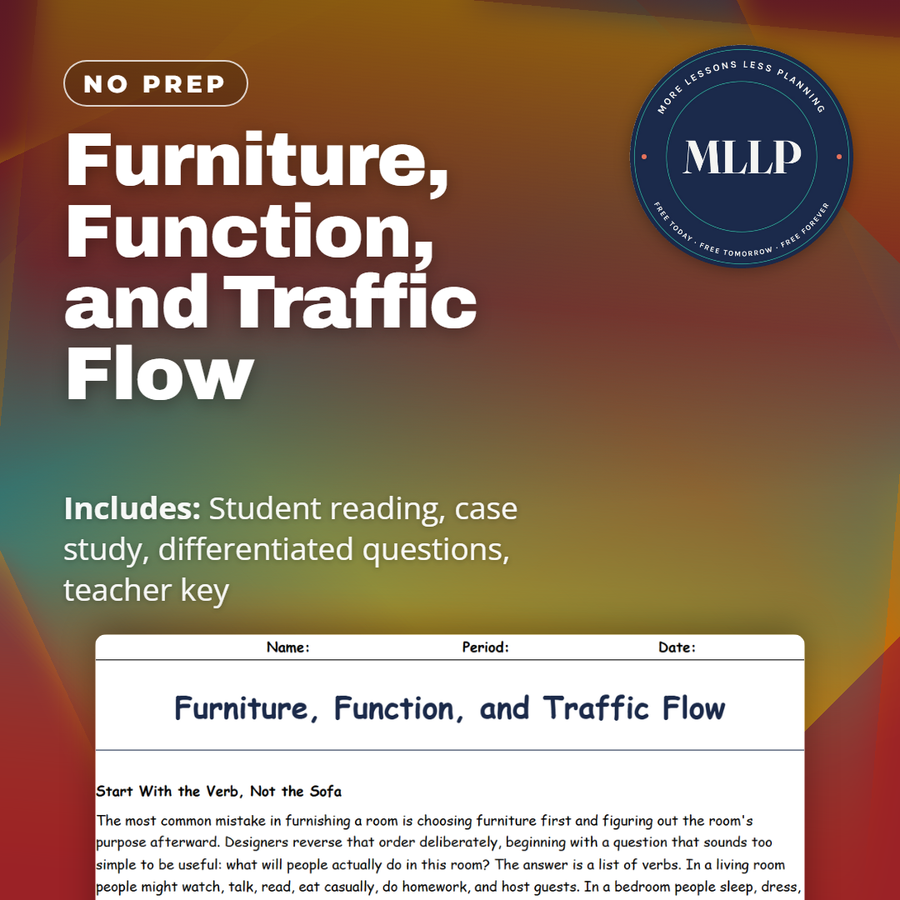
Furniture, Function, and Traffic Flow
Quality reviewed September 2026
Facts verified September 23, 2026
- Subject
- Career & Life Skills
- Grades
- Grades 9-12
- Length
- 9-page student worksheet
- Time
- About one 50-minute class period
- Great for
- Sub plans and independent work
- Includes
- Reading passage, comprehension questions + full answer key
- Format
- Print-and-go PDF
What students do
- Rosa's narrow living room gets rearranged from a wall-hugging perimeter into a working conversation area
- Explain why fit is the first of the four buying questions, ahead of construction, maintenance, and flexibility
- Identify why Rosa's eleven-foot gap between facing chairs kept people from talking
- The clearance numbers for dining chairs, dressers, and kitchen aisles get checked against the reading
What it covers
- Choosing furniture by function, fit, and construction quality
- Arranging seating for conversation instead of a perimeter line against the walls
- Traffic flow clearances and Rosa's eleven-foot seating gap
Start reading this worksheet
Start With the Verb, Not the Sofa
The most common mistake in furnishing a room is choosing furniture first and figuring out the room's purpose afterward. Designers reverse that order deliberately, beginning with a question that sounds too simple to be useful: what will people actually do in this room? The answer is a list of verbs. In a living room people might watch, talk, read, eat casually, do homework, and host guests. In a bedroom people sleep, dress, store clothing, and sometimes study. Each verb implies requirements. Talking requires seating arranged so people can hear each other without shouting or twisting. Reading requires a chair and a light source positioned over the shoulder. Homework requires a hard surface at the right height and a place to put a bag. Once the verbs are listed, furniture becomes a solution to a stated problem rather than a purchase justified after the fact. This approach also exposes the most expensive error in furnishing, which is buying for an imagined life rather than an actual one. A formal dining set bought for hosting dinners that happen twice a year occupies space every single day that a household using its table for homework and projects would rather have. Designers ask how often an activity truly occurs, because square footage is permanently expensive and rarely used furniture charges rent daily. Function first is not a limitation on style. It simply decides what the style is applied to. Writing the verb list down and keeping it visible while shopping is what holds the discipline together, because showrooms are designed to make attractive pieces feel necessary.
Choosing Pieces That Fit and Last
Selecting individual pieces involves four questions that beginners tend to answer in the wrong order. The first is fit, meaning measured dimensions, since a piece that is admired and does not fit is worthless. Measure the piece, the room, and critically the path it must travel to get there, because doorways, stairwells, and elevator openings defeat more furniture deliveries than floor space does. Furniture professionals recommend measuring the narrowest point on the route before purchase, and a sofa that clears every door except the one turn at the top of a stairway ends up going back on the truck. The second question is construction, since quality lives in places buyers cannot see. Solid hardwood frames joined with corner blocks and screws outlast stapled particleboard. Eight-way hand-tied springs outlast sinuous wire springs, which outlast webbing. Higher-density foam holds its shape longer, and fabric durability is measured in double rubs, with heavier ratings holding up to daily family use. The third question is maintenance, meaning whether the piece survives the household that actually owns it. Light linen upholstery in a home with a toddler and a dog is a decision with consequences, while performance fabrics and leather forgive far more. The fourth question is flexibility. Pieces that serve two purposes, such as storage ottomans, nesting tables, or a daybed, earn their footprint twice, which matters most in small spaces where every item competes for the same floor. Buying fewer and better pieces gradually generally outperforms furnishing an entire home at once with the cheapest option available.
Arranging for Conversation
Arrangement is where furniture becomes a room, and conversation is the standard that governs most social spaces. Seating pieces should sit close enough that people can talk comfortably, which in practice means no more than about eight feet between facing seats. Beyond that distance people raise their voices slightly, and rooms where this happens feel oddly unfriendly without anyone identifying why. The most persistent amateur habit is pushing every piece of furniture against the walls, sometimes called the perimeter arrangement. It feels efficient and it produces a room with a large useless void in the middle and seating too far apart to use socially. Pulling seating inward, even six or eight inches off the wall, creates a defined conversation area and usually makes the room feel larger rather than smaller, which surprises people every time. Seating should generally face inward toward a center point or shared focal point rather than all facing one wall, since a row of chairs aimed at a television is a waiting room. Every seat also needs a surface within reach for a drink or a book, roughly within arm's length, and a side table or the corner of a coffee table satisfies this. Coffee tables should sit about fourteen to eighteen inches from the seating, close enough to reach and far enough to walk past. Area rugs anchor the group, and the group should sit on the rug rather than beside it.
Like what you read? The full reading, the case study, and every question set are in the free download below, along with the answer key.
Why this matters
Most students will furnish a room with almost no money before they furnish one with any real budget, whether that is a dorm, a first apartment, or a bedroom rearranged with what a family already owns. Knowing that a couch pulled eight inches off a wall changes how a room functions, without spending a cent, is the kind of detail that saves a semester of tripping over the same coffee table.
From one teacher to another
Rosa's living room opens the reading, and her narrow apartment with two roommates sets up the whole lesson on furniture and flow. Students first work through the four questions a real purchase should answer, fit, construction, maintenance, and flexibility, before ever getting to arrangement. From there the reading covers conversation distance, the eight-foot rule that explains why a room can seat five people and still feel unused, and traffic flow, the difference between a path that cuts through a seating group and one that moves around it. Rosa fixes her own room using nothing but a nine dollar lamp and eight inches of clearance.
What you get
Download
Where should I send the next one?
Everything here is free and it stays that way. Leave your email and I'll send you the new lessons as they go up. You can unsubscribe from any one of them.
Related resources
Color Theory in the Home
Floor Plans and Space Planning
Housing Needs vs. Housing Wants
Lighting and Window Treatments
Reading a Lease and Knowing Your Renter's Rights
Renting vs. Buying: Understanding Your Options
Every lesson on this site is free to download and use. If one of them saved you a prep period, you can chip in a few bucks toward my three kids' daycare fund. That's genuinely where tips go.