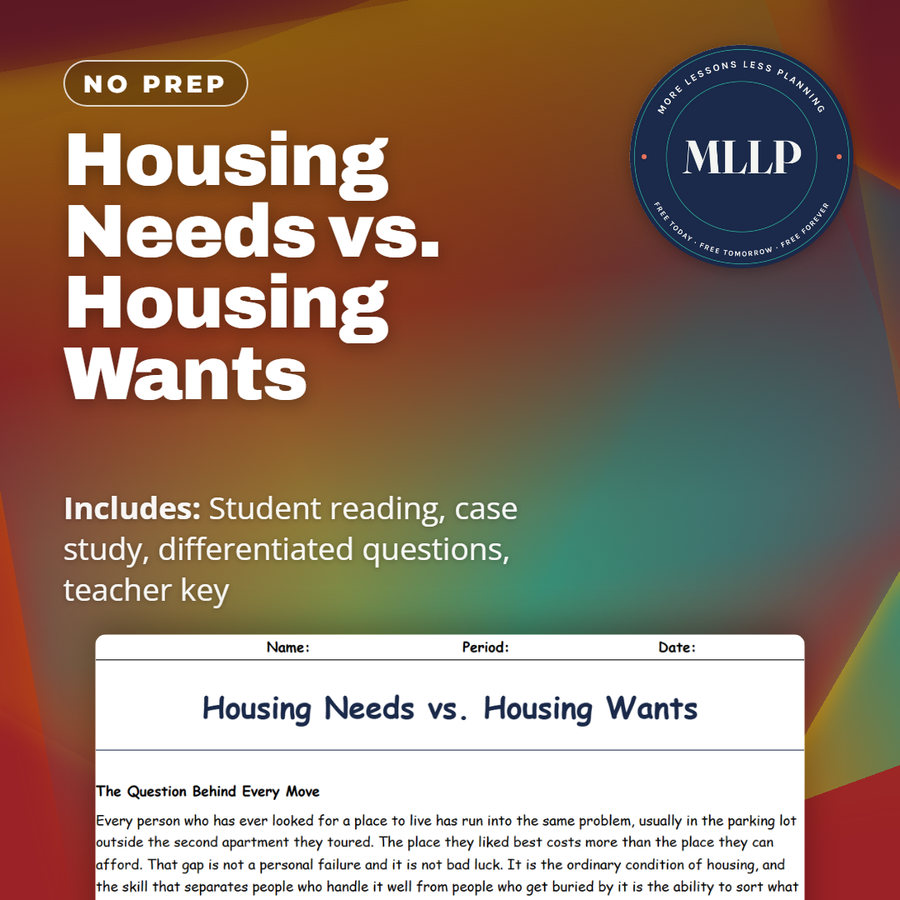
Housing Needs vs. Housing Wants
Quality reviewed September 2026
Facts verified September 23, 2026
- Subject
- Career & Life Skills
- Grades
- Grades 9-12
- Length
- 9-page student worksheet
- Time
- About one 50-minute class period
- Great for
- Sub plans and independent work
- Includes
- Reading passage, comprehension questions + full answer key
- Format
- Print-and-go PDF
What students do
- Deven's case study compares two real apartments, one at 43 percent of his income and one under the 30 percent line
- Explain why a second bathroom can feel like a need even though the household could function without it
- Explain what habitability legally requires a rental to provide
- The five housing trade-offs, from space versus location to flexibility versus stability, run through the reading's final passage
What it covers
- The legal difference between a housing need and a housing want
- The thirty percent rule, cost burden, and the residual income method
- Housing trade-offs and Deven's decision between two apartments
Start reading this worksheet
The Question Behind Every Move
Every person who has ever looked for a place to live has run into the same problem, usually in the parking lot outside the second apartment they toured. The place they liked best costs more than the place they can afford. That gap is not a personal failure and it is not bad luck. It is the ordinary condition of housing, and the skill that separates people who handle it well from people who get buried by it is the ability to sort what they need from what they want before they sign anything. A housing need is something that must be present for the home to be safe, functional, and workable for the people living in it. A housing want is something that makes the home more comfortable, more attractive, or more enjoyable, but whose absence would not stop anyone from living there. The distinction sounds obvious in a classroom and gets slippery fast in real life, because wants arrive wearing the costume of needs. A person touring a place with a second bathroom does not think I want this; they think I need this, and the sentence feels true while they are standing in it. Housing counselors see the consequences constantly. Renters who blur the two lines commit to payments that leave nothing for groceries, transportation, or an emergency. The point of the exercise is not to strip the joy out of a home. It is to make sure the joy is affordable once the bills arrive.
What Counts as a Need
Needs in housing are narrower than most people expect, and they are largely defined by law rather than preference. Every rental unit in the United States must meet a standard called habitability, which is the legal floor below which a dwelling cannot be rented at all. Habitability generally requires working heat, safe electrical wiring, running hot and cold water, working plumbing, a roof and windows that keep out weather, functioning locks on exterior doors, and freedom from serious pest infestation. Local building and housing codes fill in the details and inspectors enforce them. Beyond the legal floor sit needs specific to the household. Adequate space is one, and the common standard used by housing agencies is that a unit is overcrowded when there is more than one person per room excluding bathrooms. Location is another genuine need when it determines whether a person can reach work or school at all, since a cheap apartment ninety minutes from a job may cost more in transportation and lost hours than a closer unit that rents for more. Accessibility becomes a hard need for a household that includes someone who uses a wheelchair or cannot manage stairs. Proximity to medical care can be a need rather than a preference. The test to apply is simple and unsentimental. Ask whether the household could function safely without it. If the honest answer is no, it is a need, and it belongs at the top of the list where it cannot be traded away.
Where Wants Come From
Wants are not frivolous, and treating them as shameful is a mistake that leads people to ignore them until they overspend impulsively. Wants are the features that shape daily satisfaction: an extra bedroom for guests, a dishwasher, a balcony, granite counters, an in-unit washer and dryer, a garage, a pool, a fashionable neighborhood, or simply more square footage than the household strictly requires. Wants come from several places at once. Some are learned from family, so a person raised in a house with a big kitchen tends to want one. Some come from culture and marketing, since listing photographs, home improvement shows, and social media are built to make certain finishes read as normal rather than optional. Some come from anticipated life changes, like wanting a second bedroom because a child is expected within two years. That last category deserves respect, because planning ahead is legitimate even though it is technically a want today. The useful move is not to eliminate wants but to rank them. Housing counselors often have clients list every desired feature and then force a numbered order, one through ten, with no ties allowed. Forcing the ranking is what makes it work, since almost everyone can name fifteen things they want and almost nobody can defend which one matters least until they must. Once ranked, wants become a shopping tool. The top two or three get pursued seriously, and the rest become tiebreakers between otherwise equal units.
Like what you read? The full reading, the case study, and every question set are in the free download below, along with the answer key.
Why this matters
A ranked list of wants versus needs is a skill a student will use for the first apartment, not a hypothetical one years off, since roughly half of renter households have been found to spend more than thirty percent of income on housing. Practicing the arithmetic now, before a lease is a live decision with a real deadline, means the thirty percent line gets checked before the signature instead of after the first missed grocery trip.
From one teacher to another
Every apartment search runs into the same gap between what a person likes and what a person can actually afford, and this reading gives students a way to sort the two honestly. It defines habitability, the legal floor a rental has to meet regardless of price, then separates it from wants such as a second bathroom or a balcony that shape comfort but not survival. Students work through the thirty percent rule for housing costs against income, the criticism that the same percentage does not mean the same hardship at every income level, and the trade-offs that follow: space against location, condition against price, privacy against cost. Deven's case study has him choosing between two real apartments on the same Saturday.
What you get
Download
Where should I send the next one?
Everything here is free and it stays that way. Leave your email and I'll send you the new lessons as they go up. You can unsubscribe from any one of them.
Related resources
Color Theory in the Home
Floor Plans and Space Planning
Furniture, Function, and Traffic Flow
Lighting and Window Treatments
Reading a Lease and Knowing Your Renter's Rights
Renting vs. Buying: Understanding Your Options
Every lesson on this site is free to download and use. If one of them saved you a prep period, you can chip in a few bucks toward my three kids' daycare fund. That's genuinely where tips go.