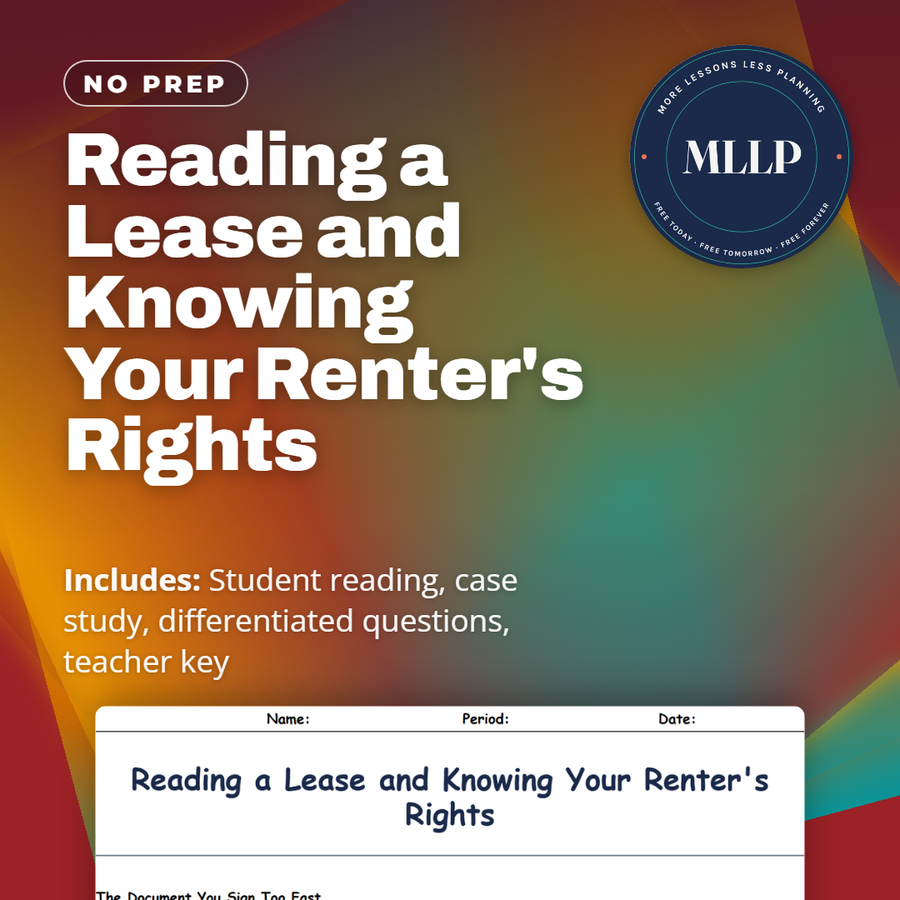
Reading a Lease and Knowing Your Renter's Rights
Quality reviewed September 2026
Facts verified September 23, 2026
- Subject
- Career & Life Skills
- Grades
- Grades 9-12
- Length
- 9-page student worksheet
- Time
- About one 50-minute class period
- Great for
- Sub plans and independent work
- Includes
- Reading passage, comprehension questions + full answer key
- Format
- Print-and-go PDF
What students do
- Kiana's move-in photos end up proving her landlord wrong about a carpet that was already worn
- Identify the twelve items a standard residential lease should cover
- Explain the legal difference between normal wear and tear and real damage
- The implied warranty of habitability and a tenant's own reporting duties get worked through side by side
What it covers
- What a standard lease covers and why a verbal promise will not hold up
- Security deposits, normal wear and tear, and documentation that protects a tenant
- The habitability duty landlords owe and how to end a lease cleanly
Start reading this worksheet
The Document You Sign Too Fast
A lease is a legally binding contract between a landlord and a tenant that transfers the right to occupy a property for a defined period in exchange for rent. The word binding is the part that gets skipped. Once signed, a lease obligates both parties, and a tenant who did not read it is bound by it anyway. Courts have very little patience for the argument that someone did not know what was in a document they signed. This matters because the leasing moment is designed for speed. A prospective tenant is often standing at a counter, competing with other applicants, holding a pen, and feeling that asking for time to read will cost them the unit. That pressure is real, and it is exactly when the most expensive mistakes happen. The professional habit is simple and worth adopting permanently. Ask for a copy of the lease to read before the signing appointment, and treat any refusal as information about the landlord. Read every clause, including the ones in smaller type, and ask about anything unclear in writing rather than in conversation. Never accept a verbal promise about a repair, a pet, or a rent amount that contradicts the written document, because the written lease controls if there is ever a dispute. A lease is also a two-way protection. It locks the rent for the term and limits what the landlord can do, which is why a tenant benefits from understanding it rather than fearing it. Most states also require the landlord to give the tenant a copy of the signed lease, and keeping that copy somewhere retrievable matters, since the document is the only reliable record of what both parties actually agreed to.
What Every Lease Contains
Leases vary by state and by landlord, but a standard residential lease covers a predictable list of items, and knowing the list makes an unfamiliar document navigable. It names the parties and identifies the property by address and unit. It states the term, meaning the start and end dates, and whether the agreement is a fixed-term lease or a month-to-month tenancy. It states the rent amount, the due date, the accepted payment methods, any grace period, and the late fee. It states the security deposit amount and the conditions for its return. It assigns utilities, specifying which are paid by the tenant and which by the landlord, a clause that can change the true monthly cost by well over a hundred dollars. It sets occupancy limits and names every authorized occupant. It states the pet policy, including any pet deposit or monthly pet rent. It covers subletting, which is a tenant renting the unit to someone else, usually requiring written landlord approval. It describes maintenance responsibilities on both sides. It specifies the landlord's right of entry, which in most states requires advance notice, commonly twenty-four hours, except in genuine emergencies. It lists conditions for termination and renewal. Finally, it usually includes rules about alterations, meaning painting, mounting a television, or changing locks. Reading for these twelve items turns an intimidating document into a checklist. Anything promised in conversation but missing from that list should be added in writing before signing rather than after.
The Security Deposit Fight
Security deposits generate more tenant-landlord disputes than any other single issue, and nearly all of them are preventable with documentation. A security deposit is money held by the landlord to cover unpaid rent or damage beyond normal wear and tear. That last phrase is the whole battleground. Normal wear and tear means the ordinary deterioration that happens when a person simply lives somewhere: carpet worn along a hallway path, small nail holes from hanging pictures, faded paint, minor scuffs on a wall. Damage means harm beyond ordinary use, such as a hole punched in drywall, a cracked window, pet stains soaked into carpet padding, or a missing door. Landlords may deduct for damage but may not charge tenants to repaint simply because the paint aged. Most states cap deposits, commonly at one or two months' rent, and most set a deadline for returning the deposit after move-out, frequently between fourteen and forty-five days, along with a requirement to provide an itemized written statement of any deductions. The protective habit is photographic. Before moving a single box in, photograph or record video of every room, including closets, appliances, floors, and existing damage, with a visible date. Complete the move-in inspection checklist in writing, keep a signed copy, and repeat the entire process at move-out. Tenants who do this recover deposits routinely. Tenants who rely on memory usually lose, because the dispute becomes one person's word against another's.
Like what you read? The full reading, the case study, and every question set are in the free download below, along with the answer key.
Why this matters
A lease is very likely the first legally binding contract most students will ever sign, and it arrives at exactly the moment they are standing in an apartment, holding a pen, and afraid that asking questions will cost them the unit. Knowing that photographs settle deposit disputes that memory cannot, and that a written lease controls over whatever a landlord said in person, is the difference between Kiana getting eight hundred dollars back and losing it to a claim she could not disprove.
From one teacher to another
Kiana's security deposit dispute opens the reading, and her nine minutes of move-in photos end up doing more work than any argument she could have made. Students first learn what a lease legally is, a binding contract that controls even if a landlord promised something different out loud, then work through the twelve items a standard lease covers, from rent and utilities to right of entry and subletting. The reading spends real time on the security deposit fight, defining normal wear and tear against real damage, and on the implied warranty of habitability that landlords owe whether or not the lease mentions it. It ends with how a lease can end cleanly, and how an illegal lockout differs from an actual eviction.
What you get
Download
Where should I send the next one?
Everything here is free and it stays that way. Leave your email and I'll send you the new lessons as they go up. You can unsubscribe from any one of them.
Related resources
Color Theory in the Home
Floor Plans and Space Planning
Furniture, Function, and Traffic Flow
Housing Needs vs. Housing Wants
Lighting and Window Treatments
Renting vs. Buying: Understanding Your Options
Every lesson on this site is free to download and use. If one of them saved you a prep period, you can chip in a few bucks toward my three kids' daycare fund. That's genuinely where tips go.