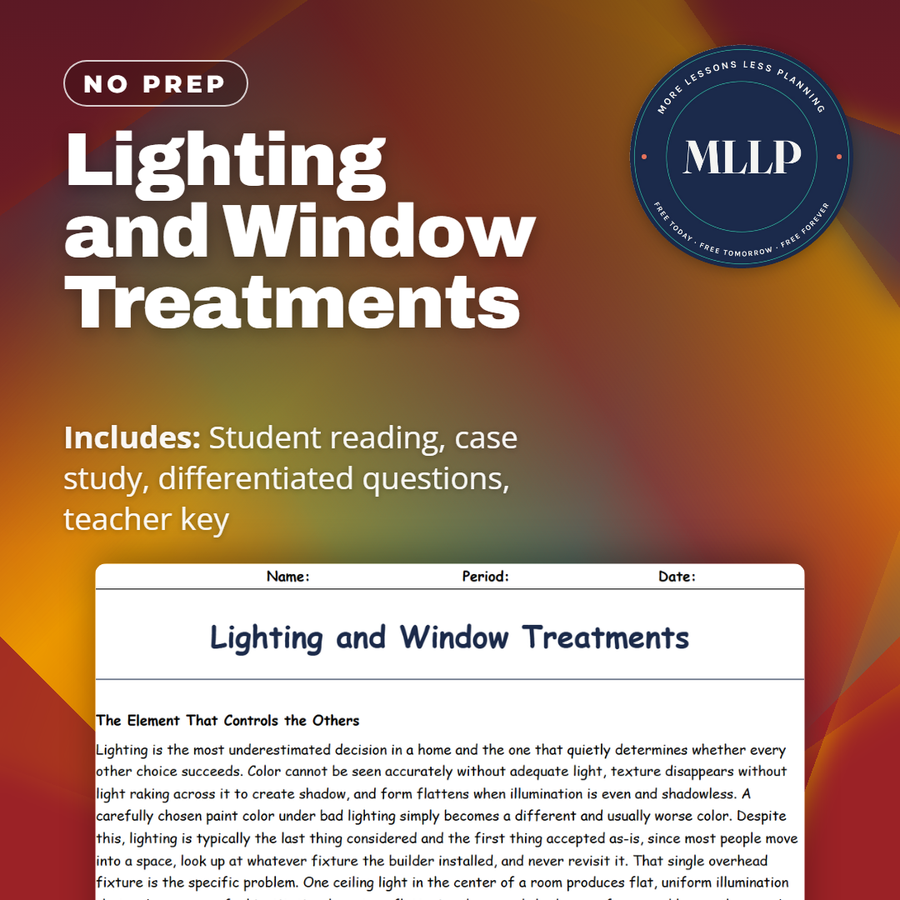
Lighting and Window Treatments
Quality reviewed September 2026
Facts verified September 23, 2026
- Subject
- Career & Life Skills
- Grades
- Grades 9-12
- Length
- 9-page student worksheet
- Time
- About one 50-minute class period
- Great for
- Sub plans and independent work
- Includes
- Reading passage, comprehension questions + full answer key
- Format
- Print-and-go PDF
What students do
- Jamal's headaches trace back to one ceiling fixture and a shadow falling across his own homework
- Match ambient, task, and accent lighting to what each layer actually does
- Compare lumens against watts to find which one actually measures brightness
- Cellular shades, sheers, and curtain rod height get weighed against what each window treatment is built to do
What it covers
- The three layers of lighting and why one ceiling fixture is never enough
- Reading lumens, color temperature, and the color rendering index on a bulb
- Window treatment types and Jamal's fix for his own study lamp
Start reading this worksheet
The Element That Controls the Others
Lighting is the most underestimated decision in a home and the one that quietly determines whether every other choice succeeds. Color cannot be seen accurately without adequate light, texture disappears without light raking across it to create shadow, and form flattens when illumination is even and shadowless. A carefully chosen paint color under bad lighting simply becomes a different and usually worse color. Despite this, lighting is typically the last thing considered and the first thing accepted as-is, since most people move into a space, look up at whatever fixture the builder installed, and never revisit it. That single overhead fixture is the specific problem. One ceiling light in the center of a room produces flat, uniform illumination that makes a space feel institutional, casts unflattering downward shadows on faces, and leaves the room's corners dim regardless of how bright the bulb is. Designers solve this with layered lighting, meaning multiple light sources at different heights doing different jobs. The result is a room that can be bright for cleaning, moderate for company, and low for relaxing, all with the same fixtures. Layered lighting is also one of the few genuine upgrades available to renters, since lamps require no permission, no installation, and no landlord conversation, and they move to the next apartment. A hundred dollars spent on three lamps changes a room more reliably than the same amount spent on almost anything else. Lamps also let a household change the character of a room by season or by activity, which a single fixed ceiling fixture cannot do at any price.
The Three Layers
Professional lighting design divides artificial light into three layers, each with a distinct purpose. Ambient lighting, also called general lighting, provides the overall level of illumination that lets a person move safely and see the room as a whole. It comes from ceiling fixtures, recessed cans, track lighting, or light bounced off a ceiling, and it is the layer most homes have and stop at. Task lighting provides focused, brighter light exactly where a specific activity happens: reading, cooking, homework, applying makeup, or sewing. It comes from desk lamps, under-cabinet strips, pendant lights over an island, floor lamps positioned beside a chair, and vanity fixtures. Task lighting is the layer whose absence causes eyestrain, and the common failure is a person working at a desk lit only by a ceiling fixture positioned behind them, so their own body shadows the work. Accent lighting is directional light that highlights something specific, such as artwork, a bookshelf, a plant, or an architectural feature, and it typically runs about three times brighter than the surrounding ambient level to register as an accent at all. It comes from picture lights, spotlights, and strip lighting, and it supplies visual interest and depth rather than function. A well-lit room contains all three, and the diagnostic question is simple. If a room has exactly one light source, it has at most one layer, and adding a second layer will improve it more than any other change of comparable cost. Bathrooms and kitchens are the rooms where missing task lighting causes the most daily frustration.
Bulbs, Temperature, and Brightness
Choosing bulbs became more confusing when efficiency improved, because the old shorthand stopped working. For decades people bought light by watts, but watts measure energy consumed rather than light produced, and modern LEDs produce the same light on a fraction of the power. The correct measure of brightness is lumens. A traditional sixty-watt incandescent bulb produces roughly eight hundred lumens, and an LED delivering the same eight hundred lumens draws about eight to ten watts. Reading lumens rather than watts is now the basic literacy of buying a light bulb. The second specification is color temperature, measured in kelvins, which describes whether light appears warm or cool. Lower numbers are warmer and yellower, with twenty-seven hundred kelvin resembling traditional incandescent light and suiting bedrooms and living rooms. Three thousand to thirty-five hundred kelvin reads as neutral white and works well in kitchens and bathrooms. Four thousand kelvin and above reads as cool or bluish white and suits garages, workshops, and task areas, though it feels clinical in a living space. Mixing temperatures within one room is a common and visible mistake, since two lamps at different kelvin ratings make a room look subtly broken. A third specification, the color rendering index, describes how accurately a bulb shows true colors on a hundred-point scale, and a rating of ninety or above matters wherever color judgment happens. Dimmers add flexibility cheaply, letting one fixture serve several moods.
Like what you read? The full reading, the case study, and every question set are in the free download below, along with the answer key.
Why this matters
A desk lamp costs less than a movie ticket, and a teenager can buy or borrow one without asking permission from anyone, which makes lighting one of the few design fixes fully inside a student's own control. Jamal's fix cost thirty-four dollars and ended headaches caused by working in his own shadow, which is the kind of result that makes the difference between a room a student can work in and one they just tolerate.
From one teacher to another
One ceiling fixture is where most rooms start and stop, and the reading explains why that single light source causes flat rooms, tired eyes, and headaches nobody connects to the light overhead. Students work through the three layers designers use, ambient, task, and accent, then move into how to actually shop for a bulb: lumens instead of watts, and color temperature measured in kelvins instead of guessed from a box. The reading closes with window treatments, from blinds to cellular shades to layered curtains, and how each balances light, privacy, and insulation differently. Jamal traces his own nightly headaches to a shadow he had been writing inside of for two years.
What you get
Download
Where should I send the next one?
Everything here is free and it stays that way. Leave your email and I'll send you the new lessons as they go up. You can unsubscribe from any one of them.
Related resources
Color Theory in the Home
Floor Plans and Space Planning
Furniture, Function, and Traffic Flow
Housing Needs vs. Housing Wants
Reading a Lease and Knowing Your Renter's Rights
Renting vs. Buying: Understanding Your Options
Every lesson on this site is free to download and use. If one of them saved you a prep period, you can chip in a few bucks toward my three kids' daycare fund. That's genuinely where tips go.