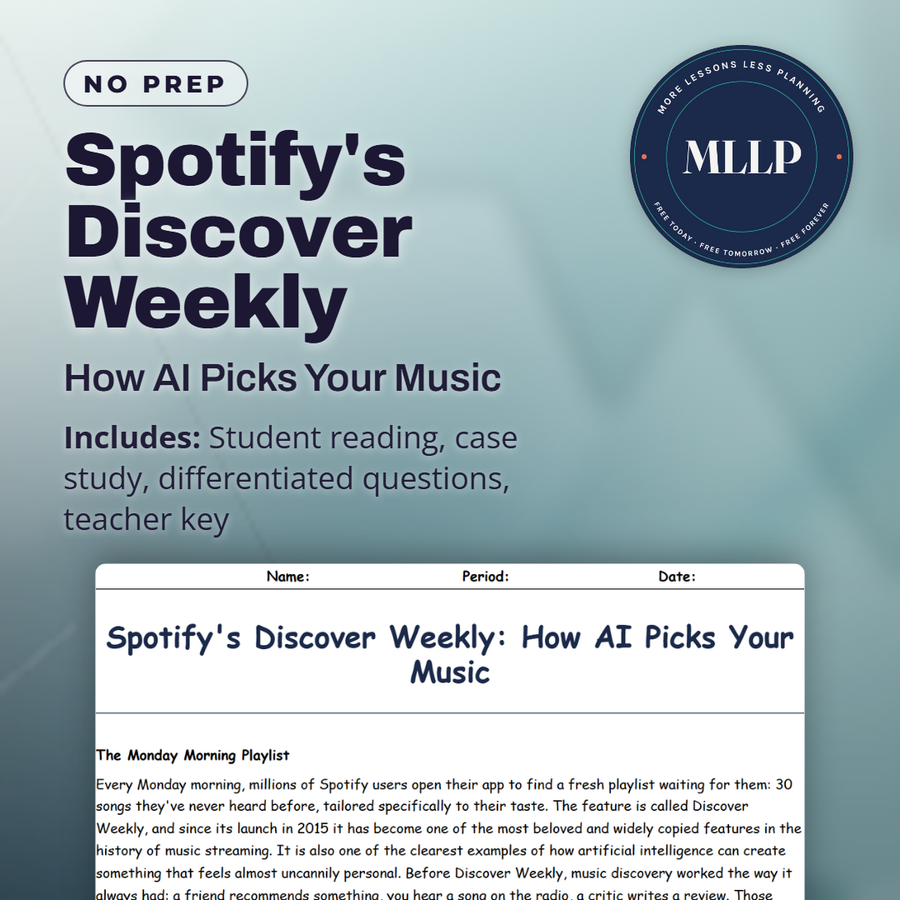
Spotify's Discover Weekly: How AI Picks Your Music
Quality reviewed September 2026
Facts verified September 20, 2026
- Subject
- Career & Life Skills
- Grades
- Grades 9-12
- Length
- 9-page student worksheet
- Time
- About one 50-minute class period
- Great for
- Sub plans and independent work
- Includes
- Reading passage, comprehension questions + full answer key
- Format
- Print-and-go PDF
What students do
- Five terms, from Discover Weekly to Taste Cluster, get matched to their definitions
- Trace how collaborative filtering, NLP, and audio analysis combine to build a 30 song Monday playlist
- Jordan's experimental taste in post-rock and drone metal keeps his Discover Weekly circling the same fifteen artists
- Explain whether an algorithm that shapes what hundreds of millions of people hear is a problem worth worrying about
What it covers
- How collaborative filtering, natural language processing, and audio analysis each shape a Discover Weekly playlist
- The filter bubble problem and what happens when a shared account blends two listening profiles
- Jordan's case study on whether algorithmic music curation is a fair cultural gatekeeper
Start reading this worksheet
The Monday Morning Playlist
Every Monday morning, millions of Spotify users open their app to find a fresh playlist waiting for them: 30 songs they've never heard before, tailored specifically to their taste. The feature is called Discover Weekly, and since its launch in 2015 it has become one of the most beloved and widely copied features in the history of music streaming. It is also one of the clearest examples of how artificial intelligence can create something that feels almost uncannily personal. Before Discover Weekly, music discovery worked the way it always had: a friend recommends something, you hear a song on the radio, a critic writes a review. Those methods still exist, but they are slow, unpredictable, and limited by the network of people you know. Discover Weekly changed the equation entirely. It promised a personalized expert music curator who knew your taste better than most of your friends, and it delivered, on a massive scale, every single week.
Three Technologies Working Together
Spotify's recommendation system is built on three distinct AI techniques that work together. The first is collaborative filtering, which we've seen on Netflix and TikTok: match you with users who have similar listening histories and recommend what they've been playing. At Spotify's scale (over 600 million users as of 2024), this technique is extraordinarily powerful. Even the most niche genre imaginable has enough listeners to build meaningful taste clusters. The second technique is Natural Language Processing (NLP). Spotify has a system that reads billions of blog posts, music reviews, playlist names, and articles on the internet and extracts what people are saying about specific songs and artists. If reviewers consistently use words like 'melancholy,' 'rainy day,' and 'introspective' when describing a particular artist, Spotify's NLP system learns that this artist occupies a specific emotional space in the musical landscape. This language-based understanding helps Spotify recommend music based on mood and context, not just genre. The third technique is audio analysis. Spotify uses machine learning to analyze the raw audio of every song in its catalog and extract acoustic features: tempo, key, loudness, danceability, energy, speechiness, and more. These audio fingerprints let the system identify songs that sound similar even if they are by completely different artists in completely different genres. A lo-fi hip-hop track and a soft acoustic folk song might share enough acoustic DNA (slow tempo, low energy, low speechiness) to be recommended together.
How Discover Weekly Is Actually Built
Each week, Spotify runs a massive computation process to build a unique 30-song playlist for every one of its hundreds of millions of users. The process starts with collaborative filtering: the system identifies your 'taste cluster' (the group of users most similar to you) and gathers all the songs those users have loved recently that you haven't heard yet. That produces a large candidate pool. The NLP and audio analysis layers then filter that pool down. Songs that match your mood fingerprint, based on what types of tracks you've been playing most recently, move up in the rankings. Songs that are acoustically similar to your recent favorites get prioritized. By the time the playlist is assembled, every track has passed through multiple AI filters, each one asking the same question: is this a song this specific user will love? Spotify then runs quality checks. If you have recently disliked a particular artist, that artist's music gets filtered out. If you exclusively listen to calm, low-energy music at work, the system knows not to put a high-tempo club track in your Monday playlist. Context matters too: Spotify can infer from your listening behavior whether you're at the gym, commuting, or working, and it weights recommendations accordingly.
Like what you read? The full reading, the case study, and every question set are in the free download below, along with the answer key.
Why this matters
Every student in this room has opened a Discover Weekly playlist or something built the same way, and most have never thought about why the app seems to know them so well. Understanding that collaborative filtering, language analysis, and audio fingerprinting are working together demystifies a piece of software that can otherwise feel like magic. It also gives students a framework for noticing when an algorithm is quietly narrowing their world instead of expanding it, on a music app now and on a news feed later, once the stakes are higher than a Monday playlist.
From one teacher to another
Discover Weekly builds a new 30 song playlist every Monday out of three AI systems working at once: collaborative filtering finds listeners like you, natural language processing reads what critics say about a song's mood, and audio analysis measures tempo and energy straight from the file. The reading walks through how those layers stack to filter a huge candidate pool down to something that feels personal. It also shows where the system breaks. Users with narrow, defined taste can get stuck in a filter bubble, replaying variations of the same fifteen artists instead of discovering anything new. The case study follows Jordan, whose post-rock and drone metal listening keeps his Discover Weekly circling familiar ground while an experimental jazz group he would probably love never surfaces. Students weigh whether that kind of algorithmic gatekeeping is something worth worrying about.
What you get
Download
Where should I send the next one?
Everything here is free and it stays that way. Leave your email and I'll send you the new lessons as they go up. You can unsubscribe from any one of them.
Related resources
AI Customer Service Chatbots: When to Push for a Human
AI in Banking: Fraud Detection and Auto-Approvals
AI in Self-Driving Cars: Tesla, Waymo, and the Rest
AI in Sports: From Cameras to Coaching
AI in Video Games: NPCs and Procedural Worlds

Smart Home AI: Thermostats, Doorbells, Security
Every lesson on this site is free to download and use. If one of them saved you a prep period, you can chip in a few bucks toward my three kids' daycare fund. That's genuinely where tips go.