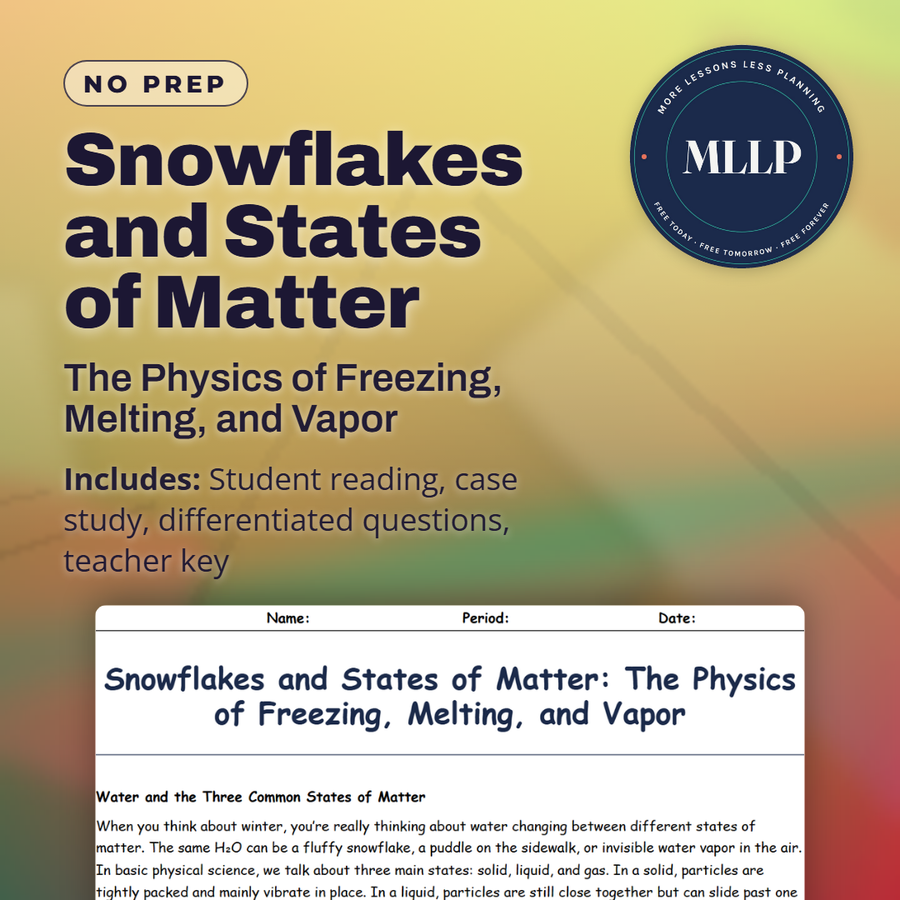
Snowflakes and States of Matter: The Physics of Freezing, Melting, and Vapor
Quality reviewed September 2026
Facts verified September 9, 2026
- Subject
- Science
- Grades
- Grades 9-12
- Length
- 8-page student worksheet
- Time
- About one 50-minute class period
- Great for
- Sub plans and independent work
- Includes
- Reading passage, comprehension questions + full answer key
- Format
- Print-and-go PDF
What students do
- Explain why ice floats on water due to hydrogen bonding and crystal structure, and trace consequences for ecosystems and weather
- Calculate latent heat absorbed or released during phase changes (melting, freezing, evaporation, sublimation) using energy data
- Apply latent heat concepts to real scenarios like afternoon slush refreezing into black ice overnight on roads
- Predict how temperature, humidity, and altitude will shape snowflake crystal formation and resulting snow type behavior
What it covers
- States of matter and water's anomalous properties
- Phase changes, latent heat, and energy transfer
- Snowflake formation and seasonal snow types
Start reading this worksheet
Water and the Three Common States of Matter
When you think about winter, you’re really thinking about water changing between different states of matter. The same H₂O can be a fluffy snowflake, a puddle on the sidewalk, or invisible water vapor in the air. In basic physical science, we talk about three main states: solid, liquid, and gas. In a solid, particles are tightly packed and mainly vibrate in place. In a liquid, particles are still close together but can slide past one another. In a gas, particles are far apart and move freely in all directions. Water is a little weird compared to many other substances. Most materials are denser as solids than as liquids, but ice actually floats on liquid water. That’s because water molecules form a fairly open crystal structure when they freeze, leaving extra space between molecules. This has huge consequences for winter on Earth: lakes freeze from the top down, creating an insulating layer of ice that helps aquatic life survive underneath. In winter weather, these states constantly trade places. Vapor in the air can condense into liquid droplets or deposit directly as ice. Snow on the ground can melt into water or even sublime—go directly from solid to gas on very cold, sunny days. Seeing winter as a giant “states of matter lab” helps you connect what you feel on your face (cold wind, dry air, sleet, or snow) with how water molecules are behaving.
Phase Changes, Latent Heat, and Energy That Hides
Changing state is called a phase change. When ice melts into liquid water, or water evaporates into vapor, energy must be absorbed from the surroundings. When water freezes or condenses, energy is released back into the environment. This “hidden” energy is called latent heat. It doesn’t show up as a temperature change during the phase change itself, but it’s absolutely there in the energy budget. Think about heating a pot of ice on the stove. As you warm it from well below 0 °C up to 0 °C, the temperature of the ice rises. Once it hits the freezing point, something interesting happens: the temperature pauses at 0 °C while the ice melts. All the energy from the stove is going into breaking the bonds that hold the solid crystal together, not into raising the temperature. Only after all the ice has melted does the temperature of the liquid water start to climb again. The same “temperature pause” happens at 100 °C while water boils into steam. You can summarize some of the key phase changes like this: Even when the thermometer doesn’t move much, these phase changes quietly move large amounts of energy around. That’s one reason winter weather and climate models pay so much attention to ice, snow, and clouds: they’re constantly trading latent heat with the air.
Like what you read? The full reading, the case study, and every question set are in the free download below, along with the answer key.
Why this matters
Every student in this class has slipped on black ice without knowing why the road turned dangerous overnight. Afternoon sun melts surface snow into a thin layer of water, night temperatures drop, and that water refreezes while releasing the latent heat it absorbed hours earlier.
Once students trace that energy step by step, black ice stops being bad luck and becomes a transfer they can calculate themselves. The same reasoning carries into the snowflake section, where crystal structure connects directly to whether a storm produces light powder or heavy wet snow. I've found that physics explaining why the driveway turned dangerous sticks in a way a textbook diagram never does.
From one teacher to another
Students remember this one because they've all slipped on black ice without understanding why it happened. The case study walks through it step by step: sunlight warms the pavement, snow melts into liquid water, temperature drops at night, water refreezes with latent heat releasing back to the surroundings. Black ice is energy moving through a system, and the reading makes students trace every step of that transfer. The snowflake section ties crystal structure to weather conditions in a way that makes students notice winter differently. Powder snow versus wet snow, crust layers, avalanche risk. All of it flows from understanding latent heat and how molecules arrange themselves based on temperature and humidity. Physics that matters.
What you get
Download
Where should I send the next one?
Everything here is free and it stays that way. Leave your email and I'll send you the new lessons as they go up. You can unsubscribe from any one of them.
Related resources
Biology of Evergreen Plants: The Science Behind Christmas Trees
Body Clocks and Midnight Countdowns: Circadian Rhythms at New Year’s

Calendars, Orbits, and the Science of New Year’s Day
Christmas on the Home Front: WWII Rationing and Resilience
Colorful Chemistry: Holiday Lights, Fireworks, and the Science of Glow
Crowded Skies: Holiday Air Travel and the Environment
Every lesson on this site is free to download and use. If one of them saved you a prep period, you can chip in a few bucks toward my three kids' daycare fund. That's genuinely where tips go.