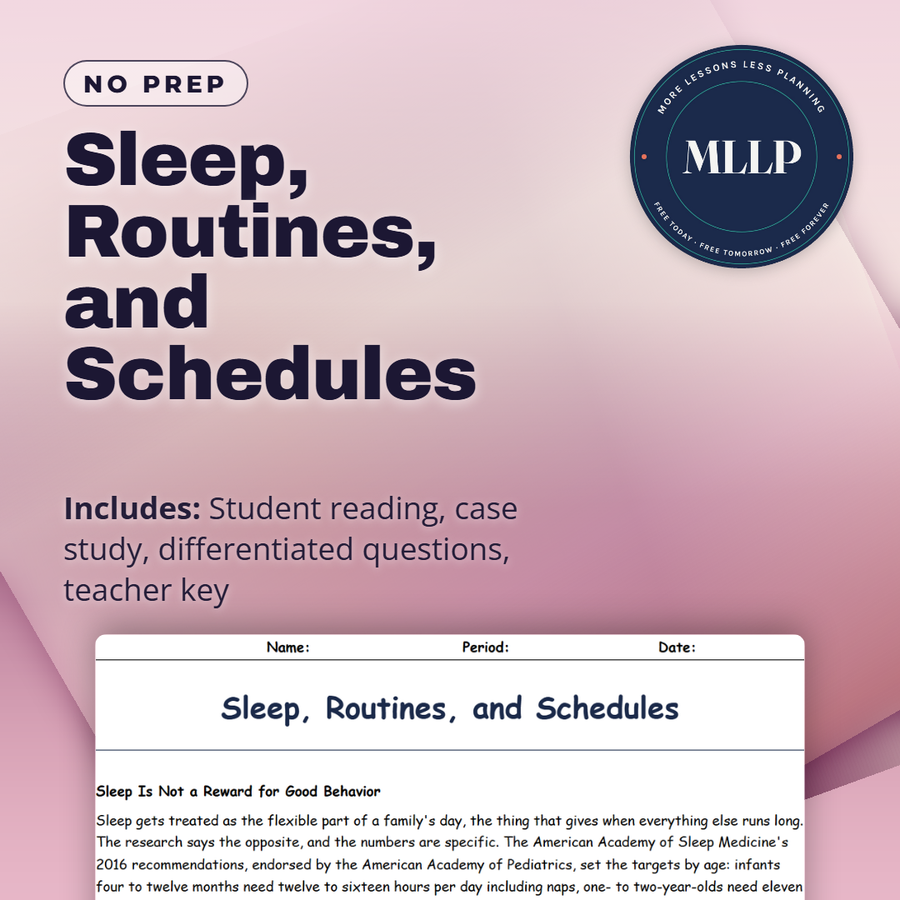
Sleep, Routines, and Schedules
Quality reviewed September 2026
Facts verified September 23, 2026
- Subject
- Career & Life Skills
- Grades
- Grades 9-12
- Length
- 9-page student worksheet
- Time
- About one 50-minute class period
- Great for
- Sub plans and independent work
- Includes
- Reading passage, comprehension questions + full answer key
- Format
- Print-and-go PDF
What students do
- Match sleep consolidation, sleep association, and drowsy but awake to what each term actually describes
- Elena's shifting work schedule gets solved with a sequence based routine instead of a fixed clock time
- Trace how sleep needs change from an infant's twelve to sixteen hours down to a teenager's eight to ten
- The safe sleep ABCs get checked against what actually belongs in an infant's crib
What it covers
- The AASM's 2016 sleep hour targets by age, from infants through teenagers
- The safe sleep ABCs and why room sharing without bed sharing is recommended for six months
- Elena's fixed order bedtime routine, built to survive a work schedule that changes every week
Start reading this worksheet
Sleep Is Not a Reward for Good Behavior
Sleep gets treated as the flexible part of a family's day, the thing that gives when everything else runs long. The research says the opposite, and the numbers are specific. The American Academy of Sleep Medicine's 2016 recommendations, endorsed by the American Academy of Pediatrics, set the targets by age: infants four to twelve months need twelve to sixteen hours per day including naps, one- to two-year-olds need eleven to fourteen hours, three- to five-year-olds need ten to thirteen hours, six- to twelve-year-olds need nine to twelve hours, and teenagers need eight to ten. Those totals are not aspirational. Children who consistently fall short show measurable effects, and the effects rarely look like sleepiness. A tired adult looks tired, while a tired four-year-old often looks wired, defiant, clumsy, and emotionally explosive, which is why chronic short sleep so often gets misread as a behavior problem or even a suspected attention disorder. During sleep the developing brain consolidates memory, the body releases the bulk of its growth hormone, and the immune system does much of its work. Insufficient sleep in children is associated with poorer learning, weaker emotional regulation, more injuries, and higher rates of obesity. For a caregiver trying to decide where to spend limited effort, protecting sleep is close to the highest-return move available, because it quietly improves nearly everything else. The same logic applies to the adults in the house. A caregiver running on five hours has less patience for exactly the behaviors that short sleep produces in a child, which is how one tired person in a household quickly becomes two.
Why Babies Wake Up
Understanding infant sleep architecture removes an enormous amount of unnecessary worry. Adults cycle through sleep stages in roughly ninety minutes; infants cycle in about fifty, and they spend a much larger share of the night in light, active sleep. At the end of each cycle everyone surfaces briefly toward wakefulness, adults included, and adults simply roll over and drop back down without ever remembering it. Infants do exactly the same thing, several times a night, all night. The question is not why the baby woke up, because the baby was always going to wake up. The question is whether the baby can get back down without help. That is where sleep associations come in. Whatever conditions are present when a child falls asleep at bedtime are the conditions they will look for at two in the morning. A baby who always falls asleep while being rocked will need rocking at two, because from their point of view the room has changed and something is missing. This is the reasoning behind the standard advice to put a baby down drowsy but awake, letting them finish the last stretch of the trip themselves so that they own the skill. Sleep also consolidates gradually over the first year as short stretches merge into longer overnight blocks, and that timeline varies widely between perfectly healthy babies. Most infants begin stringing together longer stretches somewhere between three and six months, but a baby who does not is not broken and usually needs time rather than intervention. Comparing babies on this particular measure has ended more friendships than it has solved problems.
The Routine Is the Signal
A bedtime routine is not decoration; it is a signal system. Young children have a shaky sense of time and rely heavily on sequence to know what happens next, so a predictable chain of events tells a child that sleep is coming long before anyone says the word bed. Effective routines share a few features. They are short, roughly twenty to thirty minutes, because a ninety-minute production becomes a stalling opportunity. They run in the same order every night, since the order is the actual message. They move steadily downward in stimulation, so bath, pajamas, teeth, two books, song, lights out works while a wrestling match after the books undoes the whole thing. They end in the room where the child will actually sleep. Screens come off at least an hour before bed, both because the light interferes with the body's sleep signals and because the content is stimulating right when the goal is the reverse. Consistency in timing matters too, since a bedtime that swings between seven and ten produces something close to permanent jet lag. Weekends are part of the pattern, and a two-hour weekend shift is enough to make Monday morning miserable for a school-age child. The routine takes a few weeks to establish and repays that investment nightly for years. Travel, illness, and holidays will break the routine, and that is expected rather than a failure. Routines are unusually easy to restart, and most families find that two or three consistent nights are enough to get back to where they were.
Like what you read? The full reading, the case study, and every question set are in the free download below, along with the answer key.
Why this matters
Students who babysit evenings or watch younger siblings after a parent's late shift are running into exactly the bedtime chaos Elena describes, usually without knowing that a tired four-year-old is more likely to look wired than sleepy. The reading's point that sequence matters more than the clock is genuinely useful for anyone whose own schedule is unpredictable, since it means a real routine does not require a fixed hour to work. Elena's fix, the same six steps in the same order no matter the hour, is something a student could build tonight for a sibling instead of waiting for a calmer week that never comes.
From one teacher to another
Elena works retail with a schedule that shifts every week, so her four-year-old, Theo, has been going to bed anywhere between seven and ten depending on the night, and bedtime has turned into a ninety-minute production of running, arguing, and pajama complaints. The reading explains why that happens before it explains what to do about it, starting with the AASM's 2016 sleep targets by age and the specific ways a tired preschooler looks wired rather than sleepy. A passage on infant sleep architecture covers why babies wake up on a fifty-minute cycle and what a sleep association actually is, followed by the features of a working bedtime routine and the safe sleep ABCs for where a baby sleeps. The last passage extends the same logic to the whole day, arguing that predictable sequence, not a fixed clock, is what actually calms a young child. Elena's fix, the same six steps in the same order regardless of what time she walks in the door, is the reading's clearest proof that the idea holds up against a real schedule.
What you get
Download
Where should I send the next one?
Everything here is free and it stays that way. Leave your email and I'll send you the new lessons as they go up. You can unsubscribe from any one of them.
Related resources

Are You Ready? The Realities of Parenthood

Caring for Children with Special Needs

Childcare Options and What They Cost

Childproofing and Child Safety

Feeding Infants and Young Children

Parenting Styles and How They Shape Kids
Every lesson on this site is free to download and use. If one of them saved you a prep period, you can chip in a few bucks toward my three kids' daycare fund. That's genuinely where tips go.