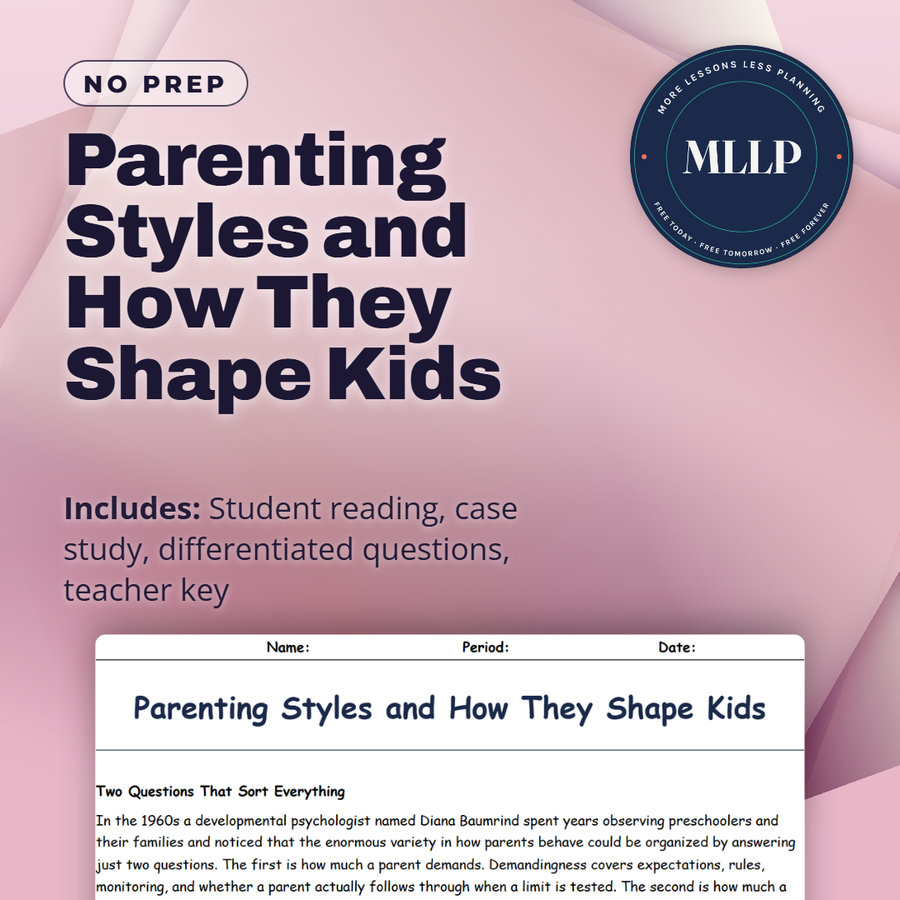
Parenting Styles and How They Shape Kids
Quality reviewed September 2026
Facts verified September 23, 2026
- Subject
- Career & Life Skills
- Grades
- Grades 9-12
- Length
- 9-page student worksheet
- Time
- About one 50-minute class period
- Great for
- Sub plans and independent work
- Includes
- Reading passage, comprehension questions + full answer key
- Format
- Print-and-go PDF
What students do
- Compare demandingness and responsiveness using Kai's mother and his aunt as two real examples
- Demandingness, responsiveness, authoritative, authoritarian, and permissive get matched to their real definitions
- Decide which style best fits a household from its actual habits rather than a label
- Kai's interview closes on one line his teacher circled, and students explain what it reveals about each style
What it covers
- Baumrind's two dimensions, demandingness and responsiveness, and how they combine into four styles
- The research pattern behind each style, plus the cultural limits of applying it everywhere
- Kai's side by side interview of two households with the identical curfew rule
Start reading this worksheet
Two Questions That Sort Everything
In the 1960s a developmental psychologist named Diana Baumrind spent years observing preschoolers and their families and noticed that the enormous variety in how parents behave could be organized by answering just two questions. The first is how much a parent demands. Demandingness covers expectations, rules, monitoring, and whether a parent actually follows through when a limit is tested. The second is how much a parent responds. Responsiveness covers warmth, affection, listening, and whether a child's feelings and needs are treated as real and worth attention. Those two dimensions are independent, which is the insight that makes the model useful, because most people assume they trade off. They assume a strict parent must be cold and a warm parent must be lenient, and neither is true. A parent can be highly demanding and highly warm at the same time, and a parent can be neither. Crossing the two dimensions produces four combinations, and those four combinations became the standard vocabulary for describing how families operate. Baumrind identified three of them, and researchers Eleanor Maccoby and John Martin added the fourth in 1983 by pointing out that the model had no place for parents who were low on both dimensions. The four labels are used in nearly every child development textbook printed since, which makes them worth knowing precisely rather than approximately. Precision matters here because the everyday meanings of these words are misleading. Authoritative and authoritarian sound nearly identical in conversation and describe opposite approaches in the research, and confusing the two reverses the entire finding, which is a mistake that appears constantly in popular writing about parenting.
The Four Styles
Authoritative parenting is high in both dimensions, meaning clear expectations paired with real warmth. These parents set firm limits, explain the reasoning behind them, listen to a child's objections without necessarily granting them, and adjust as the child gets older. The child knows the rules and also knows they are loved and heard. Authoritarian parenting is high demandingness with low responsiveness. Rules are strict and obedience is expected without explanation, and the characteristic phrase is because I said so. There is often real love in these households, but the warmth is not communicated in the moment a rule is enforced, and the child's perspective is not solicited. Permissive parenting reverses that, pairing high warmth with low demands. These parents are affectionate and involved but set few rules, avoid confrontation, and rarely follow through on the limits they do set, often positioning themselves more as a friend than as a parent. Uninvolved parenting, sometimes called neglectful in the literature, is low in both. The parent meets basic physical needs but is otherwise disengaged, providing neither structure nor warmth, and this style is often a product of severe stress, untreated mental illness, or overwhelming work demands rather than indifference. It is worth separating the label from the judgment, because the styles describe patterns of behavior, not the quality of a person. It also helps to picture the four as a grid rather than a ranking. Demandingness runs along one axis and responsiveness along the other, so every household sits somewhere in that space rather than landing cleanly inside one of four boxes.
What the Research Actually Found
Across decades of studies, the pattern in the findings is fairly stable. Children raised in authoritative homes tend on average to show stronger self-regulation, better academic outcomes, higher self-esteem, more social competence, and lower rates of anxiety, depression, and substance use. The likely reason is that the combination delivers two things a child needs simultaneously: structure, which teaches that actions have consequences and the world has expectations, and warmth, which makes those expectations feel like guidance rather than control. Children of authoritarian parents often behave well and perform adequately, particularly when adults are watching, but tend to show lower self-esteem, weaker social skills, and more difficulty making decisions independently, which makes sense in a household where decisions were never practiced. Children of permissive parents often show good self-esteem and social confidence alongside more difficulty with impulse control, authority, and persistence at hard tasks. Children of uninvolved parents show the weakest outcomes across nearly every measure, which is the least surprising result in the entire literature. Two cautions belong with these findings. They are averages across large groups and predict nothing about a specific child, and they are correlations, so untangling parenting from income, neighborhood, school quality, and genetics is genuinely difficult. The pattern is real. It is not a formula. Researchers have also tested the model outside the home, in classrooms and in coaching, and the same combination performs well there: clear standards, consistently enforced, delivered by an adult the young person believes is on their side. That consistency across settings is part of why the framework has lasted.
Like what you read? The full reading, the case study, and every question set are in the free download below, along with the answer key.
Why this matters
Most students in this room are currently living inside one of these four styles, and naming the two dimensions gives them language for something they have only ever experienced, not described. Kai's observation, that his sister argues with her mother because she is allowed to and his cousin does not argue with his because it does not work, is the kind of detail a family therapist would circle, and it came from a student paying attention to his own family. The research also matters for anyone who will parent someday, since it points at two specific things, expectations and warmth, rather than a personality a person either has or does not.
From one teacher to another
Kai interviews his mother and his aunt for a class assignment, both of whom set his cousin and his sister the exact same ten o'clock curfew, and the different results are the reading's whole argument in miniature. The first passages lay out Diana Baumrind's two dimensions, how much a parent demands and how much a parent responds, and the four styles that come from crossing them, authoritative, authoritarian, permissive, and uninvolved. A full passage covers what decades of research actually found for each style, followed by the cultural limits of the model, including studies of Chinese American and Black American families where the standard categories did not predict the same outcomes. The last passage reframes the styles as habits rather than identities, since the same parent can be authoritative at breakfast and worn down by bedtime. Kai's interview closes the loop by showing the same rule producing an open argument in one house and silent lying in the other.
What you get
Download
Where should I send the next one?
Everything here is free and it stays that way. Leave your email and I'll send you the new lessons as they go up. You can unsubscribe from any one of them.
Related resources
Are You Ready? The Realities of Parenthood
Caring for Children with Special Needs

Childcare Options and What They Cost

Childproofing and Child Safety
Feeding Infants and Young Children
Positive Guidance vs. Punishment
Every lesson on this site is free to download and use. If one of them saved you a prep period, you can chip in a few bucks toward my three kids' daycare fund. That's genuinely where tips go.