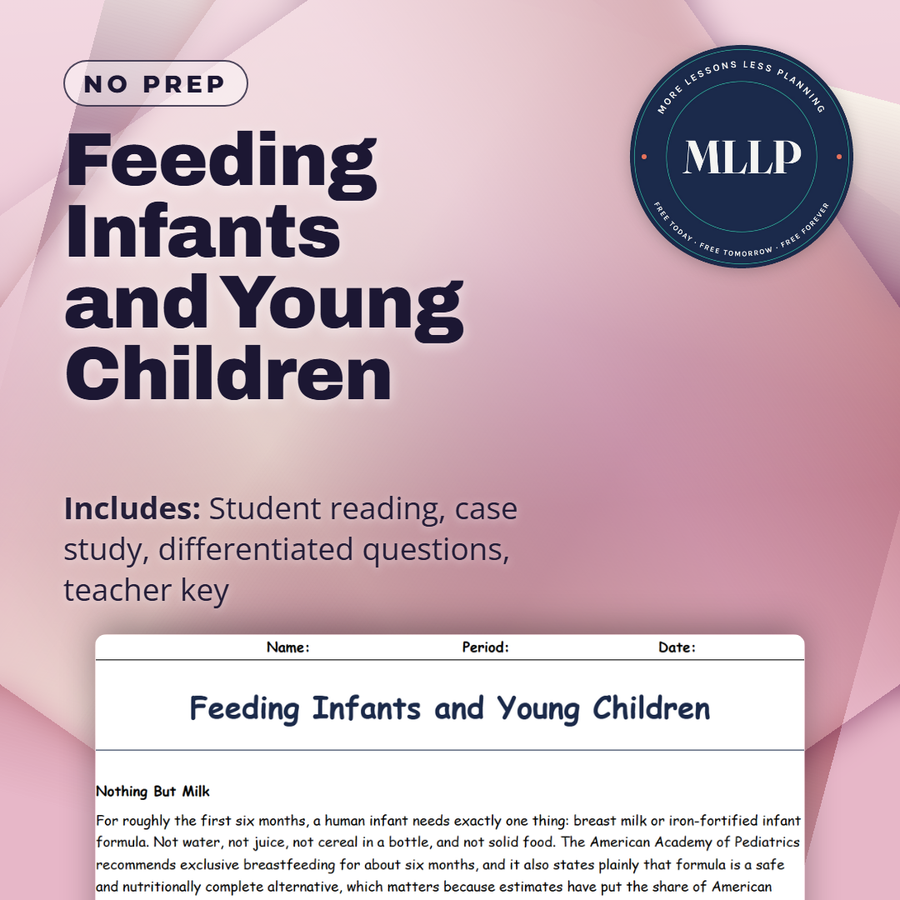
Feeding Infants and Young Children
Quality reviewed September 2026
Facts verified September 23, 2026
- Subject
- Career & Life Skills
- Grades
- Grades 9-12
- Length
- 8-page student worksheet
- Time
- About one 50-minute class period
- Great for
- Sub plans and independent work
- Includes
- Reading passage, comprehension questions + full answer key
- Format
- Print-and-go PDF
What students do
- Hunger cues such as rooting and hands to the mouth get matched to their meaning as the signals that come before crying
- Whitney's dinner table battle with Cole gets traced back to the division of responsibility she was not using yet
- Trace how a first food moves from thin puree to a finger food over the first year
- Grapes cut lengthwise for children under about four is one safety rule students complete from the reading
What it covers
- Why honey, cow's milk, and choking foods are off limits before certain ages, and what changed on peanuts
- Ellyn Satter's division of responsibility and why the adult and the child each own half the job
- Whitney's three week broccoli experiment, tracked from ignoring it to eating two pieces
Start reading this worksheet
Nothing But Milk
For roughly the first six months, a human infant needs exactly one thing: breast milk or iron-fortified infant formula. Not water, not juice, not cereal in a bottle, and not solid food. The American Academy of Pediatrics recommends exclusive breastfeeding for about six months, and it also states plainly that formula is a safe and nutritionally complete alternative, which matters because estimates have put the share of American families who use formula at some point at roughly three-quarters. A fed baby is the goal, and the guilt attached to this decision does far more harm than the decision itself. Newborns feed on demand, generally eight to twelve times in twenty-four hours, and caregivers are taught to watch for early hunger cues rather than waiting for crying. Rooting, where the baby turns toward a touch on the cheek, hands moving to the mouth, lip smacking, and general stirring all come before crying, which is a late and frantic signal. A baby who has waited long enough to cry is usually too upset to latch well. Adults also worry about whether the infant is getting enough, and the reassuring answer is that diapers tell the story. Six or more wet diapers a day, steady weight gain, and a baby who seems satisfied after feeding are the practical indicators, and they are more reliable than counting ounces or minutes. Growth also does not run in a straight line. Babies go through stretches of feeding far more often for a few days at a time, which is normal and temporary, and it is one of the most common reasons a caregiver wrongly concludes that their milk supply has failed.
Starting Solids
Somewhere around six months, most infants are ready for their first solid food, and readiness is judged by the baby rather than the calendar. Three signs matter. The infant can sit up with support and hold their head steady, because swallowing safely requires an upright posture. The tongue-thrust reflex has faded, meaning food placed on the tongue no longer gets automatically pushed back out. And the baby shows real interest, watching food travel to other people's mouths and reaching for it. Starting much before four months is associated with problems, and waiting well past six months can make later acceptance harder and risks running short on iron, because the iron a baby is born with begins to run low around then. That is why iron-rich first foods such as pureed meat, iron-fortified cereal, beans, and lentils are recommended early rather than the traditional rice cereal alone. New foods are introduced one at a time with a few days between, so that a reaction can be traced to a specific food. Texture progresses over months from thin purees to thicker mashes to soft lumps to finger foods, and that progression is itself developmental work, because chewing is a learned motor skill. Through all of it, milk or formula remains the primary nutrition source for the entire first year. Solid food in the first year is practice, not replacement. Practice is the right word, because the first months of eating are mostly about learning to move food around the mouth, tolerate unfamiliar textures, and coordinate a swallow. A meal where most of the puree ends up on the chin has still done its job.
The Advice That Reversed
Some feeding rules are absolute. Honey is never given before twelve months, because it can carry bacterial spores that cause infant botulism, a serious illness in babies whose digestive systems cannot yet handle them. Cow's milk is not used as a main drink before twelve months, since it is low in iron and hard on an infant's kidneys, though small amounts in cooked food are fine. Choking foods are excluded outright. But one major piece of advice reversed completely, and it is worth understanding why. For years parents were told to delay peanuts, eggs, and other common allergens until age two or three. Then a landmark trial published in 2015 found that infants at high risk who were introduced to peanut early had dramatically lower rates of peanut allergy than infants for whom it was delayed. Federal guidelines followed in 2017, reversing the old advice and recommending early introduction, in some high-risk cases as early as four to six months and in consultation with a doctor. This is a useful lesson beyond feeding. Guidance changes when the evidence changes, which means a caregiver who learned the rules a decade ago may be confidently repeating advice that has since been overturned. Checking current recommendations is not second-guessing; it is the job. Anyone introducing an allergen should also know what a reaction looks like. Hives, swelling around the mouth, vomiting, or difficulty breathing after a new food all call for immediate medical care, and severe reactions almost always begin within minutes rather than hours.
Like what you read? The full reading, the case study, and every question set are in the free download below, along with the answer key.
Why this matters
Feeding a younger sibling or a cousin some weeknights is already on the schedule for a good number of students here, and the feeding fights this reading describes are probably familiar before the vocabulary for them is. Whitney's shift, from bribing with ice cream to saying nothing and letting Cole decide for himself, is a specific tool rather than a mood, and it is one a fifteen-year-old babysitting a toddler can actually use tonight. The peanut guidance reversal is worth sitting with too, since it shows that even federal advice about feeding a baby gets rewritten when new evidence shows up.
From one teacher to another
Whitney has a three-year-old named Cole who has decided vegetables are not food, and dinner has turned into a nightly negotiation with dessert as the bargaining chip. The reading gets there by way of the earlier feeding stages, the first six months of milk or formula only, the three signs that a baby is ready for solids, and the short list of foods that stay off the table before certain ages, including honey and cow's milk. A full passage is spent on choking, since it is the feeding risk that turns serious fastest, with specific cutting instructions for grapes and hot dogs. Whitney's case study arrives once the division of responsibility has been explained, and it follows her attempt to hand the eating decision back to Cole over three actual weeks. Her own journal entry, about getting out of the way instead of winning, is the reading's clearest example of the idea in practice.
What you get
Download
Where should I send the next one?
Everything here is free and it stays that way. Leave your email and I'll send you the new lessons as they go up. You can unsubscribe from any one of them.
Related resources
Are You Ready? The Realities of Parenthood
Caring for Children with Special Needs
Childcare Options and What They Cost
Childproofing and Child Safety
Parenting Styles and How They Shape Kids
Positive Guidance vs. Punishment
Every lesson on this site is free to download and use. If one of them saved you a prep period, you can chip in a few bucks toward my three kids' daycare fund. That's genuinely where tips go.