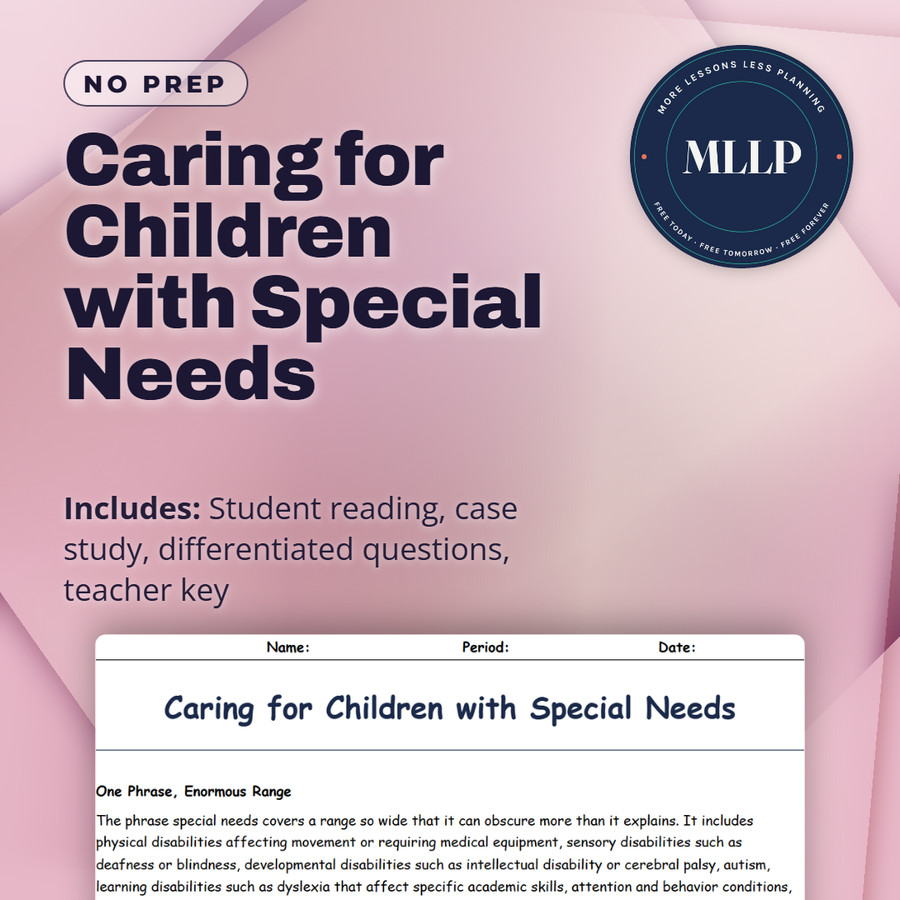
Caring for Children with Special Needs
Quality reviewed September 2026
Facts verified September 23, 2026
- Subject
- Career & Life Skills
- Grades
- Grades 9-12
- Length
- 9-page student worksheet
- Time
- About one 50-minute class period
- Great for
- Sub plans and independent work
- Includes
- Reading passage, comprehension questions + full answer key
- Format
- Print-and-go PDF
What students do
- Denise's eighteen-month-old case notes get compared against what the reading says early intervention can catch
- IFSP, IEP, Section 504 plan, early intervention, and respite care get matched to their real definitions
- Identify why a childcare provider often notices a delay before a pediatrician does
- Person-first and identity-first language get weighed as two different ways families and individuals describe disability
What it covers
- The wide range the phrase special needs actually covers, from physical to sensory to developmental
- How IDEA splits into an IFSP for children under three and an IEP for ages three to twenty one
- Denise's case study, where a home childcare provider notices what a doctor's brief visits miss
Start reading this worksheet
One Phrase, Enormous Range
The phrase special needs covers a range so wide that it can obscure more than it explains. It includes physical disabilities affecting movement or requiring medical equipment, sensory disabilities such as deafness or blindness, developmental disabilities such as intellectual disability or cerebral palsy, autism, learning disabilities such as dyslexia that affect specific academic skills, attention and behavior conditions, chronic health conditions such as severe asthma or type one diabetes, and mental health conditions. The Centers for Disease Control and Prevention has reported that roughly one in six children in the United States between three and seventeen has a developmental disability, which means a childcare provider or teacher will work with these children constantly rather than occasionally. Language deserves attention here because it changes over time and it matters to the people described. Person-first language puts the child before the condition, as in a child with autism, and it was adopted deliberately to push back against defining a person by a diagnosis. Many autistic adults, however, prefer identity-first language, describing themselves as autistic because they experience it as part of who they are rather than something attached to them. The respectful default is to notice what a family or individual uses and follow it. What every one of these children shares is more important than the differences: they are children first, with the same needs for play, affection, routine, friendship, and high expectations as anyone else. That is not a sentiment, it is a working instruction. A provider planning an afternoon should be asking how this particular child gets to join the activity, rather than which activity has to be skipped, and the difference between those two questions is visible to the child immediately.
Why Early Matters So Much
Early intervention refers to services provided to children under three who have or are at risk for a developmental delay, and the reason it is emphasized so heavily comes down to brain development. The first three years are the period of the most rapid neural growth and the greatest plasticity, meaning the brain is at its most adaptable, so support delivered during that window produces larger and more durable gains than the same support delivered later. Services can include speech therapy, occupational therapy, physical therapy, family training, and specialized instruction, and under federal law they are often provided in the child's home or childcare setting rather than a clinic, because a young child learns in the settings where they actually live. Access begins with somebody noticing, and that somebody is frequently not a doctor, since a pediatrician sees a child for a few minutes a few times a year while a childcare provider sees them for forty hours a week. Providers and teachers are often the first to notice that an eighteen-month-old is not babbling, or that a two-year-old does not respond to their name, or that a child has lost a skill they previously had. Evaluations through the public system are free, and a parent can request one in writing at any time without a physician's referral. Federal law also requires states to actively look for children who may qualify, an obligation called Child Find, though families should not wait to be found.
The Alphabet That Runs the System
Services are organized under the Individuals with Disabilities Education Act, known as IDEA, and the law splits into two parts by age. Part C covers birth to age three and produces an Individualized Family Service Plan, or IFSP. The word family in that name is deliberate, since services at this age are built around the whole family and often coach the caregivers, on the reasoning that a therapist has a child for an hour a week while the family has them for the rest of it. Part B covers ages three to twenty-one and produces an Individualized Education Program, or IEP, a legally binding school document listing the child's present levels, measurable annual goals, the specific services the school will deliver, and any accommodations. An IEP is reviewed at least once a year, and the parent is a required member of the team with the right to disagree, to request a meeting, and to bring someone with them. Section 504 of the Rehabilitation Act is a separate and often confused route. A 504 plan provides accommodations for a child whose disability limits a major life activity but who does not need specialized instruction, so a student with severe food allergies or type one diabetes might have a 504 plan and no IEP. The transition from an IFSP to an IEP around a child's third birthday is a known rough patch, and families are advised to start it several months early.
Like what you read? The full reading, the case study, and every question set are in the free download below, along with the answer key.
Why this matters
A number of students in this room will end up in a classroom, a daycare, or a coaching role where a child with a disability is simply one of the kids they are responsible for, and the reading's point that these children need play, routine, and high expectations just like anyone else is the working instruction that actually helps. Denise's notebook shows how ordinary attention, paid consistently over weeks, is what catches a delay early enough for it to matter. That habit of writing down small patterns instead of guessing applies far past parenting.
From one teacher to another
Denise keeps a spiral notebook on her kitchen counter, and it is what lets her notice, months before anyone else does, that Eli has stopped adding new words and does not turn when she calls his name. The reading opens by pointing out how much ground the phrase special needs actually covers, from physical and sensory disabilities to autism, learning disabilities, and chronic health conditions, and it spends real time on the language families use to describe themselves. From there it walks through why the first three years matter so much for the brain, and how IDEA splits services into an IFSP before age three and an IEP after. A section on daily caregiving covers routine, communication, and treating behavior as a form of communication rather than a problem to shut down. The last passage turns to the whole household, including sibling attention and the real value of respite care.
What you get
Download
Where should I send the next one?
Everything here is free and it stays that way. Leave your email and I'll send you the new lessons as they go up. You can unsubscribe from any one of them.
Related resources
Are You Ready? The Realities of Parenthood

Childcare Options and What They Cost

Childproofing and Child Safety
Feeding Infants and Young Children
Parenting Styles and How They Shape Kids
Positive Guidance vs. Punishment
Every lesson on this site is free to download and use. If one of them saved you a prep period, you can chip in a few bucks toward my three kids' daycare fund. That's genuinely where tips go.