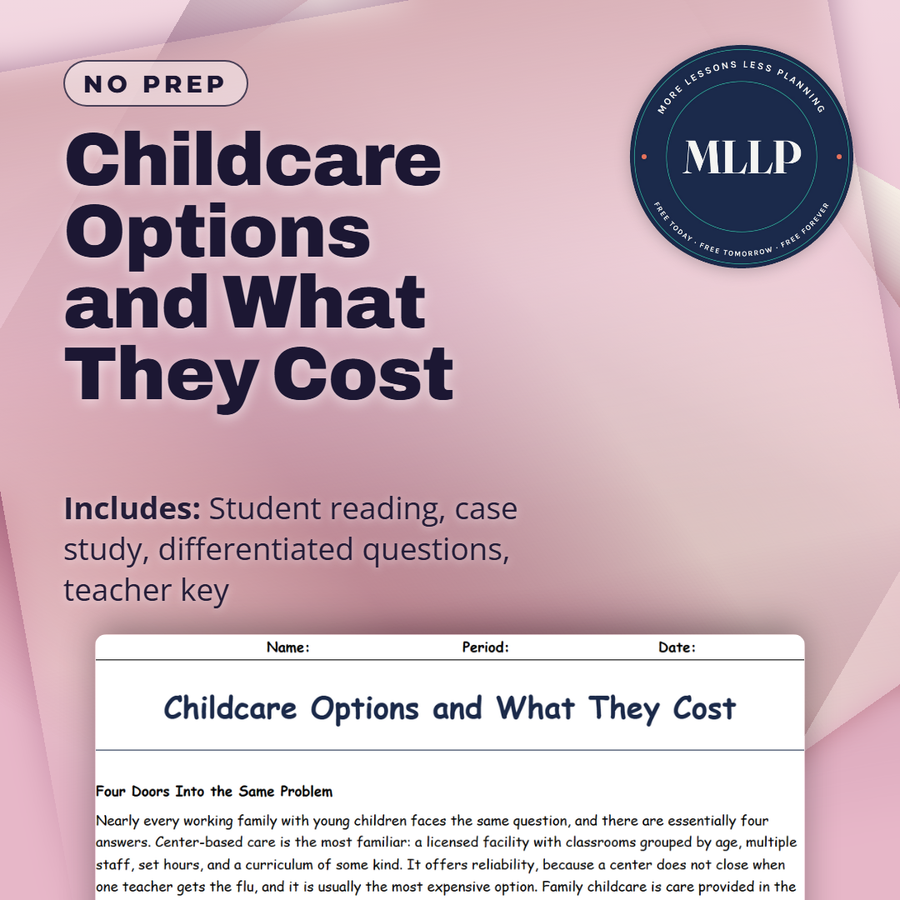
Childcare Options and What They Cost
Quality reviewed September 2026
Facts verified September 23, 2026
- Subject
- Career & Life Skills
- Grades
- Grades 9-12
- Length
- 9-page student worksheet
- Time
- About one 50-minute class period
- Great for
- Sub plans and independent work
- Includes
- Reading passage, comprehension questions + full answer key
- Format
- Print-and-go PDF
What students do
- Explain what a childcare license actually guarantees and what it leaves out
- The four childcare types, center-based, family childcare home, in-home care, and relative care, get weighed against cost and reliability
- Compare the ratio, group size, and staff turnover clues a family should check on a tour
- Dominique's two Saturday tours get replayed, and students decide which evidence actually predicted the better room
What it covers
- The real difference between a childcare license and an accreditation like NAEYC
- Hidden costs such as registration fees, late pickup charges, and billed holiday weeks
- Dominique's side by side tour of a new center and an eleven year old family childcare home
Start reading this worksheet
Four Doors Into the Same Problem
Nearly every working family with young children faces the same question, and there are essentially four answers. Center-based care is the most familiar: a licensed facility with classrooms grouped by age, multiple staff, set hours, and a curriculum of some kind. It offers reliability, because a center does not close when one teacher gets the flu, and it is usually the most expensive option. Family childcare is care provided in the caregiver's own home for a small mixed-age group, often licensed, generally less expensive, and frequently more flexible about hours. Its strengths are a small group, a consistent single adult, and siblings staying together; its weakness is that one provider getting sick closes the whole operation. In-home care means a nanny or au pair coming to the family's house, which is the most flexible and by far the most expensive, and it makes the family an employer with tax and payroll obligations most people do not anticipate. Relative care, usually a grandparent, is the most common arrangement in the country and often the cheapest, but it carries its own costs in family dynamics, since disagreements about screen time or discipline are much harder to raise with your own mother than with a paid provider. None of the four is the correct answer. The correct answer depends on a family's hours, budget, commute, and the temperament of the particular child. Commute deserves more weight than families usually give it, because care near work and care near home produce very different days, and a program twenty minutes in the wrong direction quietly costs a parent more than three hours every week.
What a License Actually Guarantees
Families routinely misread the word licensed, and the misreading costs them. A childcare license is a floor, not a ranking. It means a state agency has verified a basic set of safety conditions: criminal background checks on adults, adult-to-child ratios within legal limits, safe sleep and first aid training, immunization records, a physically safe building, and periodic inspections, some announced and some not. Those things matter enormously and their absence should end a conversation. What a license does not measure is whether anyone in that room talks to the children, reads to them, or notices when one is struggling. It is a health and safety credential, not an education credential. Accreditation is the next level up and is voluntary. The best-known accrediting body for early childhood programs is the National Association for the Education of Young Children, and accreditation requires meeting standards well beyond state minimums in curriculum, staff qualifications, family communication, and assessment. Fewer programs pursue it because it is demanding and expensive. Many states also run a quality rating and improvement system, usually displayed as stars, which sits between licensing and accreditation and gives families a rough comparative signal. A useful habit is to treat licensing as a yes-or-no gate and everything above it as the actual comparison. Unlicensed care is legal in some situations and for some arrangements, especially relative care, but a family choosing it should know exactly what oversight they are giving up. Most states publish inspection reports online, including violations and how they were resolved, and reading through two or three years of a program's history takes about ten minutes. It is the cheapest research available and almost nobody does it.
Ratios, Group Size, and the Turnover Question
Two numbers do most of the work in describing a childcare setting. The ratio is how many children one adult is responsible for, and the group size is how many children are in the room in total. Both are set by state rule and both get stricter the younger the children are, with infant ratios commonly one adult to three or four babies and preschool ratios often one to ten or more. Ratio and group size interact, so a room with two adults and eight infants is a genuinely different environment from four separate rooms of one adult and four infants, even though the ratio is identical. Families should ask a question most never think of: what is the ratio during breaks, at opening, and at closing, when staffing is thinnest and coverage sometimes slips below the posted number. The third number is the one that predicts quality best and appears on no brochure, and that is staff turnover. Young children form real attachments to their caregivers, and a program where teachers leave every few months cannot deliver the consistent, responsive relationships that make care developmentally valuable. Early childhood work is chronically underpaid, so turnover is high across the field, and a program that has kept its infant teacher for four years has told a family something important about both the workplace and the care. Asking about turnover directly is fair and completely normal, and the useful version of the question is how long the specific adults in this specific room have been here, rather than how long the center has been open, which answers nothing.
Like what you read? The full reading, the case study, and every question set are in the free download below, along with the answer key.
Why this matters
Learning to read a childcare price tag the way this reading teaches it, past the advertised weekly rate to registration fees, late charges, and billed holiday weeks, is the same skill that reads a lease or a phone contract honestly. A few students in this room already babysit for pay, and some will be the ones calling around for infant care sooner than they expect. Dominique's second look at the plain house with worn rugs is a reminder that the room that photographs well is not always the room that serves the child well.
From one teacher to another
Dominique tours two programs for her eight-month-old on the same Saturday, and the reading uses that morning to make a point most families learn the hard way, that a mural and a climbing structure are the easiest things to judge and the least predictive of anything. Before her case study, the passages walk through the four main childcare arrangements and what actually separates a state license, which only sets a safety floor, from voluntary accreditation. There is a full breakdown of ratios, group size, and the staff turnover numbers that never make it onto a brochure, along with the real cost of infant care against the 2016 federal affordability benchmark. A section on financial help covers subsidies, Head Start, and dependent care accounts that families often do not know exist. The last passage turns touring itself into a skill, with specific questions to ask and what to watch for in how adults actually talk to the children in the room.
What you get
Download
Where should I send the next one?
Everything here is free and it stays that way. Leave your email and I'll send you the new lessons as they go up. You can unsubscribe from any one of them.
Related resources
Are You Ready? The Realities of Parenthood
Caring for Children with Special Needs
Childproofing and Child Safety
Feeding Infants and Young Children
Parenting Styles and How They Shape Kids
Positive Guidance vs. Punishment
Every lesson on this site is free to download and use. If one of them saved you a prep period, you can chip in a few bucks toward my three kids' daycare fund. That's genuinely where tips go.