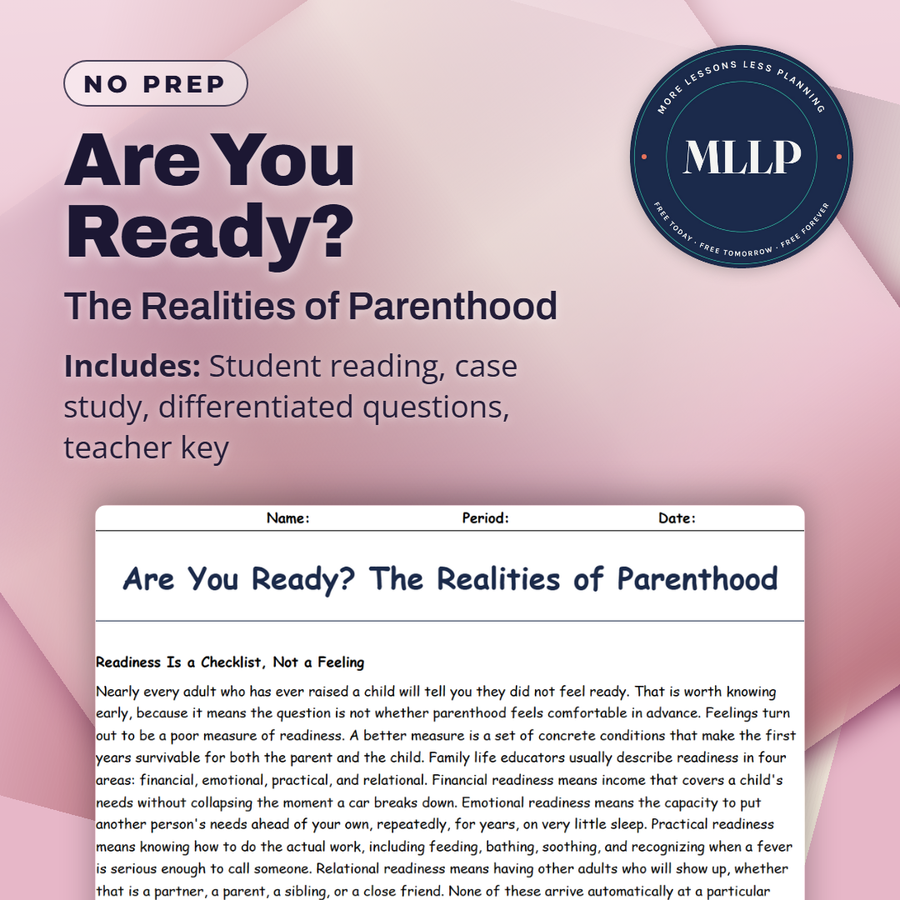
Are You Ready? The Realities of Parenthood
Quality reviewed September 2026
Facts verified September 23, 2026
- Subject
- Career & Life Skills
- Grades
- Grades 9-12
- Length
- 9-page student worksheet
- Time
- About one 50-minute class period
- Great for
- Sub plans and independent work
- Includes
- Reading passage, comprehension questions + full answer key
- Format
- Print-and-go PDF
What students do
- Andre's budget project gets tested against the one cost the reading says most families underestimate
- Match key terms like opportunity cost and mental load to their definitions
- Explain why age alone cannot predict whether someone is ready to parent
- Andre's semester project runs into a childcare bill bigger than his rent, and students work out what he missed
What it covers
- The four readiness areas and why feelings are a poor measure of them
- The real weekly and yearly cost of raising a child, including childcare and opportunity cost
- Andre's case study, where a semester budget project turns up an expense he never saw coming
Start reading this worksheet
Readiness Is a Checklist, Not a Feeling
Nearly every adult who has ever raised a child will tell you they did not feel ready. That is worth knowing early, because it means the question is not whether parenthood feels comfortable in advance. Feelings turn out to be a poor measure of readiness. A better measure is a set of concrete conditions that make the first years survivable for both the parent and the child. Family life educators usually describe readiness in four areas: financial, emotional, practical, and relational. Financial readiness means income that covers a child's needs without collapsing the moment a car breaks down. Emotional readiness means the capacity to put another person's needs ahead of your own, repeatedly, for years, on very little sleep. Practical readiness means knowing how to do the actual work, including feeding, bathing, soothing, and recognizing when a fever is serious enough to call someone. Relational readiness means having other adults who will show up, whether that is a partner, a parent, a sibling, or a close friend. None of these arrive automatically at a particular birthday. A twenty-eight-year-old with unstable housing and no one nearby may be less ready than a twenty-two-year-old with a steady job and a grandmother two blocks away. That is why the honest version of this conversation is not really about age. It is about whether the conditions a child needs are actually in place, and about being specific enough to name the ones that are missing. Naming a gap is what makes it fixable. A vague sense of not being ready leads nowhere, while the observation that you have no reliable childcare and no savings points directly at what to work on first. Family life educators often have students write the four areas out as a checklist and mark each one honestly, because the exercise turns one overwhelming question into four smaller ones that can actually be answered.
The Real Price Tag
Money is the part people underestimate most, and the numbers are not small. The most-cited federal estimate, published by the United States Department of Agriculture, put the cost of raising a child born in 2015 through age seventeen at roughly $233,610 for a middle-income family, and that figure deliberately leaves out college. Adjusted for the inflation that followed, independent researchers have placed the real total above $300,000. Those numbers are useful for perspective and almost useless for planning, because the money does not arrive as one bill. It arrives as a stream. The first year alone typically brings thousands of dollars in diapers, formula or feeding supplies, clothing outgrown every few months, a car seat, and medical costs that continue even with insurance. The largest single line item for most working families is childcare, which across much of the country has run between ten and twenty thousand dollars a year for one infant in a licensed center, and in some states costs more than in-state college tuition. Housing costs often rise as well, since a growing family usually needs more space. Then there is the cost that never appears on a receipt, which economists call opportunity cost: the wages, hours, promotions, or schooling a parent gives up. For a teen parent that cost is usually education, and it compounds for decades afterward. None of this makes parenthood unaffordable. It makes it something that rewards planning, because families who look at the actual numbers before a child arrives consistently make better decisions than families who discover those numbers afterward.
The Job That Never Clocks Out
The second underestimated cost is time, and specifically the kind of time that cannot be scheduled. A newborn sleeps roughly fourteen to seventeen hours a day, but almost never for more than two to four hours at a stretch, which means the adult caring for that newborn does not get an unbroken night of sleep for months. Feedings come every two to three hours around the clock. Diaper changes total somewhere near two to three thousand in the first year alone. Beyond the visible tasks sits the mental load, the constant background tracking of when the child last ate, what the pediatrician said, whether the next size of clothing has been bought, and when the childcare payment is due. That work is invisible, exhausting, and in most households unevenly divided. Research on chronic sleep loss is blunt about the consequences: judgment, patience, and emotional control all degrade, which is exactly when a parent needs them most. This is why practical advice for new parents is so relentlessly unglamorous. Sleep when the baby sleeps. Accept help when it is offered and ask for it when it is not. Lower the standard on housework for a while. Trade night shifts with a partner if there is one. None of it is heroic and all of it works. Understanding that the first months are a temporary emergency rather than a permanent condition is itself a survival skill, and it is one of the few things an expecting parent can learn ahead of time.
Like what you read? The full reading, the case study, and every question set are in the free download below, along with the answer key.
Why this matters
Every student in this room is closer to these numbers than they think, whether that is babysitting a sibling most weeknights or watching a friend's older sister figure out childcare costs on her own. The reading names the exact areas, money, time, and support, that turn parenthood from an abstract someday into a set of decisions a person can actually plan for. Andre's spreadsheet is a useful model for any big financial decision a teenager is about to face, long before a child is part of the picture.
From one teacher to another
Andre's budget project is the spine of this reading, a high school senior who assumes diapers and formula will be the expensive part of a first year and then calls three childcare centers to check. The passages before his case study lay out what readiness actually means, not a feeling, but four concrete areas, financial, emotional, practical, and relational, that family life educators ask students to check off honestly. The numbers get specific fast, from the USDA's cost estimate to what a newborn's sleep cycle actually does to a caregiver's judgment. There is also a section on support networks and one on timing, closing with why the teen birth rate mattered enough to build a whole unit around it. Students spend real time with the case study math, tracing what Andre missed and why that particular expense is the one most families underestimate.
What you get
Download
Where should I send the next one?
Everything here is free and it stays that way. Leave your email and I'll send you the new lessons as they go up. You can unsubscribe from any one of them.
Related resources

Caring for Children with Special Needs

Childcare Options and What They Cost

Childproofing and Child Safety

Feeding Infants and Young Children

Parenting Styles and How They Shape Kids

Positive Guidance vs. Punishment
Every lesson on this site is free to download and use. If one of them saved you a prep period, you can chip in a few bucks toward my three kids' daycare fund. That's genuinely where tips go.