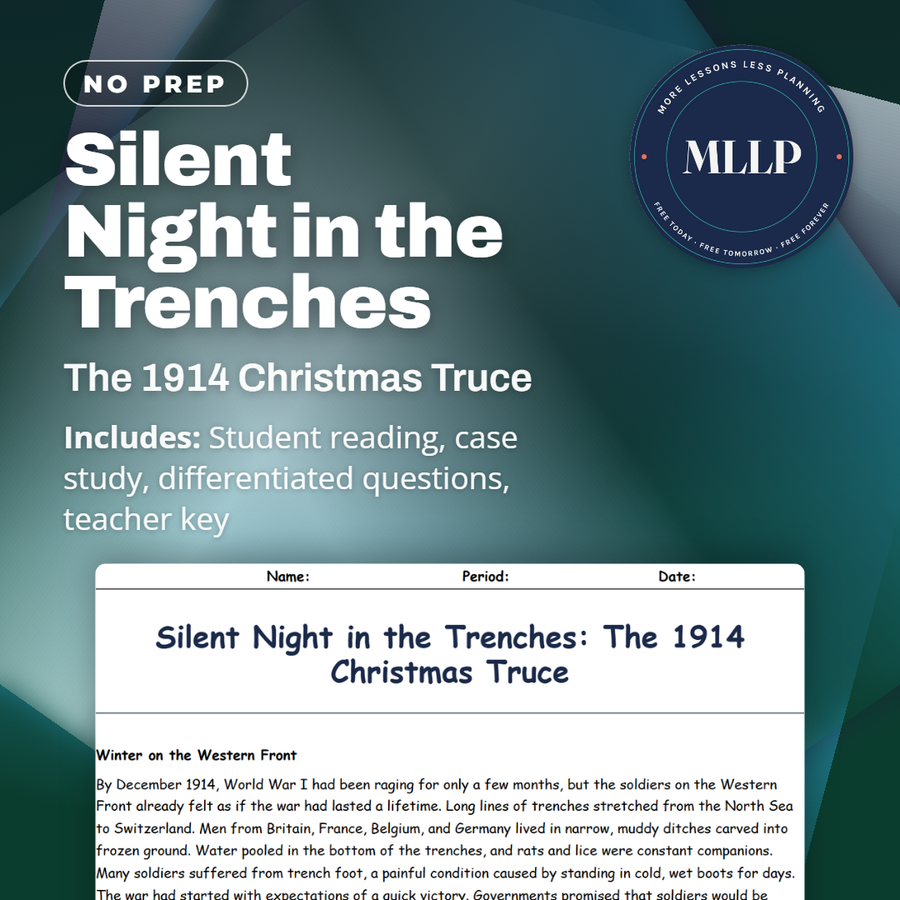
Silent Night in the Trenches: The 1914 Christmas Truce
Quality reviewed September 2026
Facts verified September 9, 2026
- Subject
- Social Studies
- Grades
- Grades 9-12
- Length
- 8-page student worksheet
- Time
- About one 50-minute class period
- Great for
- Sub plans and independent work
- Includes
- Reading passage, comprehension questions + full answer key
- Format
- Print-and-go PDF
What students do
- Analyze how shared culture, mutual exhaustion, and shared humanity led soldiers to ignore orders and meet as neighbors instead of enemies
- Trace how military command changed policies after 1914 to prevent fraternization and strengthen fighting discipline
- Examine how a historical event becomes myth over time and identify what is gained and lost in the simplification
- Debate whether the truce should be remembered as a symbol of hope for peace or as a cautionary reminder of how quickly war returns
What it covers
- World War I trench warfare and front-line conditions
- Power, hierarchy, and the choices of ordinary soldiers
- Memory, myth-making, and historical interpretation
Start reading this worksheet
Winter on the Western Front
By December 1914, World War I had been raging for only a few months, but the soldiers on the Western Front already felt as if the war had lasted a lifetime. Long lines of trenches stretched from the North Sea to Switzerland. Men from Britain, France, Belgium, and Germany lived in narrow, muddy ditches carved into frozen ground. Water pooled in the bottom of the trenches, and rats and lice were constant companions. Many soldiers suffered from trench foot, a painful condition caused by standing in cold, wet boots for days. The war had started with expectations of a quick victory. Governments promised that soldiers would be “home by Christmas.” Instead, by the winter of 1914, both sides were locked in a bloody stalemate. Machine guns, barbed wire, and artillery made it deadly to cross the open ground known as no man’s land. Attacks often gained only a few meters of territory at the cost of hundreds or thousands of lives. Morale sagged as soldiers realized that the war would not be over quickly and that the cost would be far higher than anyone had imagined. Yet even in this brutal environment, soldiers carried small pieces of home with them. Many units decorated their dugouts with bits of evergreen, candles, and makeshift crosses. Families sent care packages filled with food, tobacco, and small gifts. Chaplains organized services and carol singing. These reminders of ordinary life clashed with the reality of war, creating a strange, emotional tension: a “season of peace” unfolding in a place designed for killing.
An Unexpected Truce
On Christmas Eve 1914, something unusual began to happen along parts of the front. In some sectors, German soldiers placed candles and small trees on their trench edges. They sang carols like “Stille Nacht” (“Silent Night”). Allied soldiers, surprised to hear familiar tunes (sometimes in a different language), responded with their own songs. Singing back and forth across no man’s land slowly shifted into shouted greetings and cautious waves. In a number of locations, individual soldiers took a risk. A German soldier might climb out of his trench holding up a lantern or a white cloth. A British or French soldier might answer by doing the same. Instead of firing, both sides walked slowly into no man’s land, hands visible, weapons left behind. They met in the middle, exchanged handshakes, shared cigarettes or chocolate, and in some places swapped small souvenirs like buttons or caps. The informal Christmas Truce was not universal. It did not happen everywhere on the front, and in some sectors the fighting continued. But where it did occur, the front line briefly turned into a meeting ground. Soldiers buried the dead who had been left between the trenches, sometimes holding joint funerals. There are reports of improvised football (soccer) games played in the mud. For a few hours or days, the men at the bottom of the war’s hierarchy quietly set aside the orders they had been given and acted like neighbors instead of enemies.
Why Did Enemies Lay Down Their Arms?
Historians point to several reasons why the Christmas Truce was possible in 1914 but did not repeat on the same scale in later years. First, the war was still relatively “young.” Many soldiers still believed that peace might be negotiated and that the war might end in months rather than years. Hate-filled propaganda images had not yet fully convinced everyone that the enemy was less than human. Second, the shared cultural background of many soldiers, including common Christian traditions, similar carols, and overlapping languages, made it easier to find common ground. Front-line units also faced the same miserable conditions: cold, mud, constant danger, and the sight of unburied bodies between the trenches. When both sides agreed to a temporary ceasefire, they were not just being sentimental; they gained a chance to repair trenches, fetch supplies, and care for the wounded and dead. The truce offered practical benefits as well as emotional ones. Military leaders, however, worried that fraternization would undermine discipline. If soldiers began to see the enemy as individuals with families and feelings, would they still be willing to attack on command? After 1914, many high commands tightened regulations, rotated units more frequently, and increased punishment for unofficial truces. As the war grew more destructive, with poison gas, massive offensives, and higher casualties, bitterness hardened. Later winters saw only rare, cautious gestures rather than widespread ceasefires.
Like what you read? The full reading, the case study, and every question set are in the free download below, along with the answer key.
Why this matters
For one day in 1914, soldiers who had spent months trying to kill each other sang carols across the same ground and buried their dead side by side. Then the war continued for four more years, and many of the men who sang that night were dead within months.
Students want this to end as a story about hope winning out, and I do not let them have that ending. High command had to issue orders specifically to prevent fraternization, which tells students something uncomfortable: the truce threatened the war more than it threatened the soldiers. Sitting with why we remember the carols and forget the resumption of killing is the actual lesson, not the carols themselves.
From one teacher to another
This worksheet resists a simple feel-good ending. Yes, men sang carols and buried their dead together. Yes, that moment was real and moving. But then the war continued for four more years. Many of those men were dead within months. The reading doesn't hide that. It uses the truce to ask bigger questions: What does it tell us about war when even enemies want to stop fighting? What does it tell us that high command had to order fraternization prevented? Why do we remember the moment and forget the resumption of killing? I use this because history is not about heroes and villains. It's about how power works and how ordinary people navigate impossible situations.
What you get
Download
Where should I send the next one?
Everything here is free and it stays that way. Leave your email and I'll send you the new lessons as they go up. You can unsubscribe from any one of them.
Related resources

Biology of Evergreen Plants: The Science Behind Christmas Trees
Body Clocks and Midnight Countdowns: Circadian Rhythms at New Year’s

Calendars, Orbits, and the Science of New Year’s Day
Christmas on the Home Front: WWII Rationing and Resilience
Colorful Chemistry: Holiday Lights, Fireworks, and the Science of Glow
Crowded Skies: Holiday Air Travel and the Environment
Every lesson on this site is free to download and use. If one of them saved you a prep period, you can chip in a few bucks toward my three kids' daycare fund. That's genuinely where tips go.