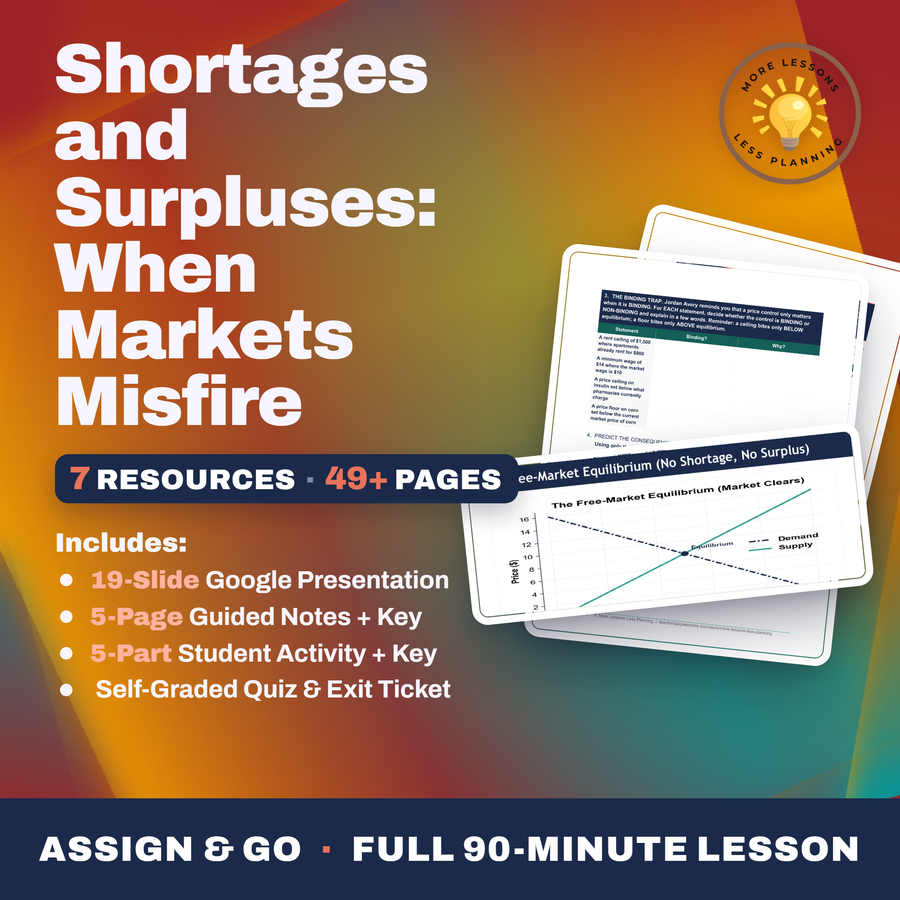

Shortages and Surpluses
Quality reviewed September 2026
- Grades
- Grades 9-12
- Time
- About two 50-minute class periods
- Includes
- 11 ready-to-teach files
- Format
- Word (.docx) · PowerPoint (.pptx)
- Slide deck
- Guided notes
- Guided notes teacher key
- Activity + answer key
- Quiz + answer key
- Exit ticket + answer key
- Teacher guide
- Teacher presentation notes
What students do
- Diagnose a housing shortage caused by a rent-control price ceiling set below equilibrium
- Trace why a minimum-wage price floor set above equilibrium produces a labor surplus
- Distinguish a binding price control from a non-binding one by comparing it to the equilibrium price
- Calculate the size of a shortage or surplus by reading quantity demanded and quantity supplied off a chart
What it covers
- Why a price ceiling only causes a shortage when it is set below equilibrium, using rent control as the example
- Why a price floor only causes a surplus when it is set above equilibrium, using the minimum wage as the example
- Why those gaps do not fix themselves once the price is frozen by law
Learning targets
- Define a SHORTAGE (quantity demanded is greater than quantity supplied) and a SURPLUS (quantity supplied is greater than quantity demanded), and tell them apart
- Explain why a binding PRICE CEILING set BELOW equilibrium causes a persistent SHORTAGE, using rent control as the worked example
- Explain why a binding PRICE FLOOR set ABOVE equilibrium causes a persistent SURPLUS, using the minimum wage as the worked example
- Read a supply-and-demand chart to measure the gap between quantity demanded and quantity supplied, and predict whether a price control creates a shortage or a surplus
Peek inside
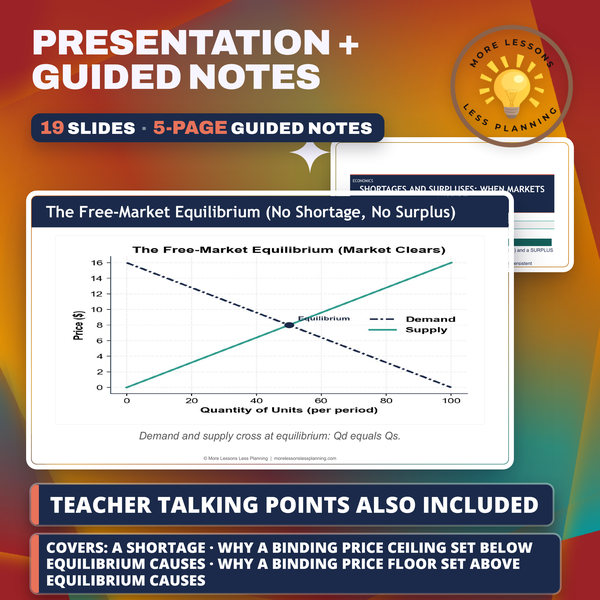
At Equilibrium
Quantity demanded EQUALS quantity supplied
The market CLEARS - nothing left over
No shortage and no surplus
The price found its balancing point
A Market Clears Only at Equilibrium
At equilibrium, the quantity demanded EQUALS the quantity .
At equilibrium the market - nothing is left over.
When the government holds the price away from balance, Qd and Qs no longer .
A price held above or below equilibrium makes the market misfire into a .
SECTION 2
1. Jordan Avery starts you off with the most important word. The one price where the demand and supply curves cross and quantity demanded equals quantity supplied - so the market clears with no shortage and no surplus - is the .
Why this matters
Almost every student has overheard an adult argue about rent control or the minimum wage, usually as a pure opinion with no mechanism behind it. Running both through the identical test, a ceiling below equilibrium causing a shortage, a floor above it causing a surplus, shows it is one idea in two headlines.
The detail most classes skip is binding versus non-binding, whether a ceiling or floor is even set high or low enough to matter. I built a whole slide around that one distinction, because once it lands, the dinner-table argument becomes one they can actually diagram.
From one teacher to another
Almost every kid in the room has heard an adult argue about rent control or the minimum wage at the dinner table, and almost none of them have heard the economist's pushback to either one. I run the exact same shortage-or-surplus test on both price controls, a ceiling below equilibrium and a floor above it, so students see it's one idea wearing two different headlines. The piece most classes skip is binding versus non-binding, so I built a whole slide around when a price ceiling or floor actually changes anything, because that's the detail that makes the rest of the chart make sense.
Every file in this toolkit
-
Activity (Student)
Jordan Avery's three charts have students read the $8 equilibrium price, then measure a $4 rent ceiling's 50-apartment shortage against a $12 wage floor's matching labor surplus, before diagnosing four more price controls and writing a city council memo.
-
Activity (Answer Key)
Every gap in this key lands on the same number, a 50-unit shortfall or overrun, then rules gasoline capped at $2 a binding shortage, milk floored at $5 a binding surplus, and a $200 concert cap plus a $7 wage floor as non-binding controls.
-
Exit Ticket (Student)
Short questions identify what happens when a price ceiling sits below market rate, what a minimum wage above that rate does to the labor market, and what a surplus means for quantity supplied versus demanded. Equilibrium and both quantities must show up to explain each outcome.
-
Exit Ticket (Answer Key)
Rent control set below the market rate causes the shortage, the minimum wage set above it causes the labor surplus, and quantity supplied exceeding quantity demanded defines any surplus. The three required terms need to appear and be used correctly.
-
Guided Notes (Student)
A rent cap and a wage floor run through the identical test, comparing the legal price against equilibrium to predict a shortage or a surplus, then a four-step method reads the exact gap size straight off a supply-and-demand chart.
-
Guided Notes (Teacher Key)
Both mechanisms get explained side by side, why a ceiling frozen below equilibrium cannot let price rise to clear a shortage and why a floor frozen above it cannot let price fall to clear a surplus, closing with binding versus non-binding.
-
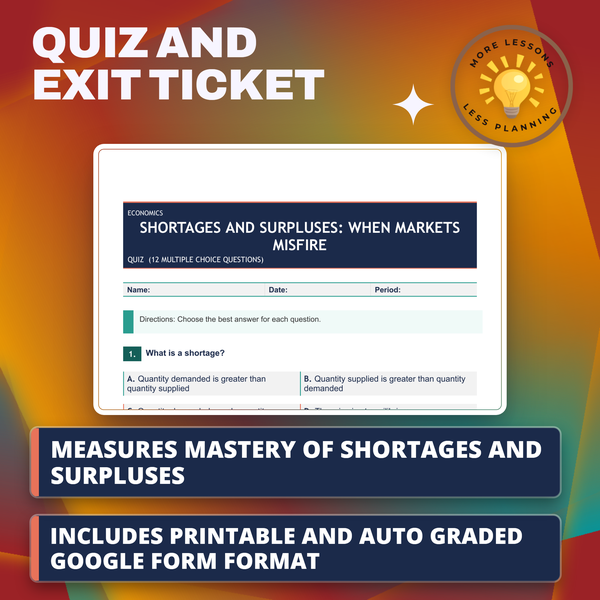
Quiz (Student)
A rent ceiling on apartments and a wage floor on labor anchor items testing when either one actually binds, how to read the size of a gap off a chart, and what an illegal black market for a good actually is.
-
Quiz (Answer Key)
A price ceiling causes a shortage only below equilibrium, a price floor causes a surplus only above it, and the illegal workaround for a binding rent ceiling gets named a black market.
-
Slides
Rent control's price ceiling produces a shortage of 50, quantity demanded at 75 against quantity supplied at 25, and the same math flips into a labor surplus once the minimum wage takes over, before a binding-versus-non-binding slide and a vocabulary term for black markets close it out.
-
Teacher Guide
Whether a $4 rent ceiling or a $12 minimum wage changes anything comes down to whether the control even bites, a test built into its own slide before either graph gets drawn. A graph-paper extension has students hand-plot the $8 equilibrium and both gaps.
-
Teacher Presentation Notes
Apartment rent frozen below what the market would otherwise charge becomes the shortage script, and a wage floor set above it becomes the mirror card, each one built around the identical Qd versus Qs test.
Download
Where should I send the next one?
Everything here is free and it stays that way. Leave your email and I'll send you the new lessons as they go up. You can unsubscribe from any one of them.
Related resources
Law of Demand - Why Price Matters
Law of Supply: The Producer Side
Market Equilibrium: Where Supply Meets Demand
Surge Pricing: Uber, Hotels & Hurricane Plywood
Taylor Swift Economics - Concert Ticket Pricing
Amazon Warehouses: Working Conditions Investigation
Every lesson on this site is free to download and use. If one of them saved you a prep period, you can chip in a few bucks toward my three kids' daycare fund. That's genuinely where tips go.